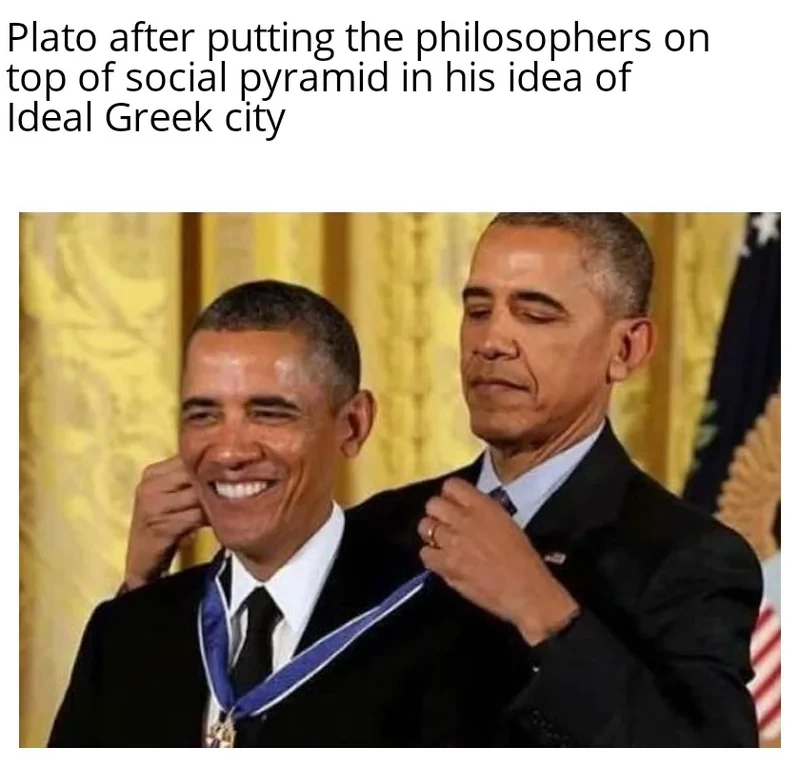

Plato’s understanding of the word philosopher was much closer to “educated person” than our concept of the word today. In addition he didn’t trust anyone with power so it was a whole class of people with power and their decisions would be based on debate and general agreement within the class to limit any individual’s power. Plato also made being a member of the ruling class undesirable for most people by making a person’s rights and freedoms inversely related to their political power. The state provided for the ruling class but they had almost no right to own property and their living spaces and possessions were subject to inspection at any time to ensure that they weren’t being bribed or acting corruptly. I think that there are some insights there that could be useful to modern thinking. Someone like Trump would never want to be a philosopher king.
Also, all companies are small absolutistic kingdoms. Which is why abuse by them is rampant. Especially if they get big enough to be real kingdoms.
In addition he didn’t trust anyone with power
That would be curious considering that his account of democracy is not an account of ‘mob rule’, but of literal anarchy - ie that all people do as they wish to. If he didn’t trust anyone with power, he should come off in support of his account of ‘democracy’, but instead he regards it as one of the worst states of a polity, below only tyranny.
so it was a whole class of people with power and their decisions would be based on debate and general agreement within the class to limit any individual’s power.
Quis custodiet ipsos custodes?
Plato also made being a member of the ruling class undesirable for most people by making a person’s rights and freedoms inversely related to their political power.
And who stops them from changing the rules to benefit themselves, as a class?
“Oh, but as philosophers, they love justice (which remains ill-defined even after an extended aside trying to pin it down) and would never do anything wrong”
Not very compelling.
The state provided for the ruling class but they had almost no right to own property and their living spaces and possessions were subject to inspection at any time to ensure that they weren’t being bribed or acting corruptly.
Inspected by who? The Auxiliaries, who are bound to obey the Guardians in all things (or else become the real rulers as a military caste a la the Mamluks)? Or their fellow Guardians?
I think that there are some insights there that could be useful to modern thinking. Someone like Trump would never want to be a philosopher king.
People want power for its own sake - and once possessed of power, leverage that power to gain more of it. Don’t think that abolishing, nominally, one form of power for a class does anything except redirect efforts towards other forms of power.
Plato blamed democracy for the death of Socrates. It was a sore spot for him. I think that having a ruling class that effectively made decisions democratically within their class was his compromise. I think that he would say that there are so many more people ruled by their stomachs (base desires) than by their hearts (honor and duty) or their heads (reason) that by giving everyone a vote democracy guarantees that the state is ruled by its stomach. His system places the responsibility of voting in the hands of those that have demonstrated that they are ruled by their heads and who have been trained to place the good of the state above all else. Restricting the vote means that the state will be ruled by its head and democratizing decisions among the ruling class defuses power to safeguards against corruption.
Who watches the watchmen is a universal critique that no system seems to have a good answer to. In Plato’s system the answer is primarily the military class. They are responsible for upholding the laws and ensuring that the state is a just system. It’s been years since I last read The Republic but if I remember correctly anyone had the right to inspect the philosophers for corruption. Any charges of corruption would ultimately be judged by the ruling class though so there is the problem of no clear way of controlling systemic corruption.
Plato’s system was theoretical and untested by application. We also have the benefit of looking back on it with the accumulated knowledge and experience of 2,500 years. I don’t argue that it’s perfect or that there aren’t valid criticisms. I interpreted your meme to say that Plato just wanted to put himself in charge. I don’t think that particular criticism is valid.
Plato blamed democracy for the death of Socrates. It was a sore spot for him. I think that having a ruling class that effectively made decisions democratically within their class was his compromise.
I don’t think there’s any ‘compromise’ about it. He doesn’t come off as having anything in the way of a ‘modern’ view of liberty and individuality, and seems to have little interest in portraying himself as such; only his reputation as a titan of philosophy makes people reluctant to ascribe the clearly oligarchic views he’s expressing to him.
This isn’t all that unusual for his time period. But that makes it all the more important to acknowledge.
I think that he would say that there are so many more people ruled by their stomachs (base desires) than by their hearts (honor and duty) or their heads (reason) that by giving everyone a vote democracy guarantees that the state is ruled by its stomach.
Yes, he repeatedly expresses deep disdain for ordinary people and ‘base’ human desires. The man says “No problem with homosexuality except for the icky carnal stuff” and “Sex should be by government lottery for purposes of procreation”
His system places the responsibility of voting in the hands of those that have demonstrated that they are ruled by their heads and who have been trained to place the good of the state above all else. Restricting the vote means that the state will be ruled by its head and democratizing decisions among the ruling class defuses power to safeguards against corruption.
Okay, so how is that voting system different than any other oligarchy of the ancient world?
Plato’s proposed system, heavy on concept and light on details (which is fine for a philosophical work), differs primarily in the intentional construction of the institutions of the state and a unity of purpose in their design; and in the idea that an educated exclusively-ruling class would be in some way inclined to pursue justice.
Plato’s Republic boils down to “If we educated our oligarchs and told them to be really strict with themselves (and especially the filthy poors), Justice Will Win In The End”
You would think all of ten minutes talking with other educated people would disabuse him of that notion, but I guess they didn’t receive the right education.
A few hundred years later and half the world away, China’s Confucian bureaucratic class would begin to take form, and boy, wouldn’t you know? It has a lot of similarities with the proposed structure of Plato’s Republic, including the emphasis on a self-selecting non-military ruling caste dedicated solely to governance and education, especially philosophical education.
Would you like to guess as to how just it was?
For a more modern example, you can look at any technocracy or Vanguardist regime of the 20th century and judge for yourself if a self-selecting caste of men educated in either practical matters (largely the former) or the humanities (largely the latter) with a clear intention of reconstructing society in their own image and with significant restrictions on the accumulation of personal property have made any exceptional progress towards a just society - or if they’ve done the exact opposite.
Who watches the watchmen is a universal critique that no system seems to have a good answer to.
Aristotle and early Roman government both came up with a solution. Checks and balances.
There is no peace but deterrence. There is no deterrence without power.
But that means everyone must share in the task to some degree - everyone must be part of governance, including the farmers, including the artisans, including the soldiers. An unacceptable deviation from the notion of singular purpose espoused by Plato’s Republic, wherein the people are not even to take up arms when the state is militarily outnumbered by its enemies (because it’s not their job).
In Plato’s system the answer is primarily the military class.
They literally are excluded from decision-making and are restricted to the enforcement of the dictates of the Guardians. He compares them to dogs at one point.
They are responsible for upholding the laws
Yes.
and ensuring that the state is a just system.
No. That would not be their purpose, and everyone is to stay in their own narrow specialization in the idea of Plato’s Republic. Having people who do not specialize in understanding justice and governance making decisions related to justice and governance would be the literal opposite of what Plato is arguing for in the dialogue.
It’s been years since I last read The Republic but if I remember correctly anyone had the right to inspect the philosophers for corruption.
Again, that would go against the entire ideal of Plato’s Republic, wherein the third class of people are not to concern themselves with anything except following the dictates of the state, which is ruled by the Guardians who, alone, have the time and specialization to understand true justice.
Plato’s system was theoretical and untested by application. We also have the benefit of looking back on it with the accumulated knowledge and experience of 2,500 years. I don’t argue that it’s perfect or that there aren’t valid criticisms. I interpreted your meme to say that Plato just wanted to put himself in charge. I don’t think that particular criticism is valid.
The Obama Awarding Obama meme isn’t about power, it’s about self-praise.
Plato says that if only philosophers like him ruled the world, there would be possible this utopia which is massively more just than any other extant system (despite reading like a dystopia to modern, liberal, non-aristocratic eyes).
Plato’s Republic is important. Plato is an important figure in the history of Western philosophy. Plato made major contributions to the development of philosophy and modern thought, including by writing the Republic in the first place.
… but the core proposal of the Republic (whether read metaphysically or literally) remains utterly broken even at a glance, the ‘dialogue’ absurd in the lack of pushback received by Plato’s mouthpiece, and the preconceptions involved (most relevant to the meme) masturbatory even if they were correct.
I don’t think there’s any ‘compromise’ about it. He doesn’t come off as having anything in the way of a ‘modern’ view of liberty and individuality, and seems to have little interest in portraying himself as such;
Individuality? Definitely not in the western way of thinking. Liberty? He did make men and women equal in the hypothetical society, while living in a highly patriarchal one. And the social mobility doesn’t depend on who you were born to. Also there are no slaves.
only his reputation as a titan of philosophy makes people reluctant to ascribe the clearly oligarchic views he’s expressing to him.
The theoretical society is aristocratic in the literal meaning of the word - rule of the best. There are distinct classes, but every class is comprised of only the people who are best suited for that task.
This isn’t all that unusual for his time period. But that makes it all the more important to acknowledge.
I’d say it’s overall quite unusual, utopic, and based on a long history of disappointment. Democracy was on its last legs and killed his teacher, an oligarchy he had an influence in was corrupt and murderously greedy, and tyranny got him enslaved for trying to teach an heir basic human decency.
Plato’s Republic boils down to “If we educated our oligarchs and told them to be really strict with themselves (and especially the filthy poors), Justice Will Win In The End”
The ruling class aren’t oligarchs, and are in fact the filthy poors when compared to the working class. It’s basically a society governed by monks with extremely strict rules and selection criteria.
I think that idea comes from an earlier form of Athenian democracy that involved a lottery to form an assembly. The idea was to prevent people who want to rule from ruling, and instead make it a chore that had to be done for the good of the community.
The working class are free to obtain all of the personal wealth they can, but they’re disallowed from any involvement in ruling or enforcement. And considering your stance on oligarchy, you agree with him that the greedy shouldn’t be involved in governing.
And if I remember correctly the founding myth warns that the society will fall apart if the greedy take control.
For a more modern example, you can look at any technocracy or Vanguardist regime of the 20th century and judge for yourself if a self-selecting caste of men educated in either practical matters (largely the former) or the humanities (largely the latter) with a clear intention of reconstructing society in their own image and with significant restrictions on the accumulation of personal property have made any exceptional progress towards a just society - or if they’ve done the exact opposite.
What did the myth warn about?
None of those had a system to completely remove all personal property from the government and enforcement. If those people are living better than the working class - you fucked up.
IMO that’s the lesson of the metaphor, if your decisioning is influenced by personal gain or desires, it is not just. Only what is best for overall harmony is just.
There are distinct classes, but every class is compromised of only the people who are best suited for that task.
“comprised”.
It would be a waste, not to fix it.Fixed, thanks.
Liberty? He did make men and women equal in the hypothetical society, while living in a highly patriarchal one.
… making men and women equal isn’t liberty. Liberty and equality are not synonyms. An equal society is not necessarily a free one.
And the social mobility doesn’t depend on who you were born to.
… the entire system is explicitly predicated on hereditary inheritance of position, with only occasional ‘promotion’ or ‘demotion’ to another caste - and abolishing marriage and private sexual relations to, again, explicitly and in a manner that is compared to breeding livestock for the best possible qualities, a system of eugenic state lottery breeding for the ruling caste.
… did you even fucking read the Republic?
Also there are no slaves.
There are no Greek slaves, foreign slaves are approved of and slavery is referenced as part of the society in several places.
Jesus fucking Christ.
The theoretical society is aristocratic in the literal meaning of the word - rule of the best. There are distinct classes, but every class is compromised of only the people who are best suited for that task.
It’s also a mostly-closed hereditary caste of rulers who hold all power. So the theoretical society is aristocratic in all fucking meanings of the word.
I’d say it’s overall quite unusual, utopic, and based on a long history of disappointment.
… no, support for oligarchy is one of the most common stances of surviving ancient writers.
The ruling class aren’t oligarchs, and are in fact the filthy poors when compared to the working class. It’s basically a society governed by monks with extremely strict rules and selection criteria.
“It’s not an oligarchy if we pinky promise to be responsible and that our decision to co-opt whomever we wish with no oversight is based on the best interests of the public (according to our judgement)”
Oh look, it’s a Vanguard Party.
I think that idea comes from an earlier form of Athenian democracy that involved a lottery to form an assembly. The idea was to prevent people who want to rule from ruling, and instead make it a chore that had to be done for the good of the community.
That was contemporary Athenian democracy.
The working class are free to obtain all of the personal wealth they can, but they’re disallowed from any involvement in ruling or enforcement. And considering your stance on oligarchy, you agree with him that the greedy shouldn’t be involved in governing.
The working class are explicitly not free to obtain all of the personal wealth they can; the issue of the Guardians ensuring no one in the third class becomes too rich is explicitly addressed in the work.
None of those had a system to completely remove all personal property from the government and enforcement. If those people are living better than the working class - you fucked up.
Jesus Christ.
Check the early days of most ML regimes.
IMO that’s the lesson of the metaphor, if your decisioning is influenced by personal gain or desires, it is not just. Only what is best for overall harmony is just.
… there is a long section in the book that addresses that justice is happiness, and that the desire to be happy is core to the desire to be just (for those who are truly wise and knowledgeable). That’s the exact opposite of disdaining personal desires.
That would be curious considering that his account of democracy is not an account of ‘mob rule’, but of literal anarchy - ie that all people do as they wish to.
Are you talking about the transition from democracy to tyranny in the Republic, or something else? I don’t know of any other accounts that could be considered in any way anarchistic.
If that’s the case, it’s not that everyone does whatever they want, but they think they can be whatever they want.
One day you’re a labourer highschool dropout, the next a doctor proving vaccinees cause autism, the next you’re a mathematician proving the earth is flat, and so on. It’s a bit exaggerated, but it makes sense something like that could lead into tyranny. Remember Pisistratus and the other tyrants of Athens?
If he didn’t trust anyone with power, he should come off in support of his account of ‘democracy’, but instead he regards it as one of the worst states of a polity, below only tyranny.
Keep the historical facts in mind.
During Plato’s life Athens went through different systems, and ended up on a direct democracy that’s paying free men to attend the assembly. The same free men who voted for Socrates to kill himself, and then a year later built a statue to honour him. Literally soldiers without a war, and the lowest of the free class, voting on things they know nothing about for a living.
He didn’t shit on democracy for no reason, it was a dream on its last legs during his life, and it died shortly after him.
Are you talking about the transition from democracy to tyranny in the Republic, or something else? I don’t know of any other accounts that could be considered in any way anarchistic.
Did you not read the Republic
The manner of life in such a State is that of democrats; there is freedom and plainness of speech, and every man does what is right in his own eyes, and has his own way of life. Hence arise the most various developments of character; the State is like a piece of embroidery of which the colours and figures are the manners of men, and there are many who, like women and children, prefer this variety to real beauty and excellence. The State is not one but many, like a bazaar at which you can buy anything. The great charm is, that you may do as you like; you may govern if you like, let it alone if you like; go to war and make peace if you feel disposed, and all quite irrespective of anybody else. When you condemn men to death they remain alive all the same; a gentleman is desired to go into exile, and he stalks about the streets like a hero; and nobody sees him or cares for him. Observe, too, how grandly Democracy sets her foot upon all our fine theories of education,—how little she cares for the training of her statesmen! The only qualification which she demands is the profession of patriotism. Such is democracy;—a pleasing, lawless, various sort of government, distributing equality to equals and unequals alike.
One day you’re a labourer highschool dropout, the next a doctor proving vaccinees cause autism, the next you’re a mathematician proving the earth is flat, and so on. It’s a bit exaggerated, but it makes sense something like that could lead into tyranny. Remember Pisistratus and the other tyrants of Athens?
Ah, yes, the poors trying to make their own decision on what to do with their own lives leads to tyranny.
You may not have read the Republic, but you certainly seem inclined towards Plato’s way of oligarchic thinking.
During Plato’s life Athens went through different systems, and ended up on a direct democracy that’s paying free men to attend the assembly.
Yes, during Plato’s life Athens lost a war and had a government installed by Sparta to rule over it, after which they overthrew it and restored their previous democracy.
The same free men who voted for Socrates to kill himself, and then a year later built a statue to honour him. Literally soldiers without a war, and the lowest of the free class, voting on things they know nothing about for a living.
“Literally soldiers”
… the Greek hoplite system was one of largely militia, not professionals.
“and the lowest of the free class”
Oh no
the filthy poors again
“voting on things they know nothing about for a living.”
Good thing the Republic restricts voting on things they know nothing about for a living to only the oligarchic caste.
He didn’t shit on democracy for no reason, it was a dream on its last legs during his life, and it died shortly after him.
It ‘died’ because it was fucking conquered by the Macedonians.
deleted by creator
Someone like Trump couldn’t be a philosopher king. He’s way too damn stupid.
He’s a puppet. The real rulers are the oligarchs.
Well, they couldn’t be philosopher kings through him, either, because he’s too damn stupid to be a reliable puppet.
The oligarchs don’t really care about becoming philosopher kings. They just want power for power’s sake.
He’s also a terrible puppet for that. Proof that if there is a shadowy cabal ruling everything, they’re really shitty at it.
Tying to hijack and taking control of the political machinery by oligarchy isn’t as streamlined as one would imagine. Oligarchs first goal is to get rid of pesky governments regulating their unbridled thirst for power and wealth. But they don’t have a plan on how to maintain power. Even then, they have their own goals that would eventually conflict with each other. Plato observed this long ago. As we see today, Musk and others funded Trump, but Musk wanted to loosen immigration to allow cheap immigrant labour that oligarch companies love to exploit, which pissed off anti-immigrant oligarchs like Steve Bannon and Kristi Noem.
Pythagoras coined the term “philosopher” and he lived only about 100 years before Plato, so they were a pretty new, cool thing. Wait, were philosophers who thought they had all the answers the tech bros of Ancient Greece?
Just one more scroll to contemplate, bro.
The word “philosopher” didn’t mean exactly the same thing in Ancient Greece as it does today. Scientists, mathematicians, and those who study politics would have been included in the label back then.
If I said that I thought our government should be led by an ethical person who was an expert in political science, you might think that sounds relatively good. In Plato’s time, that guy might have been called a “philosopher”.
To add on, the term “philosophy” comes from the Ancient Greek terms “philo” and “sophia.”
Ancient Greek had several terms for “love,” which denoted different types of affection. Philo specifically referred to the kind of love between friends. Meanwhile sophia referred to knowledge or wisdom. That is, a philosopher was someone who loved knowledge.
There were numerous terms for types of love. One example is eros, which referred to sexual love (and from which we get the term “erotic.”) There’s also agape, which referred to a greater, more unconditional or self-sacrificing type of love, associated with charity or the love provided by a deity.
I’m just mad he didn’t go with the funnier option he had, which is putting the wrestlers on top.
All fun and games until they invent Hell In A Cell.
Oh man Plato’s Republic takes me back. So hard to get past the first ten pages. I had Plato’s Republic and Das Kapital next to my nightstand because I had insomnia. Put me right to sleep, my eyelids would get heavy after a few paragraphs every time. Edit: I had Infinite Jest for the same reason. I initially bought it to pretend to be smart, which is the only reason anyone has ever purchased Infinite Jest, but I kept it due to insomnia.
I’ve still never managed to finish Das Kapital. Unlike the Republic, I feel like it’s going somewhere worthwhile, but Christ, Marx’s dryest work by far.
A lot of that (not all) is translation woes. I’ll exemplify it with an early excerpt.
[DE] Die Ware ist zunächst ein äußerer Gegenstand, ein Ding, das durch seine Eigenschaften menschliche Bedürfnisse irgendeiner Art befriedigt. Die Natur dieser Bedürfnisse, ob sie z.B. dem Magen oder der Phantasie entspringen, ändert nichts an der Sache.
[EN #1] A commodity is, in the first place, an object outside us, a thing that by its properties satisfies human wants of some sort or another. The nature of such wants, whether, for instance, they spring from the stomach or from fancy, makes no difference.
[EN #2] To start, a commodity is something external to us human beings, that satisfies our desires, due to its properties. The nature of those desires makes no difference, whether they come from the body, the mind, or from elsewhere.
Guess which is the “canonical” translation, made by someone trying to be obsessively accurate with shit that doesn’t matter (like discourse markers). And guess which was made by some rather low-quality translator in five whole minutes.
He had a way of making simple concepts complicated, very sleep-inducing.
His other works aren’t riveting, but they are at least readable. But the man made a deal with the fucking sandman to write Das Kapital, I swear.
No, that’s Engels, when he’s readable, Engels is always on the cover too.
I mean, Critique of the Gotha Program was readable, and I’m pretty sure that was just Marx.
The only part that woke me up was the part where Marx uses the concept of publicly available free hookers to insult somebody’s wife. Edit: Oh shit, no, that’s the Manifesto, that was Engels probably.
I tried to read it. I feel like, maybe, with proper guidence I could appreciate the historical significance of the work.
But I just got annoyed with how much Mary Sue-ing was going on.
There’s interpretations of Republic that don’t involve taking Plato’s Socrates literally when he’s describing his ideal polis. I quite liked Jill Frank’s interpretation in Poetic Justice, to give an example.
Even as a philosophical argument, I found it tedious and dubious.
Men who are trailblazers do get some leeway for not being refined end-products, mind.
I mean tedious, sure in the same way that all philosophy is, but I’d be interested to know why you find it dubious. In a relatively surface-level reading, it has a very perfectionist texture to it, but I don’t think there’s anything overtly controversial about the notion that we should valorize knowledge and strive to deepen our understanding of everything. There’s a good reason why it’s pretty much the seminal work of the western political philosophical tradition.
I think it’s a very well-refined work, it just doesn’t seek to provide any particular answer. It’s presented as a Socratic dialogue precisely because it’s meant to be challenged and debated. Again, if you take issue with the idea of philosopher-kings being presented as a moral or political authority, I urge you to check out Poetic Justice, or at least a review or paper that cites it.
There are repeated dubious arguments that would struggle to convince a middle-schooler. “Professionals are usually better at their jobs than part-timers. Therefore, it’s better to do only one thing ever or else you won’t be as good at it as someone who does. This is a definitely and essentially true point that we will use as a basis for numerous further claims on either politics or metaphysics, depending on your reading.”
“Oh yes, Socrates-as-a-stand-in-for-Plato, that’s SO correct! You’re SO smart and handsome and funny and no one could ever beat your humility either!”
“Bandits don’t betray each other, and loyalty is just. Therefore, even bandits have an essential sense of justice, and justice is necessary for all prosperity.
Cheatersunjust men never win in the end!”“God, your dick is so big too, Plato-I mean, Socrates! Please fuck my wife in the next breeding lottery!”
Loled at the last one, but also I think it’s wrong to conflate any specific argument that Socrates makes with Plato’s argument in any of the dialogues. The dialogues are presented as dialogues for a reason. If an interlocutor fails to push back adequately, it doesn’t mean that the argument is beyond reproach. It might just be revealing a contemporarily widely understood value, or it’s inviting the reader to engage with the dialogue. The reader is then challenging Socrates’ notion that knowledge is hierarchical by taking on a presumed intellectual authority in Socrates. Given Plato’s body of work, I think the fallibility of arguments in the dialogues are oriented towards the idea that we have imperfect knowledge and imperfect arguments, and sometimes people fail to catch and respond to these in elenchus. Plato could just be getting us to engage in the act of philosophy.
I mean, philosophers at the top kinda makes sense
You kinda need someone to get shit done between them and everyone else though
philosophers at the top kinda makes sense
sounds like something a philosopher would say
all jokes aside, the whole argument crumbles to dust when you consider that there’s a “philosopher” who can defend pretty much anything, because it all basically goes back to things that can only be matter of opinion, e.g. dualism vs. non-dualism. neither of those polar opposites are proven “right or wrong,” and neither one can be. in the end, whoever uses their rhetoric most effectively comes out on top. “philosopher” or not. case in point: fucking lying moron convicted felon rapist con man trump
power is always about people, and who’s able to control them.
Plato was well aware of sophistry and corruption. That’s part of why he diffused power among the entire class of philosophers requiring decisions to be made broadly instead of by any individual and why he limited the personal rights and freedoms of the ruling class. Trump would never want to be a philosopher in Plato’s Republic because he would have to give up the majority of his right to own property and would have to submit to inspections of his living space and property on demand to ensure that he wasn’t acting corruptly.
Philosophers aren’t immune to being assholes though. You can be a deep thinker, but lack the insight for empathy and sympathy.
I’m a recovering alcoholic and I’ve been sober now for over 30 years … but what you just said is a common thing that is mentioned by the best treatment counsellors out there.
If you were an asshole when you were drinking … chances are you, you will still be an asshole when you become sober … you can be treated for any condition you may have, but if you are an underlying asshole to begin with, you’ll stay that way no matter what happens to you.
And philosophers wouldn’t be immune to that … you can be a brilliant mind and know and remember many things … but you can still be an asshole
Congrats on your sobriety.
Thanks
It was one of the funniest revelations I learned about in recovery and had it explained to me by one of the best treatment people I know and am lifelong friends with.
We were talking about a particular person who was going through recovery that we both knew … the guy was a complete jerk, an asshole, completely without empathy or care for other people … and he was an alcoholic. My treatment counsellor friend was helping him.
I said at one point that once this jerk does become sober, maybe he’ll lighten up and be a little bit nicer to other people.
My treatment counsellor friend explained that what he was doing has nothing to do with a person’s personality … all they wanted to do was help him to stop drinking … then he added … “if he was an asshole before he got sober, he’ll probably still be an asshole when he gets sober, our job is to help you to stop drinking, it has nothing to do with anything else about how a person is. I really don’t care what he’s like after, as long as he stops drinking.”
That’s practically the summary for Ron Livingston’s tv-series Loudermilk.
That is an amazing show that all my recovery friends recommended and we all enjoyed. I’m even thinking of rewatching the whole series. One of the greatest disappointments in TV history for me was that they never continued the show. One of the best pieces of TV writing I’ve ever enjoyed.
It’s not only serious in talking about the subjects but it’s also really very funny and honest.
I recommend that everyone watch it as it’s one of the best shows out there that deals with one of the most important ideas of society today … soberity
Dude have you even read the republic? They’re literally preordained golden gods used as a metaphor to explore what righteousness means through a theoretical society. They’re presupposed to be better than the rest of the population so the discussion can move on instead getting bogged down with figuring out who goes in what caste.
But even if you interpret it literally, a ruling caste that can’t ever own personal possessions, and has been brainwashed since childhood to put the needs of the community over their own, would be a better system of governance than a bunch of rich, corrupt bastards puppeteered by corporations.
But even if you interpret it literally, a ruling caste that can’t ever own personal possessions, and has been brainwashed since childhood to put the needs of the community over their own, would be a better system of governance than a bunch of rich, corrupt bastards puppeteered by corporations.
How’s North Korea doing?
You seem to have a very distorted view of what is being proposed here if you’re making comparisons with dictatorships.
No, no, this is exactly what’s being proposed. North Korea is a vast and complex bureaucracy which boils down to a state run by a ruling caste that cannot own property and has been brainwashed since childhood to put the needs of the community over their own.
Sure, and USA is a land of freedom and chances, where people are equal and nobody is being persecuted for their religion or the colour of their skin, and where money trickles down to water all of the working class.
Get real dude.
Afaik personal property is illegal in theory, but you can buy a car and have your family inherit it. The ruling class in theory doesn’t own any private property, yet the Kim family owns a private island, yachts, luxury cars, and enough money to pay NBA players for a sleepover.
Also, you’re forgetting a few key steps in making the Plato’s polis like:
- killing/exiling all adults before starting with the reforms
- removing the concept of family, and instead having all children grow communally
- a magical system to correctly grade newborns and assign them to the correct caste
Edit:
But again, you’re comparing the myth of an actual society and it’s actual state, with a hypothetical society that wasn’t ever supposed to have an actual state. Plato purposefully Deus exes problems away so you can focus on what the polis represents - a metaphor for a righteous person.
Sure, and USA is a land of freedom and chances, where people are equal and nobody is being persecuted for their religion or the colour of their skin, and where money trickles down to water all of the working class.
Get real dude.
“a state run by a ruling caste that cannot own property and has been brainwashed since childhood to put the needs of the community over their own.” is not a positive or ideal description of NK, and I’m not entirely sure why you think a mythological interpretation of the USA is a response.
Afaik personal property is illegal in theory, but you can buy a car and have your family inherit it. The ruling class in theory doesn’t own any private property, yet the Kim family owns a private island, yachts, luxury cars, and enough money to pay NBA players for a sleepover.
Wow. Almost sounds like the theory is a bit flawed.
Also, you’re forgetting a few key steps in making the Plato’s polis like:
killing/exiling all adults before starting with the reforms
Oh boy, do I have some exciting news for you about the development of the DPRK
removing the concept of family, and instead having all children grow communally
Nominally true, but the system of collective education and totalitarian interest in family is close.
a magical system to correctly grade newborns and assign them to the correct caste
… individuals are assigned to their caste at birth according to their parentage, reassignments to another caste are done at adolescence or adulthood according to the Republic, and not by a magical system, but explicitly by the Guardians themselves.
But again, you’re comparing the myth of an actual society and it’s actual state, with a hypothetical society that wasn’t ever supposed to have an actual state. Plato purposefully Deus exes problems away so you can focus on what the polis represents - a metaphor for a righteous person.
As I said before, the argument fails on both metaphysical and political grounds - and you are here overwhelmingly supporting the political arguments of the Republic, so don’t try to fucking cop-out with “It’s all abstract philosophy, actually” now. Even if it is (and there is debate), you’re sitting pretty here defending the literal and oligarchic arguments presented. The metaphorical (or not) nature of the work is thus irrelevant to the discussion thus far.
Ok this may be what is written on paper but the major difference - if I may state the obvious here - is that NK is a dictatorship. You have the fat guy on top of everything being worshipped as a god. His dad was before him and someone else from the family will be after, if the people don’t wake up in the meantime. If you’re learning about Plato from chatgpt or something you will see terms like philosopher kings etc which sound weird and may give off the wrong impression. To understand the concept you need to keep in mind what the world looked like back then. Also I understand that we now live in an era where philosophy is not appreciated as much as it was back then, the very term has been corroded by the capitalist ideas that prevail today. The main issue that Plato identified was that people in power are becoming corrupt and seek personal gain. His idea to have philosophers at the top is that people who have the capacity to think deeper understand the meaninglessness of such behaviours and can see the world from a selfless perspective, overcoming the greed for personal power and wealth. Now I’m not saying that Plato’s vision is the perfect solution, but at the very least you should be able to see the benevolent nature of the proposal. You hating on it so much tells me you have not grasped the intention.
If you’re learning about Plato from chatgpt or something
Christ.
No, I’m literally paraphrasing the Republic, with occasional glances at specific passages when I’m uncertain if I’m remembering correctly.
To understand the concept you need to keep in mind what the world looked like back then. Also I understand that we now live in an era where philosophy is not appreciated as much as it was back then, the very term has been corroded by the capitalist ideas that prevail today.
… one of the core complaints of the Republic, and the reason for the in-narrative dialogue, is the perception that contemporary people don’t value philosophy
The main issue that Plato identified was that people in power are becoming corrupt and seek personal gain. His idea to have philosophers at the top is that people who have the capacity to think deeper understand the meaninglessness of such behaviours and can see the world from a selfless perspective, overcoming the greed for personal power and wealth. Now I’m not saying that Plato’s vision is the perfect solution, but at the very least you should be able to see the benevolent nature of the proposal.
On the contrary, the argument remains based on a selfish premise - one of the very first things established as a prerequisite for the whole discussion is the idea that just behavior leads to happiness for the just person. The point of making the ruling class philosophers is that philosophers will be able to understand what is and is not just (and, according to Plato’s arguments there, no one chooses injustice except out of ignorance).
You hating on it so much tells me you have not grasped the intention.
Oh, I’m sorry, the system of oligarchic hereditary oppression has good intent, so I shouldn’t hate it. Of course. Silly me. I’ll start glazing the Chinese Confucian bureaucracy, medieval theocratic feudalism, and the Stalinist regime next.
That’s what the slaves were for.
His political system was based on his concept of the tripartite soul. The base hunger, ruled by the stomach, was the merchant and worker class at the bottom and contained the bulk of the people. The spirit of honor and glory, ruled by the heart, was the military class between the people and the rulers who enforced laws. And the reason, ruled by the head, made the laws and served as judges. So the military class was between the philosophers and the rest of the people and were responsible for getting shit done.
You’re missing the most important part. Get rid of everyone over 10 years old.
Oh I’ve seen that episode of TOS. Is that the one where the dirty girl says “grups grups grups” to Captain Kirk?
No idea what that is. I just remember laughing about Plato saying everyone over 10 should die so the gods can take over in philosophy 101
Star Trek. The Original Series. They end up on a planet where a virus killed all the adults, leaving only the kids, and they also die when they reach a certain age.
Trump-Kennedy Centre wants a word.