
You must log in or register to comment.
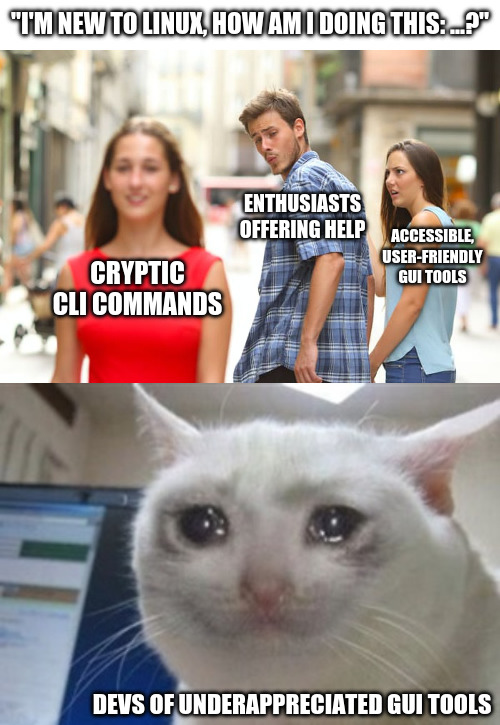
The problem I have is that the GUI tools are very specific to distros, dms, and releases. It’s a problem that arises from having so many choices.
CLI tools work long after they’re deprecated and very often cross distros.
Something as simple as getting your IP address can be in diferent areas, the settings->network panel isn’t even a safe bet. A lot of distros are now putting a network or wifi icon in your tray, but it doesn’t always look the same, can be hidden, isn’t in the same place.
Ifconfig and ip work on everything and can be installed on almost, if not every, platform.
If you do a web search for how to find your local network address in linux using the GUI, you’re given a choice of a bunch of different places to look and the reccomendations don’t line up word-for-word with what the current menus in KDE->settings look like. What’s more interesting is when I go into kde-settings and do manages to find Wi-Fi and internet instead of network connections, it doesn’t give me my ip, it’s all just blank.
Simple things can work well in GUI.
Now, working on a GUI that tries to expose every little features? No thank you. I would not want to develop it, and I would not want to have to use it.
It’s ok to go install a software through discover instead of using the CLI.
I find it’s the GUI tools that are usually cryptic, especially when you want to do more than the most basic operations.
A lot of devs don’t put much work into planning the flow of their GUI from a user’s perspective and it really shows.
IMHO a UI should offer everything a user can do in a given moment, readily available, nothing hidden behind more than a single menu. If something isn’t currently possible, it shouldn’t be available, and if the dev chooses to make the option visible but unavailable, it should be clearly and visibly marked as something that can be available (grayed out text for example).
I think devs tend to overestimate both the skill of the user, and the usefulness of their UI.
a UI should offer everything a user can do in a given moment, readily available, nothing hidden behind more than a single menu.
That would be a nightmare for any sufficiently complex software. Can you imagine how dense the UI would need to be for something like Blender or even Excel if literally every possible option of “things available to do right now” had to be at most two clicks away?
Bud theres obviously exceptions for massive suites like that. But I’m talking about apps with built in UIs that the dev clearly threw together as a last minute thought. Apps with every single thing you could possibly have to do either burried deep in 10k submenus, or hastily packed onto a window.
All I’m saying is there should be a clear and obvious workflow. Devs shouldn’t be afraid to say “I know better than you, do it this way”. Throwing every single tool on a toolbar like with Office suites or editing suites is awful IMO. Gimme menus, but gimme menus that make sense (looking at you Microsoft)
Anyway, you can disagree with me, and it won’t ever effect you, that’s the beautiful thing about the open software world. My opinions can be total shit, and you get to just ignore them 🥰
Sorry for rambling, I’m losing my mind a little bit more every day 🫡
For excel as an example isnt it already like that? One click to the ribbon/menu, one click to the option, and maybe a 3rd if that option had a nuance dropdown
That’s when you go to alternativeto.net and get a different one. If you’re running into that problem then you just are using the wrong tools.
We’re talking about programs that are equally useful in both GUI and CLI, we’re not talking about libre office which is necessarily complex or a video editing program with a thousand transitions. Those are always going to be cryptic and always going to be GUI.
The problem with CLI is it can’t be made easier with a different interface.
It’s unlikely I will use your “accessible” GUI tools, but I applaud you for making them, even if they’re shit. It’s like art, the more art there is, the better the world is, even if I personally can’t appreciate some of it, I acknowledge the greatness if it’s existence.
“I’m having an issue with Windows”
"Please open
CMD.EXEand runsfc /scannowandDISM.exe /Online /Cleanup-image /Restorehealth
If that doesn’t solve your issue, you need to reinstall Windows
Hope that helps!I cant think of a time that sfc scannow or dsim cleanup has ever fixed a problem
If you actively edit/delete some system files non-essential for boot, but that would break some integrated features, sure. But random corruption of protected system files? If that happens, you’re not fixing anything without changing your storage and/or the rest of the hardware anyway.
It worked for me on an issue once. Which, tbh, is worse than it never working, because it gave me hope and a reason to keep trying it in the future.
Same.
I reinstall my windows partition every like year.
I have had DISM work a handful of times for work. SFC has never fixed anything.
You forgot to start with shutdown /g
Hope that helps.

no chkdsk?
I think we should just add a button on the desktop that runs both of those.
We’ll call it… “New All”?
ffmpeg is great, and doing simple things is pretty straightforward, but if you work with a lot of media and do different kinds of operations, give Shutter Encoder a shot, it’s an amazing FOSS GUI tool for ffmpeg, yt-dlp, and more!
ffmpeg ❌
ffmpreg ✔️
Interesting. Their website would make me run away fearing it’s from a cheap fake download button scam from ten years ago, but the software itself looks pretty legit.
From the comments I fail to understand why it has to be one thing or the other.
I want both. Not only that, I would love GUI tools that show the CLI commands for doing the same thing in real time, so I would learn them with examples of things I actually want to do.
It doesn’t have to be one or the other. It’s just a rhetoric that was jokingly pushed on back when communication wasn’t worldwide, immediate, and lacking context. It has now been repeated ad-nauseam by people that have no idea of why it was said in the first place.
Some GUI tools are efficient. Some CLI tools are efficient. Sometimes, both are efficient. It depends on the tool AND the task at hand. Unless you’re taking internet memes at heart, then use whatever.
Well, to be honest, I do sometimes mock (in a friendly manner) some coworker that are using GUI almost exclusively. The only reason I do that is because the exact same task could be accomplished in a fraction of the time with minimal CLI knowledge. But even then, it gets the job done.
I’ve been saying this for a while now. A good gui doubles as documentation.

I think this is a space where the decline of online search is very apparent. This is really a challenge of finding the right information: e.g. finding the right wiki page or, more often than not, some one else explaining the practical use of what the wiki says in a way that you as a user can understand.
My favorite part of Linux troubleshooting is you get to enter all these command line commands that barely make sense and in the end nothing works because they’re meant for glibktw-6.32ajqx_rc4.1 but in the three weeks since that obscure forum post was made, every distro moved to glibktw-6.32ajqx_mgtk+2 and nothing works anymore.
Nah
- CLI is relatively consistent, UIs keep changing; documentation on how to do X will be outdated extremely quickly and unlike CLI those changes aren’t documented nor searchable
- GUIs are straight up not documented, you can’t know an option exists unless you stumble on it
- Even if the GUI is explicit enough to count as documentation, you can’t search a GUI; the CLI documention can be searched for keywords
- You can’t automate GUIs if the need arises
I’m not against GUIs in general, but they should always be supplementary to CLI, otherwise you end up with windows
otherwise you end up with windows
Windows without the garbage? I’m okay with that.
No, Windows as in “this setting is hidden under this menu, that submenu, here click to open another sub-window…”. This will happen any time a dev tries to arrange settings in logical way (instead of flat list of toggle and input boxes), because “logically belong together” and “actually often used together or one after another” are not the same, and also dev logic, internal system logic and user logic are also three different things. Result - mad maze
Which is why many tinkerers like CLI - at least one can run
man somethingorsomething --helpin most casesYeah, man is clutch… I wonder if people would be so intimidated by CLI if everyone knew how easy it was to learn commands with man
A lot of people are afraid of text. Like, they see text on a screen and get visibly scared. Weirdest shit ever.
I feel like a dinosaur at work because many times I have no idea how to use the different programs there, mostly because everything is so incoherent (to me).
And I don’t mean a large living dinosaur cracking trees in two while chasing my dinner.
I mean a bunch of sad brown bones held up by sticks in a dusty museum everyone walks by.
Look honey , it’s the HugeNerdosaurus
So? I want to see the T rex!
I get what you meant, I was just making a little joke, though I feel like there’s a huge difference between shitty ui that can’t be bypassed and reasonable ui that still can’t be bypassed. The latter is usually managable and tolerable.
I personally prefer having both options but in general I go with a UI.
To do this setting, you have to open up regedit, and…
That part of Windows isn’t so pretty. A quick copy-paste of a CLI is so much better than opening up regedit. Powershell has improved this, but for a long time this was the approach for settings microsoft couldn’t be bothered to make intuitive UI for.
This guy operates systems.
I don’t need someone else to make a gui to enter commands for me.
Shoutout to qpwgraph devs
GrapheneOS web installer appreciation post/comment
You can’t copy and paste into a GUI, and it’s painful to help people to use them.
So you want newbies blindly entering scripts to there command line and not knowing what that are doing.
They’re blindly doing it either way. I understand and want GUIs as well, but dumping commands into terminal is starting to seem easier than “go here click this, now click that”
Open “app” -> open menu -> select option -> change this / push this button.
Just as easy to write as a command. But many people (me included) is so used to go the CLI route that the GUI way is only an afterthought.
Just as easy to write as a command.
No. First you, the helper, have to find the option in the gui. Then you have to look up every step in the path through the gui. At every step you have to find the english name for the button/menu (localization exists), and manually type it (because you can’t select and copy the text of the gui (by default at least)). Also just referring to buttons by name sometimes won’t work. It is so cumbersome.
I can’t find this menu, where is it?
Now you have to go figure out what they’re actually looking at and whether it’s what you said to do or not. Command line copy-paste removes any uncertainty.
If it’s “oh, you can open up [application X] and it’s easy to figure it out, and there’s videos out there to cover your use case”, then ok.
But if it’s to help a user with a very specific task and they want their hand held, well from a GUI perspective I’m either making a bunch of screenshots or maybe even a tutorial video or a screen share session… Or I shoot them a relatively short CLI command that does it and move on to other things.
It is usually much shorter to tell someone the CLI to do something than it is to try to train them on a GUI for the same thing. If it’s well-trodden subject matter, well they probably already found a youtube tutorial and didn’t even have to ask.
And where a typo can cause a catastrophic outcome
their* they/those*
Ideally piping directly from curl to bash, yes
/sTeach them to double check against the man page before pasting, would be my guess.
But then the CLI wouldn’t be faster anymore and the whole argument most people keep bringing up falls apart.
Also those man pages aren’t even remotely written to be understandable by Linux novices most of the time…
But then the CLI wouldn’t be faster anymore and the whole argument most people keep bringing up falls apart.
It is much faster for the one giving the answer. Also, the looking up the man page is something you only do the first time. With the gui the user should also verify before blindly following instructions, but it is usually harder to find proper documentation of gui features than cli commands.
Also those man pages aren’t even remotely written to be understandable by Linux novices most of the time…
That is a fair point. They are dense, technical and at times pretty hard to read. But when a novice asks for help they are always going to either trust blindly or verify. Verifying can be a difficult task for a novice no matter if gui or cli is suggested. I do think most novices would trust the gui way more and feel more in control of it, even if they are basically doing the same thing.
Or pipe GUI output into another GUI function.
Or
log.txtbasic_task_list = ['copy and paste', 'install package', 'type', 'keyboard', 'read and write' ] for basic_task in basic_task_list: print(f""" Newbies can't {basic_task}. They never {basic_task} in windows. Windows has replaced {basic_task} with copilot, this is what linux needs to do to compete. How will linux ever hope to attract windows user if it still maintains this ancient hacker 1337xor tools like {basic_task}? Users just want to turn on computer and watch it do computance - how does linux not get this? """)What’s easier to support?
"Ok, open app commandX,
now click on the button labeled Y… It’s just there, just below your mouse cur… oh now you’ve moved your mouse… no, not there, it’s more to the left, up a bit… down a bit, it’s labeled Y. Third one from the top.
Yes, that’s the one, now click it.
ok, in this pop up you type "super secret code thing’,
no, capitalization doesn’t matter.
Yes. I’ll spell it “s u p e r {space} s e c r e t {space} c o” what do you mean, you don’t have a T on your keyboard? "Or. “Open up the terminal and type this code: commandX --CodeY This will do XYZ. After it’s done, can you tell me the error it says on the screen?”
But yes, I agree, the GUI looks nicer.
Exactly. You can tell someone to type a command, and ask for the output. Otherwise you’re spending 90% of your time asking someone to explain what they see, and searching for buttons that just move around from week to week.
Yep, this is just one factor. It’s difficult for people not to judge a book by its cover.
Correctly done, cli is superior for a lot of things.
I finally got Docker Desktop to work over the weekend, after months of not being able to sign in - from a browser or CLI.
Some GUIs are nice. I prefer GUIs to CLI. But some GUIs aren’t as usable as CLI
I like using Podman Desktop to keep an eye on containers and glance at logs, but more often than not I’m doing most operations on the CLI.
You are not alone. It also took me months to sign in.
I’ve been in a situation like this recently and all I can say is that the CLI is universal.
Yes, it is complex. Yes, it is challenging. But it gets things done.
Don’t be afraid.
It’s not even that complex, it just looks that way if you’re not used to using it
It isn’t, I admit. But the first impression is intimidating.
I know what you mean, just beware: in lots of cases it’s not as universal (as in distro-independent) as some still think it is.
For people who want to get things done with their PC that isn’t inherently IT-related (like, doing office work or music production or anything else) and just need to do the occasional light sysadmin thing like setting up new drives to be auto-mounted somewhere, pointing to GUI tools is just so much better. And in many cases it is also safer (making your system fail on boot with a small typo in the fstab is painfully easy).
I know what you mean, just beware: in lots of cases it’s not as universal (as in distro-independent) as some still think it is.
This is especially true when we start talking about BSDs and other non-GNU platforms.
I get where you’re coming from. But as something of an enthusiast myself I don’t always know GUI tools for all the tasks I can do in a terminal. Edit: typos
True.
As someone that started in Linux, for real, with Debian, and in a time that I had to mannually install my graphics card, I learned the way I did things on Debian was significantly different from things got done on other distro families. That, alone, kept faithful to the Debian tree.
Yeah, I’m with you. I fucked up my Deb install because I strayed from “doing things the debian way” and overtinkering with things I wasn’t meant to do.
But compared to other distros, debian feels like a bomb bunker; once you set it up, it’s going to stay set up.
Monolith is a word that fits Debian very well.
It’s like a landmark. It just exists and reality itself seems to bend around it.
I ran a Debian machine, a laptop, until the hardware literally gave up. Eight years of solid service. Regular updates and one reinstall to move to the next version.
It kept working. It kept playing music, playing videos, managing my office needs, surfing the web and receiving my email. Flawlessly.
It outperformed newer machines in its last years and people could not wrap their heads around the notion.
Debian, as a Linux+FOSS combo is a winner combo
Also, GUI changes faster than CLI, CLI has ALWAYS more options, and you can save those commands to a file.
Also can get explanations for every command.