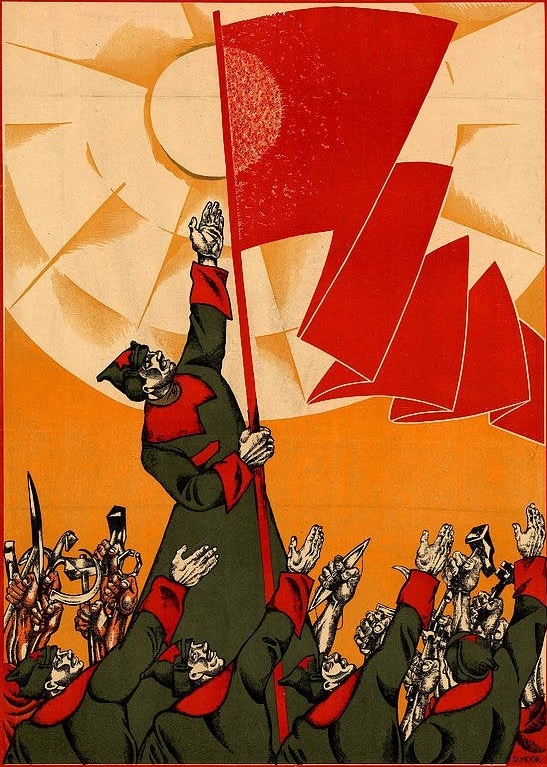
Communism looks good on paper
and looks even better in the real world
“Of your choice” isn’t even true.
maybe you will get your choice among a list of our pre-approved options.
Very good point. Parenti had something to say about that in “Power and the Powerless” pp. 10-12:
"Usually the least powerful party in an exchange relation is the one who stands in greatest need. The worker who is desperate to maintain his job, and who can easily be replaced by someone else, has a greater interest in the relationship than the employer who can readily replace him. The boss, having a lesser need for the worker than the latter has for his job, enjoys an advantage in the relationship. That is what has been described as ‘‘the principle of least interest,’’'? or, if taken from the perspective of the underdog, what I would describe as ‘‘the princi- ple of the greater need.”’ The choice for people in subordinate positions is more apt to be one of relative deprivations, that is, the lesser of two undesirable choices, than one of relative advantages. Indeed, one way we deter- mine that a person is in a subordinate or weaker position is by observ- ing that her choices vis-a-vis another are predominantly ones of rela- tive deprivation, for instance, compliance in an underpaid, exhausting job as opposed to unemployment. Implicit in such exchanges is the element of coercion, for if the subordinate party had her way, presumably she would choose neither of the deprivations. She submits to conditions not to her liking out of fear of having to face worse ones. Habit and custom are such, however, that we frequently do not recognize the element of coercion involved in most social relations. But once divested of the affirmative aura of legitimacy, these ex- changes reveal their asymmetrical and coercive quality. Consider one of the more blatant examples of social coercion, a relationship traditionally represented as one of glory and duty by those who do the coercing: specifically, that situation in which a ruling sovereign (whether king, dictator, or elected assembly) demands two or more years of a young man’s life in military service under penalty of law. Whether he chooses the army, jail, or exile, he is confronted with an exchange relationship not of his making; he is the weaker party faced with a coercive choice of relative deprivations. In such situations, assuming the absence of irrational ties to ultimate and purely affectual values of the kind Weber mentioned, the individual will comply only as long as he remains convinced that obedience has its returns, specifically the ‘‘reward’’ of being able to escape a still greater deprivation. The deprivations suffered by less fortunate persons in an asym- metrical exchange relationship are not immutable, that is, the ex- change could get better or worse. If the fortunes of the superior take an ill turn, the fortunes of the subordinate may suffer also. Hence, one can speak of a ‘‘forced collusive interest’’ between both parties, as between the slave and master, serf and lord, worker and owner. I say ‘*forced’’ because the subordinate party accepts the relationship at great cost to himself only because the alternative threatens an even greater cost: painful obedience instead of death, poor wages instead of starvation, and the like. To pursue the earlier example: suppose a young man decides to go into the army rather than suffer imprisonment or exile, or suppose he selects jail or exile as the preferred course, in what sense can it be said that he has chosen what is ‘‘best for his own interests’’? In fact, his own interests, as he might want to define them, would rule out all three choices and would demand a situation free of compulsory mili- tary service. His ‘‘real interest,’’ that is, his real or first preference, were he free to set his own agenda, might be to have nothing to do with conscription. But that alternative is, in the immediate situation, an ‘‘unrealistic’’ one, and he does not get the opportunity to consider his real preference. In facing the draft, he finds his interest range has been defined by others. The point is that power is used not only to pursue interest but is a crucial factor in defining interest or predefin- ing the field of choice within which one must then define one’s in- terests. You are free to ‘‘worship at the church of your choice,’’ or ‘‘vote for the party of your choice (Republican or Democratic).’’ The exercise of choice may be so narrow, so much a matter of relative deprivations, so tightly circumscribed by power conditions serving in- terests other than one’s own that the ‘‘choice’’ may be more a mani- festation of powerlessness than of power. A distinction should be made between one’s immediate interests within a narrow range of alternatives fixed by politico-economic and institutional forces (e.g., procuring a job with a firm that manufac- tures a highly profitable and ecologically damaging product) and one’s long-term interests (e.g., protecting the environment from dam- age by the manufactured product, working in a kind of productive system that rules out profits as the primary goal, etc.). A characteristic of our social system is its ability to oblige people to make choices that violate their broader long-term interests in order to satisfy their more immediate ones. To give no attention to how interests are prefigured by power, how social choice is predetermined by the politico-economic forces controlling society’s resources and institutions, is to begin in the middle of the story—or toward the end. When we treat interests as given and then focus only on the decision process in which these in- terests are played out, we fail to see how the decision process is limited to issue choices that themselves are products of the broader conditions of power. A study of these broader conditions is ruled out at the start if we treat each ‘‘interest’’ as self-generated rather than shaped in a context of social relationships, and if we treat each policy conflict as a ‘*new issue’ stirring in the body politic.
As usual I’d love for the down voters to comment instead of being cowards.
I’ll bite.
China is not communist. But we should talk about different economic systems because that’s the ultimate goal.
Communism in itself is a true ideal as long as output exceeds intake and satisfaction is high. It’s also possible on a global scale, if not designed for it.
Capitalism is also a true ideal as long as it’s built on an immovable foundation of human rights paid for by centralized non profit corporations.
The issue has nothing to do with the ideas themselves. The issue is and always has been the concentration of power.
It is the ideas of the few which can never properly represent the masses. Even with the best intentions. The only true ideal for power is that there is none except when handled by all. The US Constitution seemed to have this idea in mind with its intent, though it’s evolved into the same old concentration of power over time. Doesn’t matter which party either. The reality is power is so concentrated now that there are no true parties anymore. This is a mafia that transcends both sides.
So no China is no proof of anything except improper concentration of power. Mostly capitalist by the way. And totally tyrannical in their wielding of power against free thought, sex, religion, etc. It’s practically anti freedom and contradicts every protected class we have in the US.
Does anyone have the statistics on how many abortion occur there? Even if you’re pro choice, the piles of discarded fetuses could reach skyscraper height. This is not a normal issue to have. How many illiterate? How many old people died while they were bolted inside their homes during COVID?
If the question is what system would you be willing to put your life in the hands of, there is only one answer: which one has the most distributed power and wealth above the rest.
I don’t have time to go through everything wrong with your post but I want to touch on Chinese vs American literacy rates for a moment
In America while the total population literacy rate is often cited at 99%, functional literacy (the ability to manage daily living and employment tasks) is lower, with estimates placing it between 65% and 85%.
China’s literacy rate has grown from 79% in 1982 to 97% in 2020.
In 2018 PISA results,15-year-olds in China outperformed U.S. peers in reading, math, and science. Some analyses suggest about 20% of U.S. 15-year-olds do not read as well as they should by age 10.
In the 2018 PISA China ranked first globally in all subjects. The U.S. ranked roughly 13th in reading and 37th in math among 79 education systems
Youth literacy in the U.S. is facing a crisis, with 25% of 16-to-24-year-olds deemed functionally illiterate as of 2023, up from 16% in 2017. Roughly 60% of U.S. teens do not read at grade level, and 34% of fourth-graders perform below basic reading levels.
In 2020, youth (15–24) literacy in China reached 100%.
Nothing you said contradicts anything I wrote, so I’m struggling to understand why you started your comment this way. To say “everything wrong with my post” then address nothing I wrote… I’m not sure you should be quoting literacy at all.
You’ll find I’m highly critical of both China and the US once we discuss further.
Lastly, there is no chance in hell China’s literacy reached 97%, not will it as long as rural lifestyle continues with no need for it.
“That isn’t true because I personally am incredulous about it!”
Very compelling argument.
Lastly, there is no chance in hell China’s literacy reached 97%, not will it as long as rural lifestyle continues with no need for it.
Whether you think they had need for it doesn’t matter. History shows that every socialist state has put enormous effort into universal literacy. This is not controversial; it’s a settled question among historians.
Literacy rate by country, 2026. China is at 97%. Get out of the 20th century and turn off Fox News.
You accused the Chinese of being illiterate and I provided statistical evidence. The paragraph you wrote maligning Chinese literacy rates literally starts off with “does anybody have any statistics”.
You reject the statistical evidence because you personally can’t believe it. The rest of the world believes it. Nobody gives a fuck about your opinion when you are so wrong, so many times, in such relatively short comment.
If we can just personally dismiss things we don’t believe in, evidence, statistics, and facts be damned then I don’t believe in you. Are you an actual thinking person with a brain or sinophobic caricature impervious to evidence?
You asked:
How many illiterate?
They answered that is not that many???
Lastly, there is no chance in hell China’s literacy reached 97%
Because a bird told you?
Because a bird told you?
I think their source is much worse, after all they write things like this:
Capitalism is also a true ideal as long as it’s built on an immovable foundation of human rights paid for by centralized non profit corporations.
They are very clearly a fascist doing third way dog whistling and even breaking into full techno fascist rhetoric about ai enforcing morals in some replies.
True capitalism was never achieved!
The capitalist subject, so accustomed to being lied to and ripped of by their society, refuses to believe that any socio-economic order can deliver good results for the people in it. This is what passes for “common sense” in capitalist countries: a religious belief that anyone who claims to want to make things better is lying to you.
The saddest thing is how “enlightened” they feel in believing that there is no alternative, and that feeling further entrenches them in capitalist realism. Anyone who believes otherwise is a sucker, a naïve utopian.
The only true ideal for power is that there is none except when handled by all. The US Constitution seemed to have this idea in mind with its intent
Are we talking about the same document granting exclusive political rights to land and/or slave-owning white males or are you a visitor from another dimension?
Do you understand the word “intent”? Do you know the history of founders trying to install this intent, but being forced back by those slave owners? If you do, then I believe we both agree the intent was good and the execution has failed.
The founders were slave owners
The purpose of a system is what it does, not what its marketing department says.
This is some “revolution betrayed” mythology. The founders WERE the slave owners. But even if they what you say was true, that means that their constitution crumbled immediately to the opposition and is unworthy of my respect or consideration
I applaud you for your bravery, I’m still gonna downvote you
The only way to avoid downvotes is to stay silent.
I mean not spreading reactionary nonsense also helps

Now that china is powerful, capitalists want to claim it as theirs…
China is not communist. But we should talk about different economic systems because that’s the ultimate goal.
Communism in itself is a true ideal as long as output exceeds intake and satisfaction is high. It’s also possible on a global scale, if not designed for it.
Capitalism is also a true ideal as long as it’s built on an immovable foundation of human rights paid for by centralized non profit corporations.
This is accurate enough and largely in line with modern communist theory although lacking in detail (why did you get my hopes up to dash them?)
The issue is and always has been the concentration of power.
No it’s not, unless you are talking about literal electrical/mechanical power (engineers of the world, unite!).
Sociological power is a poorly defined concept with a nebulous effect on society.
Economic power, while more defined isn’t a cause but an effect of the organisation of production (and thus, whether a society is feudal, capitalist, socialist or communist).
And totally tyrannical in their wielding of power against free thought, sex, religion, etc. It’s practically anti freedom and contradicts every protected class we have in the US.
Not at all lmao. LGBTQ rights are about the only ones the Chinese are a bit lagging on. The rest are fine.
And before you come at me about freedom of speech, that is nothing more than the freedom for the rich to buy the public opinion. You don’t want to live in such a society, cause then you get Elon buying twitter and Trump buying the US.
Even if you’re pro choice, the piles of discarded fetuses could reach skyscraper height. This is not a normal issue to have.
Bruh … what the fuck are you talking about?
Also pro-tip, you can just Google the stats. Here it is. China is number 66.
If the question is what system would you be willing to put your life in the hands of, there is only one answer:
Selfish answer: the one that gives me tons of money and protection (imagine a dictatorship of the transfemmes)
Non-selfish answer: a dictatorship of the proletariat cause I’m a proletariat and so are most people
Removed by mod
When was the last time you visited China? Have you ever lived there?
Born and raised. You clearly have never been, yet you speak with arrogance as you spout off talking points.
The government rounds up religious minorities and genocides them
This claim gets repeated endlessly, but repetition does not turn an allegation into proof. Words like “genocide” get deployed because they carry moral weight, not because the evidence meets the definition. The actual situation is far more mundane and far more complicated. There are policies directed at separatist violence, religious extremism, and regional security. Those policies are harsh in places and worth debating, but transforming them into an industrial genocide narrative is propaganda, not analysis.
China officially recognizes multiple religions. Mosques, churches, temples, and monasteries operate openly across the country. Anyone who has actually walked through cities in Ningxia, Gansu, Henan, or Zhejiang would know that immediately.
They once encouraged people to speak up about how they can improve upon society then threw all the people who did in prison for 35 years.
You are vaguely referencing events without understanding the historical sequence. The campaign encouraging criticism of the party was followed by a backlash when leadership feared that the criticism was destabilizing the state itself. It was a political struggle inside a revolutionary system still trying to define its direction after a civil war and a massive social transformation. That period was chaotic and involved real repression, but your version reduces decades of complex political conflict into a moral fable.
The Cultural Revolution itself was something entirely different from what you described. It was a moment when ordinary workers and students were mobilized directly into politics at a scale never before seen in modern states. Institutions collapsed, factions formed, and power moved outside bureaucratic structures. The problem was not that “people were punished for speaking.” The problem was that the political struggle escaped all stable mechanisms of coordination. The result was excess, factional violence, and eventually a reassertion of centralized authority. Treating it as a simple story about free speech misses the entire point.
The one child policy barely was removed recently and there are still abortion clinics on every corner like Starbucks in America
The one-child policy was relaxed progressively and formally replaced in 2015. Calling that “barely removed” nearly a decade later is a stretch. More importantly, the policy emerged from specific demographic pressures in a poor country attempting to industrialize rapidly with limited resources. Whether one supports it or not, it was not some arbitrary cruelty invented for ideological reasons.
As for the “Starbucks abortion clinic on every corner” line, that is simply fantasy. Reproductive health clinics exist, as they do in any country with a population exceeding a billion people. But the picture you are painting does not match reality. It reads like something copied from a political meme.
Maybe they are 66 on your list but the number is 10 million fetuses per year.
You did not read the source he linked did you? Yes, the absolute number is large. In a country with roughly 1.4 billion people almost every raw number will look enormous. Rates are what matter. Around 28 per 1,000 women places it roughly mid-table globally. That is precisely why the ranking is around 66th. Statistics are meaningless without context.
Free speech is not available anywhere. That is a criticism for all governments.
Now the argument shifts. First the claim is that China is uniquely oppressive. When that collapses under scrutiny the claim becomes that no country has free speech anyway. That contradiction should tell you something about the reliability of the earlier claims.
I could argue at least the US has a path to change through voting and the checks/balances of power
This is the most revealing sentence in your entire comment because it exposes the mythology underlying the rest of it. The United States presents itself as a system where the population governs through elections, but the material structure of power sits elsewhere. Political campaigns are financed by concentrated wealth. Media systems that shape public opinion are owned by large corporations. Lobbying organizations write legislation. Regulatory agencies rotate personnel with the industries they supposedly regulate.
Voting occurs, but the range of outcomes permitted by the system remains narrow because the economic foundation never changes. Parties compete over management of the same underlying order. When policies threaten entrenched capital interests they simply do not survive the process. That is why universal healthcare has been debated for generations without implementation. That is why financial institutions responsible for economic crises receive bailouts while ordinary people absorb the consequences.
“Checks and balances” function primarily as inertia mechanisms. They slow structural change, not empower it. The idea that the population can fundamentally redirect the system through periodic elections ignores how power actually organizes itself in advanced capitalist societies. The state becomes intertwined with the interests of the dominant economic class. Elections then operate more like a controlled feedback loop than a mechanism for transformation.
So when you claim the United States offers a path to change, what you are really describing is a ritual that produces the appearance of choice while the underlying distribution of power remains intact. If the population truly had the capacity to vote away the interests of the wealthiest sectors of society, those sectors would never have allowed such a mechanism to exist in the first place.
Just admit you’re a racist who seeks out orientalist and chauvinist narratives about China because it makes you feel better about the decline of your empire.
Thanks for writing this out. You’ve a way with words I do admire.
How many old people died while they were bolted inside their homes during COVID?
Far fewer than died outside of their homes in the rest of the world.
China actually cared about their people’s lives honestly, all the west cared about were their economies.
Ya covid was barely worse than regular flu viruses when you compare the death ratios. And I’m progressive by the way. I got the shots and locked down then saw that all the smart money was in healthcare, the vaccine manufacturers and insurance.
If the west cared about their economies then why did they require vaccine cards to enter grocery stores or the work place in their most populous areas?
I truly don’t understand where you get these ideas or care which country is better. Both suck. The people of this world deserve better than either has to offer. That is the conversation I’m trying to have.
Appreciate you commenting but I have nothing to add to critique this beyond what others have already said.
i just downvoted you but i’m commenting to let you know so that i’m not a coward, i’ll let my comrades handle it, im not in the mood. you’re about to get schooled

Still waiting for the teacher to show. Let us all know if your mood improves enough to discuss.
You already got schooled extremely hard with multiple effort posts you couldn’t respond to
@QinShiHuangsShlong@lemmy.ml already schooled you so hard
Unfortunately unlikely he will bother to read my effort post and if he does I have my doubts at his ability to comprehend it as he spouts off “third way” dog whistles and the most ridiculous orientalist chauvinist narratives and lies about China.
Your entire argument rests on idealism. You treat ideas like communism and capitalism as abstract moral propositions to be judged in a vacuum. This is precisely the error historical materialism was developed to correct. Systems do not emerge from the minds of philosophers. They arise from the material conditions of production, from the way human societies organize labor to meet their needs. To ask which system you would “put your life in the hands of” as if choosing from a menu ignores that history is not a matter of choice but of struggle grounded in concrete reality.
Let’s begin with the base and superstructure. The economic base, the mode of production, determines the political and ideological superstructure. You claim the issue is concentration of power, as if power floats freely above society. But power is not an independent variable. It is rooted in ownership and control of the means of production. Under capitalism, private ownership necessarily concentrates power in the hands of those who own capital. This is the logical outcome of a system where production is organized for profit rather than human need. You cannot have capitalism without class antagonism because the extraction of surplus value requires a class that owns and a class that sells its labor. To wish for capitalism without exploitation is to wish for a square circle.
China’s path must be understood through the dialectic of productive forces and relations of production. Socialism presupposes a high development of productive forces. A society emerging from semi-feudalism, shattered by colonialism and war, cannot leap directly into advanced communism. The socialist transitionary period is a scientific recognition that the relations of production must correspond to the level of productive forces. China develops its economy under the leadership of a proletarian state. This allows for the accumulation of social wealth under public direction. Market mechanisms are employed, but they are subordinated to strategic planning and social goals.
Your characterization of capitalism as a “true ideal” if only it were built on human rights reveals a profound misunderstanding of the system’s inner logic. Capital is not a neutral tool. It is a social relation that compels accumulation. The imperative of endless expansion is not optional. A capitalist firm that does not maximize profit is eliminated by competition. This structural compulsion drives the exploitation of labor, the plunder of nature, and the imperialist domination of the global south. Human rights discourse, while valuable, cannot tame a system whose very metabolism requires inequality. The “immovable foundation” you imagine is impossible because capital constantly revolutionizes production, uproots communities, and commodifies every aspect of life to survive.
On the question of China’s policies, a materialist analysis refuses moralistic abstraction. The one child policy was a response to a specific historical conjuncture. In the late 1970s, China faced the real prospect that rapid population growth would outstrip agricultural and industrial capacity, undermining the very basis for development. This was not an arbitrary choice. It was a harsh measure taken under conditions of scarcity. A proper approach acknowledges the genuine harms while understanding the pressures that produced the policy. It also recognizes that the policy was adjusted as conditions changed. This is materialism in practice. Ideas are evaluated by their correspondence to reality, not by their conformity to an external moral standard.
Your claims about illiteracy and COVID are not just inaccurate. They serve an ideological function. China has lifted hundreds of millions out of poverty and achieved near universal literacy through massive public investment in education. This is a historical achievement without parallel. Zero COVID was a public health strategy that prioritized the preservation of life, particularly the lives of the elderly and vulnerable. The outcome was among the lowest per capita death rates in the world. You dismiss this as tyranny while accepting a Western approach that sacrificed the vulnerable to maintain market “normalcy”. The long term disability caused by long COVID is a social catastrophe you ignore because it does not fit your narrative. A society that protects its weakest members is not tyrannical. It is humane.
The orientalism in your comment is also unmistakable. The image of “piles of discarded fetuses reaching skyscraper height” is not analysis. It is a trope drawn from a long tradition of Western propaganda that depicts Asian societies as inherently cruel, irrational, and disposable. This rhetoric dehumanizes an entire population to justify hostility. You speak of free thought, sex, and religion as if these are abstract rights detached from material conditions. But for the majority of humanity, freedom is first and foremost freedom from want, from disease, from premature death. China has delivered these substantive freedoms on a scale the West has not matched. Your focus on formal liberties while ignoring material outcomes reflects a privileged position that takes survival for granted.
Finally, your conclusion that distributed power is the only answer is correct in principle but empty without class analysis. Power is not distributed by wishing it so. It is redistributed through struggle against the structures that concentrate it. The US Constitution, for all its rhetorical brilliance, was designed to protect property interests. Its evolution into a system of concentrated corporate power is not an accident. It is the logical result of a state that serves capital. True democracy requires social ownership of the economy. It requires that the producers control what they produce and how it is distributed. This is not a utopian dream. It is the necessary next step in human development, visible in the experiments and advances of socialist construction around the world.
To judge China by the standards of liberal idealism is to miss the point entirely. History moves through contradiction. Socialism in the primary stage contains contradictions. It utilizes market forms while building the foundations for their eventual transcendence. This is dialectics. The task should not be to condemn an actually existing socialist project for not yet being perfect. The task should be to understand its trajectory, learn from its successes and errors, and advance the struggle for a world where the free development of each is the condition for the free development of all. That world will not arrive by wishing. It will be built through the material practice of millions, guided by the science of socialism, rooted in the concrete conditions of their time and place.
Absolutely cooked that fraud! 🙏😭
I would like to hear his rebuttal to some of the points I raise but unfortunately I just don’t think it’s likely he will respond.
Of course it’s based on idealism. The correct path to progress is to think of the ideal, then compare it to the current situation, identify what is missing, then close the gap.
So many commenters on here are caught up in comparing which is better: China or the US?
That is a waste of time and mirrors the ridiculous two party propaganda that wastes away American politics.
The truth is both systems are terrible.
COVID was barely more lethal than the common flu so both countries completely overreacted. Your idea of humanity being the reason they used militarized forces to bolt people’s doors in is a joke. China historically overreacts with their concentrated power as proven time and time again. Once of which resulted in the potential LARGEST loss of human life in all of history. How many did Mao “accidentally” kill in the name of creating a humane world? 30 million? 50?
The idea of fetuses pulling as high as skyscrapers has nothing to do with propaganda or justifying criticism. These are real facts with the number of abortion being 10 million per year. No country comes close to this number. It will factually create a skyscraper every single year.
I actually lived in China and the US in my lifetime. Believe me there are plenty of positives about that society that are far better than the US. But overall comparing the two existing systems… they both suck.
Lastly, the reason an ideal capitalistic structure can exist is because of technology. The point you have failed to cover (despite using AI to generate your arguments) is that humans are failed aspect of capitalism.
There is no comparing the competitive dominance of this system for the last 100 years. With barely a fraction of the same populous of China, the US sits comfortably with no potential military threat and is now leading the AI race. It’s a fools game to pretend that progress is not worthy of consideration in the best system. But to prevent the absolute abortion of human rights, it needs an infallible system to enact the foundation which I previously described. Some obvious choices are: corporations must have regulated profits to own housing and housing must have a cap on ownership by corporations, healthcare must be universal and promote preventative measures rather than for-profit reactive measures, centralized postal service is one of the greatest examples of a non profit system that has worked for Americans for a very very long time to save them millions and create jobs.
AI could be the answer to enforcing these in a way that cannot be overturned by the interests of politicians and corporations finding common goals to destroy morality.
Your definition of idealism is so wrong its incredible, it really shows how little knowledge of political economy you truly have (if you quantified it it would likely be negative). Idealism posits that consciousness determines existence. You do exactly this by imagining a perfect system in your head and demanding reality conform to it. Historical materialism understands that systems emerge from material conditions and class struggle. You cannot design morality into a system built on exploitation. Your claim that both China and the US suck is not insight. It is third way centrism that protects the status quo by refusing to analyze class character. Equating a state focused on poverty alleviation with one focused on profit maximization is a political choice to ignore reality.
COVID was not the flu. Millions died and hundreds of thousands suffer permanent disability. You trivialize this mass death to protect your worldview. You dodge the core argument that Western capitalist countries left millions to die. Zero COVID was the correct material response to preserve life. It lasted longer because Western nations refused to cooperate and instead hoarded vaccines while preaching liberty. You call it tyranny I call it protecting the vulnerable. The western strategy was to let the virus burn through the workforce to keep markets open. That is the logic of capital. Your defense of that outcome shows where your priorities lie.
The Mao era famine propaganda you recycle is again showing the kind of person you truly are. The Great Leap Forward had policy errors but the famine was largely exacerbated by natural disasters and external pressure. It was the last famine China ever had. Since then China lifted over 900 million people from poverty, all but eradicated illiteracy, built infrastructure from the coast to rural villages including roads, electricity, and clinics. You ignore this massive material gain to fixate on decontextualized body counts. You are a fascist drunk on propaganda.
Your abortion argument is blatant orientalism. Raw numbers mean nothing without population context. Ten million abortions in a population of 1.4 billion is a rate of roughly 28 per 1000. That ranks China 66th in the world. There are no skyscrapers of fetuses. That imagery is dehumanizing trash designed to paint Asian society as barbaric. You claim you lived in China but your “insights” are just Western media talking points. You sound like a disgruntled sexpat sexpest who never understood the society he lived in (if you’re not just outright lying). Maybe you just resent it now that you’re no longer glorified here.
Ideal capitalism does not exist. The Western safety net you crave is built on pillaging the periphery through violence and imperialism. You cannot have regulated profits and universal care under a system driven by accumulation. Capital will always find a way to bypass rules to survive competition. Your solution to let AI enforce morality is techno fascist logic. It assumes humans are the problem and algorithms are the savior. Also I did not use AI to write this. Your arguments are the ones that sound like generated propaganda. But I still decided to engage in the hopes maybe you were simply misguided, I see now that misguided is the wrong phrase you clearly purposefully seek out reactionary talking points.
The US is dominant only because it emerged from World War II intact and assumed leadership of Western imperialism. It spent decades extracting wealth from the Global South. Even with that head start they are losing ground to China in multiple sectors. You talk about military threats but ignore the budget. The US spends more than the next ten nations combined. Comparing the US and China is not irrelevant (even though I didn’t do that in my original comment) they both embody the current most advanced forms of their respective systems.
Your rhetoric exposes a deep seated chauvinism and you are spouting fascist logic. You speak of distributed power while proposing an infallible AI enforcer to override human agency. Your imagery of fetus skyscrapers relies on old tropes of Asian barbarism to dehumanize a population. This is orientalism pure and simple. You claim to hate power concentration while defending a system that concentrates wealth in historically unprecedented levels. Your third way Nazi dog whistles serve only to protect Western hegemony. You have a surface level understanding of political economy. You fetishize technology and ignore relations of production. You are just an a fucking idiot who barely grasps the material world. Stop parroting orientalist lies and learn what materialism actually means. Maybe then you can start to actually understand the world.
Racist fashie pig.
The US Constitution seemed to have this idea in mind with its intent, though it’s evolved into the same old concentration of power over time. Doesn’t matter which party either. The reality is power is so concentrated now that there are no true parties anymore. This is a mafia that transcends both sides.
So no China is no proof of anything except improper concentration of power. Mostly capitalist by the way.
If your opinion is that power is concentrated in the hands of the few in both the USA and China, how do you explain the difference between how bad it’s going for America rn vs. how good it’s going for China rn? Sure, both have their problems, no country is perfect, but it really looks like the USA is completely falling apart while China is having technological breakthrough after technological breakthrough.
Thanks for your response btw, the original commenter is right that people who downvote and leave don’t contribute anything to the conversation, unlike you.
I think we have different definitions of how good things are going.
In my mind the scientific breakthrough phenomena is an interesting one. The US just defunded their universities and research programs across the board. So they are truly not even competing in that space at the moment.
Right now the world is desperately racing to AI dominance because the innovations in warfare are so tragic, they are left with no other option. The US leads in this space which implies that all innovation will soon be greatly enhanced with these tools.
To me, 99% of people on the planet are interested in a handful of common ideas: health, family, housing, entertainment, and a good job (I’ve not heard a better definition for this than: challenging, make an impact, fairly compensated).
I honestly don’t care much about comparing the US and China in these regards since neither match the systems I mentioned before which are capitalism with a foundation of human rights paid for centralized non profit organizations or communism with high satisfaction and reduced concentration of government power.
If 99% of people are aligned on these topics, the reality is all war, conflict, government powers, regional economic competition are unnecessary. The government should be for the entire planet and simply administrative. That is the true ideal. Everyone gets to vote on their administrative tasks based on performance and efficiency markers every year.
No need for presidents, militaries, etc.
centralized non profit corporations.
I misread! This should be the state, not NGOs!
This is entirely vibes-based. Capitalism, socialism, and communism are modes of production and distribution, not ideals or ideas. Capitalism is characterized by private ownership as the principle aspect of the economy and the working classes in charge of the state, socialism is public ownership as the principle aspect and the working classes in charge of the state, and communism is a post-socialist mode of production where all production and distribution has been collectivized.
China is a socialist country governed by a communist party. Public ownership is the principle aspect of its economy, and the working classes control the state. The Chinese political system is based on whole-process people’s democracy, a form of consultative democracy. The local government is directly elected, and then these governments elect people to higher rungs, meaning any candidate at the top level must have worked their way up from the bottom and directly proved themselves. Moreover, the economy in the PRC is socialist, with public ownership as the principle aspect of the economy. Combining this consultative, ground-up democracy with top-down economic planning is the key to China’s success.
I highly recommend Roland Boer’s Socialism in Power: On the History and Theory of Socialist Governance. Socialist democracy has been imperfect, but has gone through a number of changes and adaptations over the years as we’ve learned more from testing theory to practice. Boer goes over the history behind socialist democracy in this textbook.
The US Constitution was written to protect slave owners, capitalists, and landlords. It is not written to protect the many. China, on the other hand, puts the working classes first and manages to use this system to uplift the working classes year over year.
An excellent and very clear answer comrade, but don’t you have any book recommendations that are more on the commenter’s level? Roland Boer is great but it takes a pretty advanced level of political econ and history knowledge to grasp. Do you know of any simpler books on the subject? Or would you recommend just listening to Hasan Piker to someone at that stage of the journey?
Not cowbee but, at this commenters level the most on his level suggestion I can think of after reading his comments is that he should try hit himself in the head with a brick repeatedly until he forgets everything he knows and start over.
Roland Boer’s work is useful because it’s meticulously well-researched and sourced. Unfortunatley, for someone actively hostile to the idea of democracy in China, simple works are easily tossed aside as “propaganda.”
Do you have a pdf for Boer’s book on SWCC? I’ve wanted to read it but haven’t been able to find it.
Tysm!
This is for Socialism in Power, ashestoashes is asking for Socialism with Chinese Characteristics: A Guide for Foreigners.
This should work! Socialism with Chinese Characteristics: A Guide for Foreigners
You are either ignorant or so desperate to pretend China is not a tyranny that you will actually say outloud that the state is controlled by the people. What a joke. It is so far from that I don’t even think a conversation is possible with you. We must first agree the sky is blue to have a conversation…
I do witness ignorance and desperation. But it is emanating from you.
Get a job
Do you have a counterpoint, or are you just going to cope? Professor Roland Boer’s work is meticulously researched and very well-sourced.