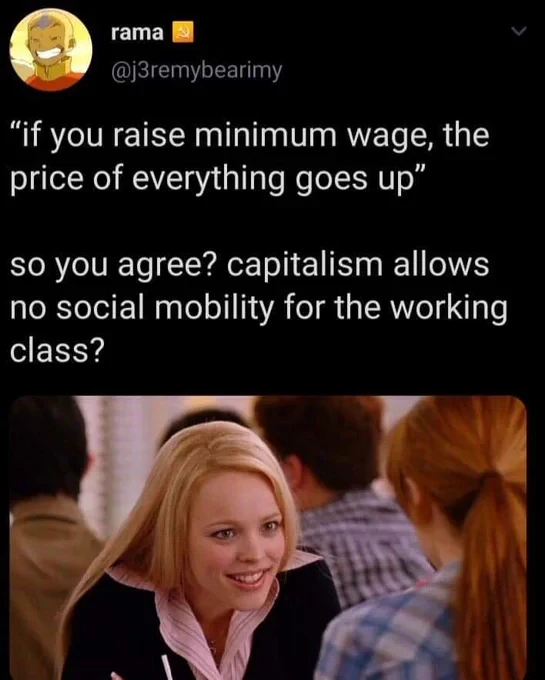
Spoiler
Also not necessarily true - Karl Marx “Value, Price and Profit” Chapter two “Production, Wages, Profits”
Not if the wage increase is covered by reduction in profits. The workers get more, and the rich get less. On a quarterly basis, 75% of the profits should be distributed among the workers.
prices went up without a wage hike
historically, no/minimal inflation follows wage hikes
People keep saying it would necessarily cause inflation but I don’t see how. You’re not printing new money, you’re redistributing it. Because demand would go up?
Correct. More money in wages means more spending means more demand means higher prices means workers demand more money in wages means more spending means…
And now you know what what a wage-price spiral is.
Are you saying people would just keep buying more and more bananas as wages go up, driving an unprecedented banana price explosion? I wonder what people will do with all their bananas that they’re gonna be buying? Cause that’s how stupid that argument is.
I haven’t even had my whole first coffee yet, I’m not nearly prepared for this level of…I don’t even know what.
So here: 👍
Happens. Thanks 👍
Which is incidentally why immigration is good for the economy too.
Don’t companies tend to pay immigrants less? I could see this having the opposite effect and suppress wages
They pay undocumented immigrants less. Documented immigrants can’t be paid under the table the same way. It’s also important how much immigrants raise demand. They need houses, clothes, food, etc.
It might be region dependent then. In my neck of the woods foreign workers are specifically brought in to work the minimum wage jobs that no local would work for the low pay and bad treatment. They’re really taken advantage of as their ability to stay in the country is tied to their employer (often their employer is even their landlord too) and it’s all on the books and legal, but suppresses wages while also raising demand so prices go up despite the stagnating wages.
I guess we may be talking about different things as temporary foreign workers aren’t technically immigrants? It’s meant to be temporary I guess, but even if they don’t get their permanent residency if they’re swapped out for a new person to abuse the effect is the same or worse.
Seasonal agricultural workers are a whole other set of exploitation, it’s true. It’s got a long racist history predating most of the southwestern US gaining statehood. I was talking more about permanent residents.
Inflation, as a metric wouldn’t really move… But the same effect as inflation at the point of sale would occur, increased prices.
However, the effect of wage increases on consumer pricing is minimal… based on every time this type of thing has happened previously. The net result is always more buying power for consumers. Prices never go up the same as the wage increases, because employee wages aren’t the total cost of a product or service.
deleted by creator
Or we could call it profiteering and a clear indication that there is no free market where competition keeps prices low.
There is no “free” market it is a rigged system you are either part of the group exploiting the system or one of the exploited!
Inflation + minimum wage is the same as devaluing money, which is good for everyone with debt, and bad for everyone with money in the bank. Not sure how it is for billionaires whose money is mostly in companies, but it’s great for me with a loan for my house, which doesn’t get indexed, unlike my salary which does.
My massive debt IS devaluing. I wonder if you can earn money by like taking up debt to buy gold, then the debt will be worth less, but the gold will keep up with inflation.
There’s interest in the debt. Gold would have to rise faster than the interest.
Someone could argue that this is just economy, not particularly capitalism. Just basic trades could suffer from it.
I still don’t like capitalism though.
Raising of prices, aka inflation, is not necessarily bad. It’s only bad for those , whose income didn’t rise faster.
Giving money to poor people might rise prices for everyone including the rich. Would be a nice turnaround from the usual give money to the rich and rise prices for everyone including the poor.
Social mobility means you start at lower income and get raises, it doesn’t require a minimum wage.
I was a manger at dollar tree. Florida cashiers got paid $12. Texas cashiers get $8. Products were the same price at both stores. This idea that prices jump dramatically when you increase min wage is crazy.
Corporations have thier prices set to the maximum a consumer will pay not how much it costs to produce
What’s the fun of doing well if there’s no underclass below you
The obvious retort would be about getting better jobs.
I feel like, and maybe I’m wrong, you need strict price controls on any market to prevent this. That said, say the US did this, for instance. Suddenly, I assume US companies with large domestic consumer bases would start trying to expand their reach because they couldn’t just jack up prices on US consumers.
If you want markets, I think you have to accept the rise in prices (limiting the effectiveness of the wage increase) or accept that domestic companies will have to compete more internationally (which should be what capitalists want, you’d think, but could in theory be bad for some foreign firms, like if a US megacorp set its sights on out-competing Canadian firms, for instance).
Idk. I’m not an economist, but it seems like there are drawbacks no matter how you do it in a market economy. Maybe someone has literature on this topic (since it comes up a fair bit irl)
It allows for social mobility in the same way a casino does