You must log in or register to comment.
Fun fact: the Egyptian god Thoth is Θώθ in Greek.
Egyptians were bronze age furries
This is well known
That certainly explains a lot of their animal gods
Most people were furries in ancient times tbf. Mythology has patterns.
So do most furries.
Hel don’t even need to get real ancient for that shit. The Bear warriors, Wolf warriors, and presumably Boar warriors were a thing up until old Norse paganism was driven into being secretive.
The boar warriors are weird and we aren’t even sure if they existed into the Viking age, while Bear warriors and Wolf warriors are written about the Boar warriors are obscure at best. Most of their documentation is from Roman reliefs which depict all three of the warrior cults. Though they may have just been hyper obscure preferring to stick to the most wild of lands and avoid civilization when possible.
Is it really an omega? I always pronounced it as an omicron. Weird…

No really, Thoath just doesn’t sound right. I always pronounced it Thawth.
Also, “WINDMILLS DO NOT WORK THAT WAY. GOODNIGHT!”
In Modern Greek, the omicron and the omega are pronounced the same, so it doesn’t really matter ig (if we’re talking about Modern Greek that is)
We’re talking about the Greek transliteration of Thoth, so I’m pretty sure we’re not talking about Modern Greek
It’s extra funny that Thoth is so similar to thot too.
That’s how you call a cat, right? Pspspspsp!
My biggest pet peeve is when there is an “olden english” or whatever text with “Ye”, and people pronounce it like “Ye” when it really is the same as “the”, just with þ (“th”) turned to y
Here’s what I mean
You used the þorn! You’re going to summon the þorn guy!
Hi porn guy.
deleted by creator
No, that’s a horn you’re talking about. þorn is a cultivated form of cereal grass/grain, with a fancy cob growing on top of a tall stalk. When it’s one of the variants that’s grown for food, it’s usually very tasty when grilled, with just some butter and salt.
My friend, I believe you were thinking of corn. In fact, þorn is an American nu metal band from Bakersfield, California, originally formed in 1993 by James “Munky” Shaffer, Reginald “Fieldy” Arvizu and David Silveria.
I guess you must be referring to the Band “Korn”, with a K.
Michael þorn ist the actor who played Lt. Worf in various Star Trek series, originally in “The Next Generation”.
No that’s Michael Dorn.
þorn is 2022 video game which was for a large part inspired by the works of H.R. Giger and Zdzisław Beksiński
deleted by creator
Even worse, 666dollarfootlong will summon all the discourse around the þorn.
the last person I saw using þ I immediately þlocked…
but since you used it in context I’ll let it $lideI saw that guy, I get his position but fuck that. Blocked him too
I keep him unblocked so I can continue downvoting him

deleted by creator
Cyrillic: First time?
于エ尺丂十 十エ从㠪?
Nani?
sō desu ka
Ninjago’s language?
Cyka, blyat
While we’re on Greek: the Greeks don’t use a standard “?” as a question mark. They use “;” which look almost identical to a semicolon, but isn’t. You can see the difference when they’re side by side. (Greek semicolons first)
;;;;;;;;;;;;;;;;;;;;;;;;;;;;;;;;;;;;;;;;;;;;;
But, apparently in fixed-width fonts they can look identical:
;;;;;;;;;;;;;;;;;;;;;;;;;;;;;;;;;Where this could be really interesting is code, where someone might cause a lot of confusion by using something that appears to be a semicolon but which the language treats as just another non-special character.
Here’s how this post looks for me:

I had no idea, learning coding is probably very funny for little while.
print(“hello world”)?
Computer: no I don’t think I will.
Javascript would have no problem with it. Semicolons are already kinda optional in there, and having tons of question marks in your code is also pretty normal. ie:
input?.map(item => !!item?.name ? item : item?.toString() ?? "New Item")Just means: If the variable named “input” has a function named .map(), which is usually the case if it’s an array, you go through that array and transform its elements in the following way:
-
is your element an object that has the property “name” and that property isn’t undefined, null or 0? (the “!!” is a double negation that would force undefined, null and 0 to evaluate to false through type coercion)?
-
if yes ( the syntax " ___ ? ___ : ___ " is a shorthand for an if-else statement) then just add that whole item to your output array.
-
if not, try to call the .toString() function on your item. If that works then that’s your result, if not then your output is the string “New Item” ( the “??” is called the nullish coalescing operator - if the left side of the ?? evaluates to undefined or null, it takes the right–hand side value instead. The “?.” part is called optional chaining and will evaluate to undefined if you try to call a function that doesn’t exist on that type)
-
oh yeah, and if input isnt an array to begin with and doesn’t have a .map() function? We just do nothing and move on without complaining. JS truly does not give a fuck.
You missed a ‘?’ I think you meant:
input?.map?.(item => …oh, you’re right lol
The first ?. after input would be more more of a safeguard against input being null/undefined and the .map not existing on it would have to have another ?.
Yeah c# has null propagation and null coale aswell. But I imagen Greeks learning programming having fun with it for a little while.
-
Same thing on my PC:

If anything, the second row looks a bit easier to distinguish here. I guess it’s the opposite on mobile.
Interesting. For me it’s the opposite, I can’t see any difference in the fixed width font, but it’s different in the variable width one.
Fonts. Full of mysteries.
For me:

This is part of why I use an IDE with syntax highlighting. Because my coworkers are mischief goblins.
You should see if it detects and highlights the difference between the two.
Unfortunately with my display it looks literally identical so I have no idea what the difference is even supposed to be .-.

Semicolon or question mark?

You can see the difference
You severely overestimate my capabilities.
I can’t tell the difference
Cyrillic often gets faux Cyrillic which irritate Russian-speakers. But Cyrillic is based from Greek letters which is now getting faux Greek. It has come full circle!
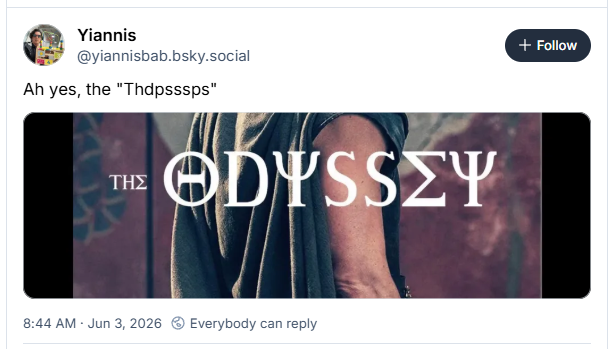
TIS THDPSSSSPS
Is this how we talk to kitties now? No pspspsps; now it’s Thdpsssps
OP needs to clean out their ears with φτιρς.
Instructions unclear, the woman at the pharmacy called security when I started inquiring about their phtirs to clean my ears while angrily swatting every box of qtips she handed me.
Just cross posted to grssk
It’s “tes” not “the”
Don’t forget the ‘TES.’
They missed an s in the middle - there are four.
Δεν βγάζει νόημα.
An epic that must be told quietly.