
Explanation: Just a rare bit of OC from me! Was thinking about food as I ate dinner today (how recursive!) and decided to make this!
All polities and cultures have different challenges and desires according to their environments and goals. Culinary challenges no less than others! How we eat is also often a reflection of how we live - or how we’re trying to live.
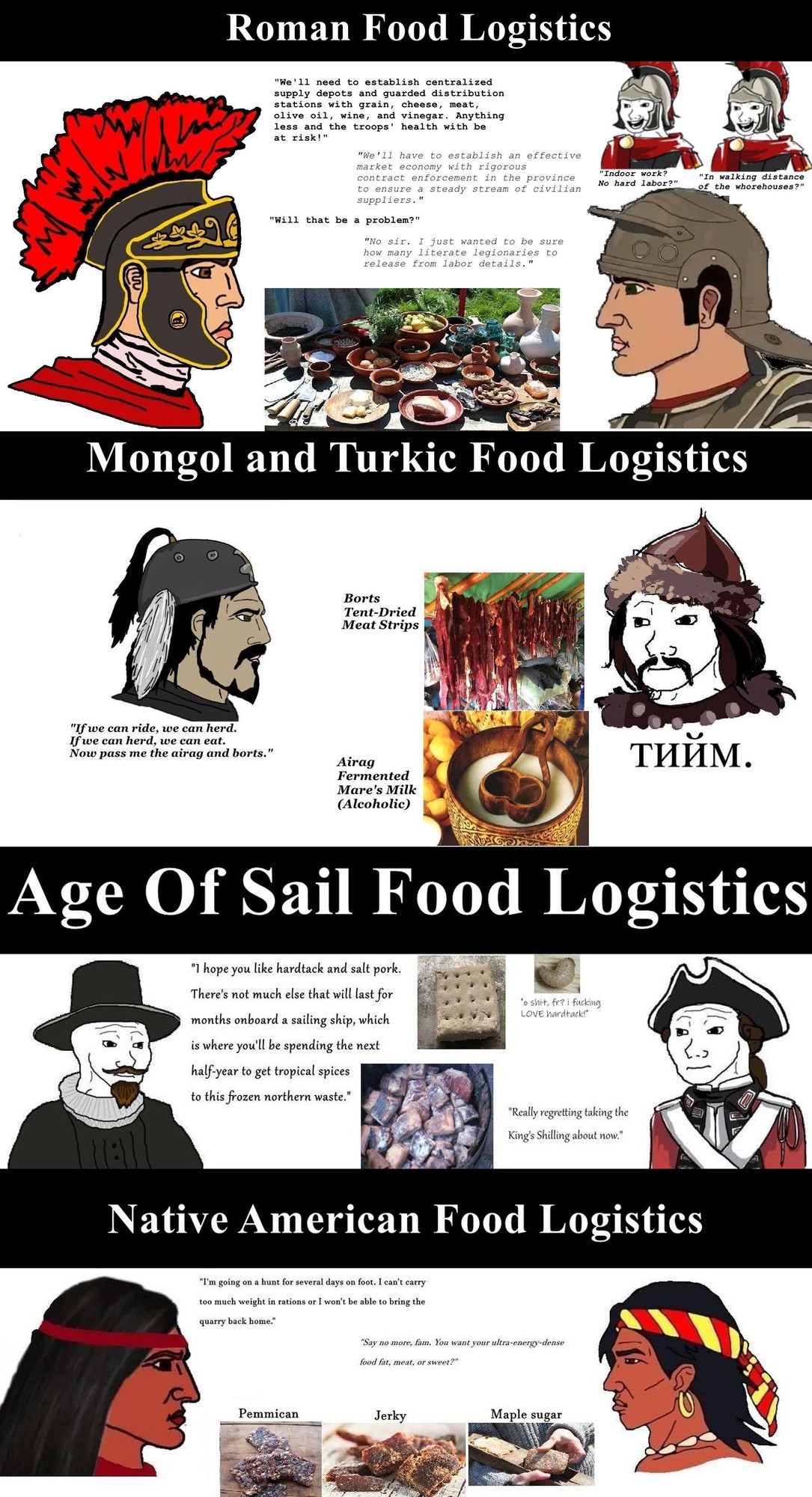
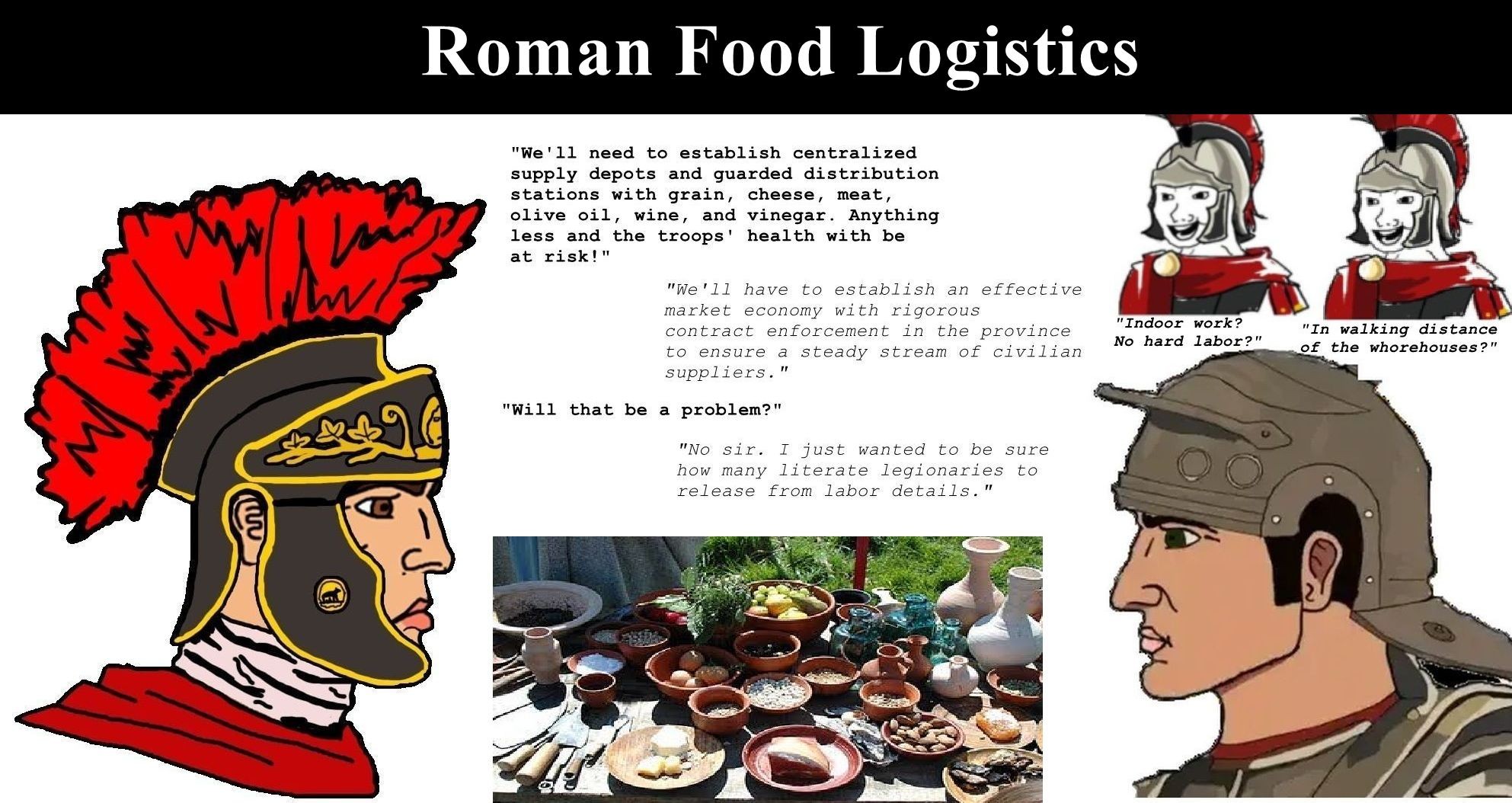
The Roman Empire had a robust logistics system for its famed Legions (and less-famed but no-less-important auxiliaries) wherein centralized supply depots were manned and kept filled so that food could be rapidly distributed to smaller distribution hubs along marching routes, or established in the wake of a legion’s advance to provide reliable supply lines to get the legionaries their allotted rations. Diet was seen as key to health by the Romans, so the ‘generous’ variety was a touch self-serving by the polity - you want your soldiers in the best condition you can get them, for as long as you can keep them there! You may be marched to exhaustion, drilled like a machine, beaten like a dog, have your leave revoked because your centurion had a bad day, and tossed into a meat-grinder of a war… but a Roman soldier can always depend on the government moving heaven and earth to get two things to him - his pay, and his food! (And, of course, as in every pre-modern military system, ravaging the land for anything edible was also an option, at least in hostile territory)
This may seem natural or intuitive to us in the modern day, but that level of organization was deeply unusual for pre-modern polities. Alexander the Great conquered a good fifth of Eurasia playing logistics by ear. As late as the 17th century AD, European supply and rationing systems - and payment - for armies could be very ad hoc. The Romans, simply by saying “Let’s make this nice and orderly” actually gave themselves a massive advantage.
But for that matter, the system could not have survived simply as a ‘command economy’ - the Roman government was actually very small, with few expenses other than the military, and the general attitude was to prefer that low-cost system for administering the provinces. Without a large civilian bureaucracy to regulate production and movement (and thus prevent the government being ‘cheated’), organizing large-scale, regular seizures would have been an impossible task. The Roman military sometimes requisitioned foodstuffs, but more often made large purchases from local merchants. To have local merchants plentiful enough - and themselves supplied enough - to make such large exchanges, a robust market is needed - something provided both by the fussy and meticulous legalism (especially in contract law) of the Romans, and the constant presence of their Legions. As bad as the Legions could be to the locals, they also were very active in crushing banditry - welcome to the general population, but especially welcome to the local merchants!
Roman legionaries were often also detached when on garrison in the provinces to act as civil servants in temporary positions that didn’t rate attention from an imperial slave or freedman - a welcome reprieve from ditch-digging duty!
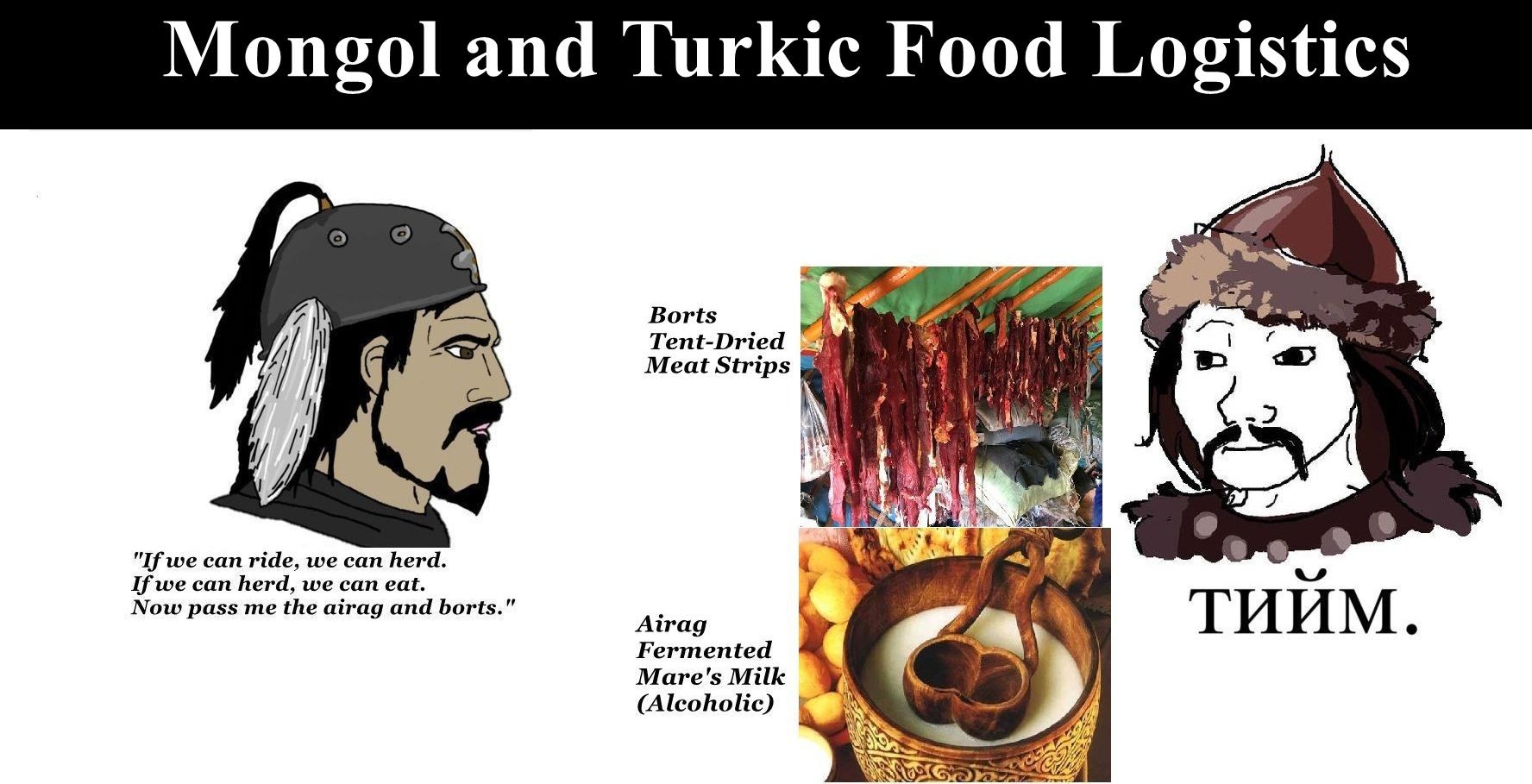
The Mongols and Turkic peoples, and to some degree horse-riding pastoralist nomads more generally, play the game of food logistics on easy mode - where they go, so too goes their food supply! Herds are split and combined as the local environment allows, and are moved almost as easily as (mounted) people! When your food supply literally marches with you, relocating or suddenly changing plans is a (relative) breeze. In particular, placing dried meat under their saddle in a bag, they could ‘tenderize’ an otherwise rather rough meal simply by doing their normal riding for the day. Work while you work!
The only question is deciding where to go… I hear there’s plenty of water and pasture for the herds just over the border, where all of those sedentary grass-eaters live…
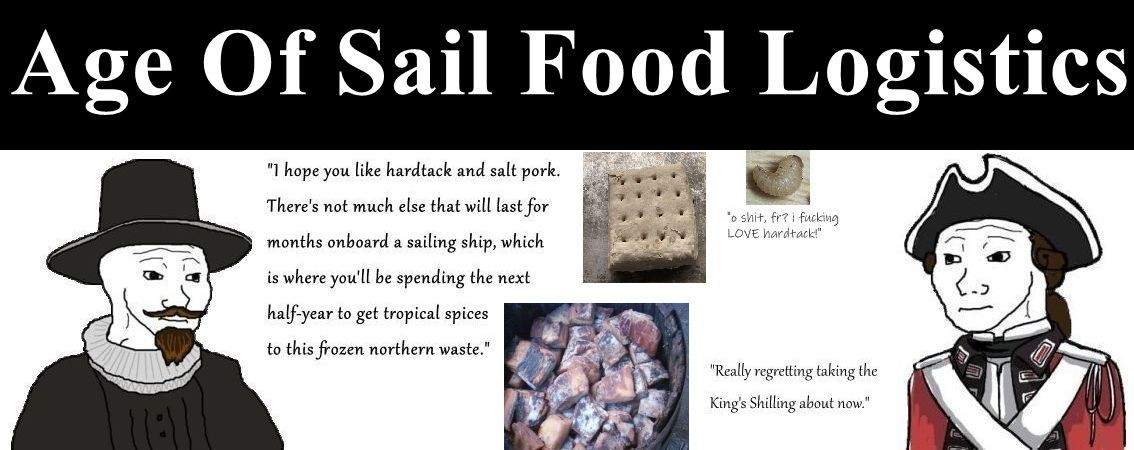
During the Age of Sail, the poor sods who gave the era its name got to ‘enjoy’ a uniquely terrible diet. Rather than poverty or local environment being the issue, it was that the Age of Sail introduced, for the first time, semi-safe oceanic travel… but that travel took literal-months without resupply, during which time the only real source of food and water was onboard the ship. Water is fairly non-negotiable in terms of storage and preservation… food, on the other hand, can get quite… ‘preserved’. Since these are largely impoverished and desperate men being fed, and by entities which are either strapped for cash (early modern states) or looking to maximize profit margins (early modern corporations), well…
The two most common foodstuffs were hardtack and salted pork (or corned beef). Salted pork was just pork that was soaked in salt… and then soaked again in a solution of salt and water. That’s a lot of fucking salt. Corned beef is similarly salted. Hardtack, on the other hand, is just a simple mixture of flour, water, and salt. Fortunately, it was discovered that with such simple ingredients, giving such a simple cracker a second trip in the oven once it’s cooled greatly increased its storage time, increased its resistance to insects and mold, and only slightly decreased its nutritional content. And baking it four times made it last even longer!
Unfortunately, even just baking it two times also makes it hard and tasteless to the point of being unpalatable. To top it off, a few insects can penetrate the hard exterior and hard interior of hardtack, namely burrowing types like worms and weevils, which added a little surprise ‘flavor’ to those ‘exciting’ long trips across the world’s oceans.
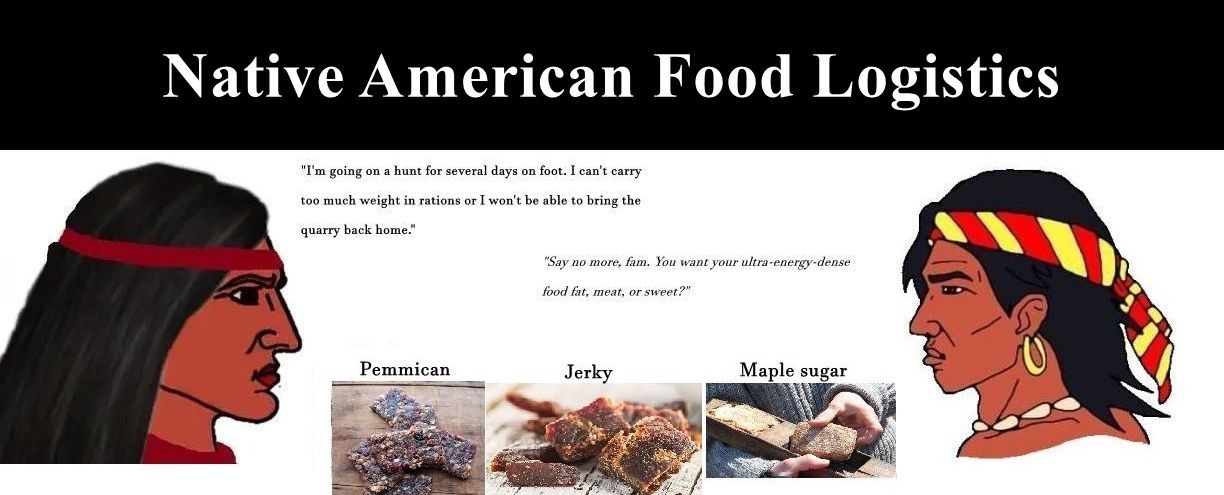
In the pre-Columbian Americas, large domesticated animals like horses and oxen were unavailable, and there aren’t many great inland seas to allow for safe and convenient shipping, which makes issues of weight all-important when considering journeys of any serious distance. Particularly for the indigenous societies which relied more on hunting than farming, this meant that food had to be calorie-dense and physically dense - you can’t just pack up a wagon with an extra box of hardtack if you’re going to be another week on the trail.
Maple sugar, modern-style jerky (albeit made from game or buffalo), and pemmican were all culinary innovations of various indigenous American cultures - the latter two foodstuffs being almost immediately recognized by later European travelers as peerless travel rations despite the… otherwise high level of cultural chauvinism expressed by many European explorers of the Americas. The technique of making jerky was eventually spread from tip-to-toe of the Americas, while pemmican and especially maple sugar were more regional.
Maple sugar might not sound like a ‘ration’ to our modern, calorie-counting ears, but as a calorie-dense food was highly useful to peoples whom often needed to make long and physically exhausting journeys carrying only minimal weight. Maple sugar was mixed with dried corn as a high-efficiency hunting ration. Just add water!
Also, if you preferred each segment separately:
This was so much reading about food logistics history. I love it
I would like to mention When Rivers Were Trails. It’s an Indigenous take on Oregon Trail that basically pokes fun at how European settlers made their journey across America overcomplicated and dangerous simply because they thought the “savages” were idiots and their culture and way of life were inferior to their own.
spoiler
The only way to die of dysentery in the game is to eat settler-colonial food and really the only source of danger over the entire game is from European settlers.
*PLEASE NOTE: Apparently there is now some weird casino-malware bullshit in the file. I had no issues or any knowledge of it when I played it on linux through steam though, just a heads up.
In the itch.io file?
I think so? Or maybe it was the file from the creators personal website… I wrote an essay on this game and that was something the prof brought up a bunch of times.
Explains this, I guess. That sucks.

yuck :(
I dled the PC file and pointed steam to the .exe, worked fine with that; going through proton at least.
Why would mongols use Cyrillic?
Retroactively invaded by Russians
American food logistics: C130 Hercules can ship a containerised Papa John’s to every remote atoll, and keep a steady supply of familiar ingredients piped into it. When the SHTF, this capability lends itself seamlessly to shipping tanks/missiles/whatever is required.
Pemmican, jerky, and maple sugar are just IRL Elvish waybread. And it is fucking delicious.
Ooh, old preserved food? Nice!! Let’s get this out on the tray