You must log in or register to comment.
I need some advice, regarding some other elements of God’s Laws and how to follow them.
- Leviticus 25:44 states that I may possess slaves, both male and female, provided they are purchased from neighbouring nations. A friend of mine claims that this applies to Mexicans, but not Canadians. Can you clarify? Why can’t I own Canadians?
- I would like to sell my daughter into slavery, as sanctioned in Exodus 21:7. In this day and age, what do you think would be a fair price for her?
- I know that I am allowed no contact with a woman while she is in her period of Menstrual uncleanliness - Lev.15: 19-24. The problem is how do I tell? I have tried asking, but most women take offence.
- When I burn a bull on the altar as a sacrifice, I know it creates a pleasing odour for the Lord - Lev.1:9. The problem is my neighbours. They claim the odour is not pleasing to them. Should I smite them?
- I have a neighbour who insists on working on the Sabbath. Exodus 35:2 clearly states he should be put to death. Am I morally obligated to kill him myself, or should I ask the police to do it?
- A friend of mine feels that even though eating shellfish is an abomination, Lev. 11:10, it is a lesser abomination than homosexuality. I do not agree. Can you settle this? Are there ‘degrees’ of abomination?
- Lev. 21:20 states that I may not approach the altar of God if I have a defect in my sight. I must admit that I wear reading glasses. Does my vision have to be 20/20, or is there some wiggle-room here?
- Most of my male friends get their hair trimmed, including the hair around their temples, even though this is expressly forbidden by Lev. 19:27. How should they die?
- I know from Lev. 11:6-8 that touching the skin of a dead pig makes me unclean, but may I still play football if I wear gloves?
- My uncle has a farm. He violates Lev.19:19 by planting two different crops in the same field, as does his wife by wearing garments made of two diverse kinds of thread (cotton/polyester blend). He also tends to curse and blaspheme a lot. Is it really necessary that we go to all the trouble of getting the whole town together to stone them? Lev.24:10-16. Couldn’t we just burn them to death at a private family affair, like we do with people who sleep with their in-laws? (Lev. 20:14) I know you have studied these things extensively and thus enjoy considerable expertise in such matters, so I am confident you can help. Thank you again for reminding us that God’s word is eternal and unchanging.
lmao that’s hilarious. saved to my disk! yeah i think that religion is like … how do i say this, like you’re asking an antique person to build an electric vehicle for you … they have neither the tools nor the knowledge to do it properly. it’s quite bizarre to think that people refuse the progress of time, and especially the progress of society by clinging onto principles of the past.
You’re taking those passages too literally:
When God (in verse 45) said that slaves are ok to buy, he meant that people, all from the start, each have slaves within their hearts. Things that we have sold or boughtten that are forced to pick our “moral cotton.” God calls for us to set these free, free our hearts from slavery.
And as God goes on to explain the logistics of buying and selling slaves…
‘logistics of buying and selling slaves’? I need some advice, regarding some other elements of God’s Laws and how to follow them.
- Leviticus 25:44 states that I may possess slaves, both male and female, provided they are purchased from neighbouring nations. A friend of mine claims that this applies to Mexicans, but not Canadians. Can you clarify? Why can’t I own Canadians?
- I would like to sell my daughter into slavery, as sanctioned in Exodus 21:7. In this day and age, what do you think would be a fair price for her?
- I know that I am allowed no contact with a woman while she is in her period of Menstrual uncleanliness - Lev.15: 19-24. The problem is how do I tell? I have tried asking, but most women take offence.
- When I burn a bull on the altar as a sacrifice, I know it creates a pleasing odour for the Lord - Lev.1:9. The problem is my neighbours. They claim the odour is not pleasing to them. Should I smite them?
- I have a neighbour who insists on working on the Sabbath. Exodus 35:2 clearly states he should be put to death. Am I morally obligated to kill him myself, or should I ask the police to do it?
- A friend of mine feels that even though eating shellfish is an abomination, Lev. 11:10, it is a lesser abomination than homosexuality. I do not agree. Can you settle this? Are there ‘degrees’ of abomination?
- Lev. 21:20 states that I may not approach the altar of God if I have a defect in my sight. I must admit that I wear reading glasses. Does my vision have to be 20/20, or is there some wiggle-room here?
- Most of my male friends get their hair trimmed, including the hair around their temples, even though this is expressly forbidden by Lev. 19:27. How should they die?
- I know from Lev. 11:6-8 that touching the skin of a dead pig makes me unclean, but may I still play football if I wear gloves?
- My uncle has a farm. He violates Lev.19:19 by planting two different crops in the same field, as does his wife by wearing garments made of two diverse kinds of thread (cotton/polyester blend). He also tends to curse and blaspheme a lot. Is it really necessary that we go to all the trouble of getting the whole town together to stone them? Lev.24:10-16. Couldn’t we just burn them to death at a private family affair, like we do with people who sleep with their in-laws? (Lev. 20:14) I know you have studied these things extensively and thus enjoy considerable expertise in such matters, so I am confident you can help. Thank you again for reminding us that God’s word is eternal and unchanging.
I feel like people somehow missed the extremely obvious satire and I don’t understand how.
I think it’s a bit more complex than this.
I think, in religious households, instead of being taught to be a good caring person you are taught to be as selfish as possible while staying within the rules.
So it’s not that religious need eternal threat of damnation, it’s that they have been taught to be as selfish as possible.
So I don’t think they lack morality naturally but they have been taught to be horrible people who obey laws.
That’s a remarkably good point
It’s conspicuous how adept the religious are at mental gymnastics
I always thought that it was because were looking for ways to justify their shitty behaviour, it never occurred to me that that was a taught thing
That makes it so much worse…
So I don’t think they lack morality naturally but they have been taught to be horrible people who obey laws.
it would be interesting to do an A/B testing study where one takes the people who would typically grow up in a religious household and places them in a household completely without religious indoctrination, and see whether they turn out better or worse.
i mean, there’s lots of correlation studies that already prove that “christians” in the US are shitheads. and that people who don’t identify as christians are typically morally superior in basically any metric. the question is: does that imply causation?
i.e. a possible mechanism is that the really worst people in society need religion to not be even worse people, i.e. you don’t see how bad it would get if there was no religion. that’s a possibility that has to be seriously considered. i’m honestly not sure what would be found out.
I think, in religious households, instead of being taught to be a good caring person you are taught to be as selfish as possible while staying within the rules.
They’re given absolution for their sins. It allows them to be cunts, and at the end of the week, Jesus washes away all their nasty actions.
Some of the worst people I’ve ever met in my life have been hardcore Jesus cultists. The kind that, when they say “god bless you”, it feels more like “go fuck yourself”.
That said, in high school (80s) I met a couple of Catholic girls and found they were more sexually open then some other girls. I remember one time we were going though a Kama Sutra book and I joked and said something like “Your God isn’t going to like this one.” and she laughed and said “that’s what confession is for”. I always remembered that.
I also swore to hang out with more Catholic girls.
That said, in high school (80s) I met a couple of Catholic girls and found they were more sexually open then some other girls.
yeah, that’s a really interesting observation, and i have made it too on numerous occasions (both when i was still a student, but it’s also a recurring theme in movies and such). i’m still not really sure what causes it.
the probably most straight-forward interpretation would be that christianity teaches the people to have lots of kids. well, to have lots of kids, you need lewd women. so maybe christianity actually causes it intentionally.
Looking back I figure it was simple rebellion from strict parents. These girls went to a private girls high school, wore the uniform, all that. After school they came and hung out with the alt punk kids. In all, I probably hooked up with 6 of them and knew of a few more. They were all hyper sexual. Lots of my “firsts” (threesome, anal, etc) were with those girls.
I can also add I dated a few Catholic women later in my mid-late 20s who also went to all girls schools. That rebellion, if they also had it in their teens, had subsided. None of those women were what I would call adventurous. No complaints, it was all fine and fun, but we weren’t trying to 69 in the car just to see if it could be done at a public park at midnight.
(Yes, it can be done. It’s not comfortable at all but worth trying for a laugh)
We’re atheists and have raised our son (almost 10) as such, but always answer any questions he has about religion, especially since he hears it in school. He has no qualms telling friends he doesn’t believe in God and one friend told him he was going to hell. This was essentially my statement for him to use in the future andI love that he has no fear expressing himself.
When my son was around 9-10 he came home from school one day and said “everyone on the bus believes in god but me”. To note, its a small bus he rides. I felt bad, was a bit upset this convo happened, but I guess its good. The conversation didnt sway him, and I did let him go to church even one time with his “big brother” from a program. He didnt want to go back. I was so conflicted what I would do if he wanted to. But thankfully, he’s just no interest in pretend people, and isnt afraid to speak his mind on the matter.
He was so excited one day last year to find out a friend of his was like us. I asked for clarification and he said he didn’t believe in God either.
Religious idiot wanting to sound smart. A classic.
It makes me feel nice to do good things and be nice to others. I usually go by that.
If in doubt, remember what Granny Weatherwax said:
'And sin, young man, is when you treat people as things. Including yourself. That’s what sin is.’
I have yet to find a counterexample.
That’s a good rule of thumb, but it runs into difficulty when you map it to the marco scale.
Whether we’re talking individual human capacity (Dunbar’s Number) or a question of public policy (for instance, in the Trolley Problem scenario) or even just common accounting and logistics principles, people become indistinguishable from things in significantly large numbers and anonymous contexts.
Bureaucracy has a de-humanizing effect on individuals. But bureaucracy is fundamental to administration of large populations. I don’t know how you square this circle without committing some degree of “sin”.
deleted by creator
I’m not sure I agree. A person doesn’t need to be in your Dunbar group to still be treated as a person, and bureaucracy doesn’t have to be dehumanizing; though I’ll grant that doing so is an easy trap to slide into. But you can plan for the needs and behaviors of large groups of people without treating them as anything less - just look at something like event planning!
In response to the trolley problem - It does get tricky with something like triage, where you have to evaluate who gets saved on the basis of their injuries. In this case, taking a cue from Weatherwax again, I think the key would be making sure that even those who don’t get saved still get treated humanely - pain relief, comfort, etc.
A person doesn’t need to be in your Dunbar group to still be treated as a person
Not incidentally, sure. But they need to be in your Dunbar group to be seen as a person.
As soon as “treating another person” carries a price, people charged with delivering treatment are going to start falling off of it.
bureaucracy doesn’t have to be dehumanizing
Again, not incidentally. But the impulse in a bureaucracy is towards expediency. You have a large volume of people to manage and a limited amount of time / manpower / resources. So you cut corners in order to mitigate shortfalls or appease overworked staff, because you don’t see the consequences of your actions or experience guilt over it.
I think the key would be making sure that even those who don’t get saved still get treated humanely
I don’t argue that this is the strictly moral path. But it ignores the biases, the capacities, and the temperaments of the people doing the triage. At some point you need people to do the things. And people routinely put their own comfort ahead of others’ health and well-being, because personal comfort is immediate and real while the experiences of others are remote and abstract.
It rings consistent with the Wiccan Rede (Do no harm) and the ethic of reciprocity, aka The Golden Rule.
Curiously this sheds light on the common sickness of the ultra-wealthy, who are surrounded by sycophantic courtiers who readily agree with their every word bur also want a taste of their sweet, sweet lucre. Inside weeks, they start seeing themselves as experts in everything, and everyone else as NPCs.
deleted by creator
I like what Ricky Gervais said about it. He asked Stephen Colbert if he believed in any of the other 3000 gods from human history. Stephen said he did not. Ricky told him that he just believes in one less than he does.
Ricky is GOAT.
I see someone struggling with something that might take a minute or two tops and help them.
Expanding on that I don’t think I’m a good person. I think the minimum people should do is help others if it’s no real skin off your nose.
Good people are the people who volunteer, the pekple who do good for the sake of it and spend meaningful amounts of time helping others.
Most people don’t, religious or not.
Laziness is a myth.
We saw it play out during the COVID-19 epidemic and lockdown. Furloughed folks were stuck inside and went mad for something to do. A lot of people started hobbies. Some of those were lucrative enough to fuel the Great Resignation. We even got a taste of class consciousness.
Depressed people can lay on a couch all day and binge-watch The Sopranos all day for weeks. I once lay in bed for nine months. It wasn’t laziness. It was literal insanity.
Healthy able-bodied people who aren’t working a 40-hour-plus-commute day job look for ways to help. (Of note, people who work that much are too exhausted to parent or be civically engaged.) But in the US we’ve been conditioned since the Calvinists to believe if we’re not breaking our back then we’re lazy.
If you’re not doing the good work you want, consider your circumstances. I mean here in the States, most of us are overworked and going into debt just for food. In straits like this, it’s a moral achievement just to show kindness to your neighbor.
How do the gullible decide which parts of their faith count and which don’t?
JK lol they just do as their told.
My told?
How can we know bad a good thing without someone who is guiding us? Would someone who has a slave think slavery is bad? It’s normal for them because they saw it every day.
i’m not sure whether this is a serious question.
How can we know bad a good thing without someone who is guiding us?
modern theology is almost always based on universal principles, i.e. insights that apply everywhere, at any time. in western literature since aristoteles, these have mainly been identified to fall into three categories:
- mathematics
- physics
- biology / chemistry
(or in the medieval ages, they were called “theology” / “law studies” / “medicine”, but these topics have been abstracted a whole lot since then.)
to your specific question: slavery is bad because it contradicts the self-determination of the person who is able to think for themselves. modern views (e.g. calvinism claim that every human is physiologically able to make their own decisions wisely enough; therefore they should also get the practical possibility to decide things for themselves).
this is not “somebody” guiding us; it is some ideas guiding us. there’s a crucial difference there.
Who decides universal principles? It’s like putting humans in a town which doesn’t have any human and they know there, they won’t know anything. Even a language, ethics etc.
And, thanks for the answer.
universal principles are figured out by postulating random conjectures, then travelling around and check whether they hold in practice. they are considered universal if they hold everywhere, not just in your personal environment.
Always these people
probably mostly because of Greek philosophers
A lot has been written over the ages about the nature of goodness. The Greeks weren’t the first, nor were they the last.
Ideas such as natural law have been attested in the ancient Egyptian Instruction of Amenemope for instance. On the other hand, in European thought, Thomas Aquinas was a highly influential figure, as well as Bentham and Kant.
And then, of course, there’s the whole rest of the world.
that was such an interesting read, thank you for that!
i mean, have you considered the possibility that you know intuitively what is “right” and what is “wrong” because it has been enshrined into you by 2000 years of religion?
What if it has been enshrined into us by hundreds of thousands of years of evolution because altruism is a trait that increases the survival chances of a social species?
i’m happy to hear that it works for you to follow purely your own instincts, but if you consider the typical person in for example the US today, there’s a 99.9% chance that’s not gonna work.
point is, lots of stuff are “right” because they’re socially told, even if you don’t call it religion, it’s still transported as “common mode of operation”. that’s what i meant.
That’s a pretty pessimistic view!
In my experience, most people have a pretty good feel for what’s right and wrong, it seems to be a basic function of empathy. There is a small percentage who lack this understanding, but more often it seems to me like it’s people who have been twisted one way or another that are the issue. They’ve been taught to value things over people, or that power is the only path to acceptance, or something else equally twisty.
Totally, when I stoned my ex wife to death for adultery I didn’t even realize it was in Leviticus.
2000 years? Religion has been around longer than that. Is it just Christianity that has “enshrined morality” into the cultures that practice it?
If you ask me to compare a country that was historically mostly Christian, like the US, against a country that was historically mostly Buddhist, like Japan, it seems to me that Japan is ahead on a lot of metrics. Compared to Americans, Japanese people pollute less, have a lower crime rate, a less militaristic foreign policy, hell, they don’t even litter.
So what, are all religions simultaneously true, despite contradicting each other left and right? If I get a society to start worshipping the Flying Spaghetti Monster, is that going to eventually “enshrine morality” in that society, even among nonbelievers? Or is it just your particular religion that’s correct, and the fact that morality doesn’t actually correlate with societies practicing it is just a glaring hole in your argument?
all good points. by “2000 years” i didn’t mean exactly 2000 years. can also be more or less of course.
and yeah, i like the japanese views a lot too, they do a whole lot of things better than us.
My points lead to the conclusion that religion does not instill society with morality.
It’s cute that you think a Jewish stick-zombie is the prevalent religious influence in the world
It says a lot about how little you know, and how worthy your opinion is
!it’s not worth a Donald Trump promise!<
Ironically, biblical morality is absolutely fucked in the head.
Killing women because they didn’t scream while they were raped (probably because the uncle or father or brother raping them was either choking them out or holding a knife to their throat or something worse.)
Killing infants and unborn children because someone 3 generations ago did a thing.
Stoning teenagers for being, you know, teenagers.
It really is a good thing morality doesn’t come from god.
Sending bears after teenagers because they called you bald once is crazy Elisha.
It’s possibly because they told him to go up the hill where people worshipped other gods, the sinnest of all sins
Yeah, but you’re forgetting a really important detail. These teenagers were like, really annoying.
Yup.
In the scope of things that’s fairly mild. I mean god once decided to bio-cide the entire planet. (or so we’re told, heh.) And that was because some angels game down and got it on with human women… who probably didn’t really have a choice…
The great flood? That was a nephilim thing?
Yeah. I mean it’s not the most explicit justification given, per se, but like here’s gen 6, where god decided to, you know, off everything except Noah:
6 1When people began to multiply on the face of the ground, and daughters were born to them, ^2 ^the sons of God saw that they were fair, and they took wives for themselves of all that they chose. 3 Then the Lordsaid, “My spirit shall not abide in mortals forever, for they are flesh; their days shall be one hundred twenty years.” 4 The Nephilim were on the earth in those days—and also afterward—when the sons of God went in to the daughters of humans, who bore children to them. These were the heroes that were of old, warriors of renown.
5 The Lord saw that the wickedness of humans was great in the earth and that every inclination of the thoughts of their hearts was only evil continually. 6And the Lord was sorry that he had made humans on the earth, and it grieved him to his heart. 7So the Lord said, “I will blot out from the earth the humans I have created—people together with animals and creeping things and birds of the air—for I am sorry that I have made them.” 8But Noah found favor in the sight of the Lord.
Chapter 5, is largely a list of men following the line of Adam through to Noah. Then chapter six kicks off with that little gem, so it certainly seems to be that the think that god found wicked is his children boinking his playthings. (Early on, they were monolatristic, believing in other gods but worshipping only one to exclusion. As they became monotheistic, the sons of god were now angels, not lesser gods.)
(Fun fact. The word used for the ark, just means “box”. Noah didn’t even build a boat. He built a box.)
The best part is when God goes " see that guy over there, he believes so much in me, i will torment him beyond reason to proof his dedication to me"
There are so many of these terrible examples of god being this huge asshole. When i read the bible in my early teens, it was reading the bible that ‘made me an atheist’. Seeing that people took this asshole god serious.
Over the years i did get to learn more about Jesus, he is the proto-hippy about sharing love and kindness. But somehow, very few christians follow up on his words and teachings. Christians actively chosing to be assholes when they have Jesus as a deity in their mythological fanfinction. It boggles the mind.
Most gods are huge assholes, though.
I think my favorite morality-thing to bring up is Song of Solomon.
Especially when people get on about purity culture. It’s Bronze Age porn.
I mean, yeah. god is a raging asshole, but that one usually gets more entertaining reactions.
Yup, I don’t believe in God, if he is real, I wouldn’t want to follow him anyways…
A screenshot of a comment I made a while back. Link to original comment

oh I’m well aware of how awful the story is. Basically the entire point was to flex how powerful ‘god’ was.
I often use it as my answer to “you just hate god” because agreeing with that statement (with a good reason as to why) is more fun than denying it entirely
Not to mention the whole Exodus problem
The pharaoh was bad guy at first but then became a victim of Adonaiyahwehjehovahbob’s torture
(I didn’t mean to comment twice)
I mean, if you believe their stories, god told the first lie. so why would you believe his divinely inspired horror novel when it says someone is the bad guy?
(good news- the exodus never happened. you’d think that rivers turning to blood would be something somebody in egypt would have mentioned/written down. Or the frogs. or the locusts or the whole slew of dead first born sons.)
Not to get into a debate, but someone did write about (something that could reasonably be) it, potential motivated reasoning by the source aside. Sources from that far into the past (or even the relatively closer past) very rarely survive to the present day, especially literary sources (which tend to be written on papyrus that rots away), and even historians of relatively well-attested periods like Rome and Classical Greece basically have a few texts they rely on*, supplemented with archeology, epigraphy (inscriptions on stone) and straight up magic, and that’s a thousand years
before(edit: after) the period in which the Exodus is taken to have happened without the advantage of Medieval monks painstakingly preserving the material. Now the Egyptian corpus is uncommonly big (yay for the Sahara), but it’s also very fragmented. For the most part what we don’t and can’t know is orders of magnitude more than what we can know, and it’s not even like we’ve studied the whole Egyptian corpus (we haven’t; there’s a shortage of trained Egyptologists able to do that work), so it’s very plausible that an event of even that magnitude would just… not show up in a way we can recognize. So what I want to say is: Truth of the Exodus aside, our sources for ancient history are nowhere near that comprehensive. Three thousand years is a long time.*For example Roman military history basically entirely relies on two guys (Livy and Polybius), whose works very frustratingly only survive in part, supplemented by some less reliable sources and fragments. When talking about Alexander the Great it’s basically just Arrian, again supplemented by less reliable/comprehensive sources and fragments. And it can get worse; we get straight up nothing in the way of literature from Carthage. There’s a lot of dumb luck involved in what does and does not survive.
Nope. not really.
it’s an apologist website, and while that in of itself is not something to suddenly dismiss out of hand, it is something to take a skeptical approach towards. for example, there’s more than a few red flags in how they talk about things.
For example, when they’re talking about the discovery of the Tomb of Sobeknakht II, they’re grossly misrepresenting things. They describe an attack that led to the complete occupation- at least, for a time- of Egypt.
Except that the inscription in the tomb they’re talking about, claims that Sobeknakht was successful in his defense at Elkab. At the time Sobeknakht was alive, ‘Egypt’ wasn’t even one kingdom. it was split between the Thebans (Who Sobeknakht led) and the Hyksos to the north. this attack was was in, at the latest 1550 bce (Sobeknahkt II was ruling somewhere in the sixteenth and seventh dynasties.)
it’s this kind of gross- and lets be honest, probably intentional- misrepresentation to conflate that with the Kush Empire’s conquest of Egypt in 700-500 bce. there’s 850 years gap- at the most generous- along with multiple kingdoms and dynastic succession separating the events of Sobeknahkt and the conquest of the kushites in 700ish. Even to suggest that behavior in one case would be the way that Egyptians of another time and another place behaved elsewhere.
And that suggestion would in fact be somewhat wrong. we do have things in the archeological record that show Egyptians suffered defeat. We even have things in the historical record where they’re talking about those defeats and what happened how to keep them from happening again- including, as an example, the adoption of certain kinds of composite bows, the adoption of chariots were brought to Egypt by the Hyksos (asiatic peoples, less a race and more a class of people- that is the “foreign rulers”.)
I have to assume this was an intentional lie, given that it took all of five minutes for me to find whose tomb they were talking about and that they were talking about a military invasion a thousand years later as if Sobeknakht would be there. You’ll notice my opinion of apologists are rather low- this kind of lie is common, and either they’re to ignorant not to believe it or it’s intentional.
which brings us to the next thing.
The argument is “Well, just because we don’t have evidence, doesn’t mean there wasn’t evidence we just haven’t found yet.” The question that needs to be asked is should we find evidence? The historical record we have that mostly survives comes from monuments and inscriptions. things on tombs and such like (like the inscription on Sobeknakht’s tomb) lauding their accomplishments and victories. One certainly does not generally put shameful things on such tombs or monuments.
So no, we wouldn’t really expect to see much in the way of historical records. that is to say, we wouldn’t expect to find much in the way of writings- histories- on the defeats. Not by the Egyptians, anyway. any writings, as you note, would have fallen away and moldered into nothing, etc. But we would expect to find things in the archaeological record. That is- in the artifacts left behind. Things like the trash heaps that have pork bones in them- or no pork bones- or the kinds of weapons, tools, and armor, the vehicles, the remains of humans themselves, the fossil record. all that kind of stuff.
And, if those stories are true and accurate, we would expect to find evidence of those stories being true in the archaelogical record. For Manetho’s story, that would have included Avaris, which has been excavated extensively, finding evidence of the lepers and corrupted people and such like. For example, the wall that Manetho says Osareph ordered built. Avaris had a wall. It was built by the Hyksos in the 1600’s and served as their capital city; where as Osareph and Amenophis were probably in the mid 1400’s. or later.
Neither do we have any evidence at all that the 80,000 were forced to work in stone quarries, nor that they moved to Avaris, and subsequently got crushed by a force 300,000 strong, nor did Amenophis (possibly Amenhotep II or Akhenaten) have major campaigns that saw them removed from their own lands and hiding with nubians to the south. Which is ludicrious to imagine that the Kush would have harbored them. the Kush and the Egyptians did not get along particularly well. (that is to say, they absolutely hated each other.)
As you can see, we have the same reasons for discounting the Exodus narrative, as well. Most scholars believe that the two narratives are separate legendary accounts. It’s absolutely ludicrous that you would expect us to believe that 2-3 million Israelites somehow managed to live in the nile delta (where the population at the time is also estimated to number 2-3 million…) without leaving so much as a trace.
I want to note at the outset that I’m not necessarily trying to convince you that the Exodus happened. I mean I believe it did, but the part about the weakness of ancient sources was what I actually wanted to say here. That said, since you responded along these lines I might as well, so instead my argument is that Exodus is a plausible interpretation of the available evidence. Also for clarity’s sake I’ll be working off the Islamic narrative, which differs from the Biblical one but not by much (mainly the lack of outlandish numbers, or indeed any numbers at all).
You’ll notice my opinion of apologists are rather low- this kind of lie is common, and either they’re to ignorant not to believe it or it’s intentional.
They didn’t strike me as the most trustworthy, but still: The text says the things they say it says (CTRL+F “Jew”), which is what I wanted to get at with that link. That’s one way we might expect the Exodus to appear in a native Egyptian secondary source.
Things like the trash heaps that have pork bones in them- or no pork bones- or the kinds of weapons, tools, and armor, the vehicles, the remains of humans themselves, the fossil record. all that kind of stuff.
The ban on pork postdates the Exodus, and I’m not sure how you want the other stuff to be distinguishable from the stuff locals leave behind (assuming it survives, which weapons and armor at least almost certainly won’t).
It was built by the Hyksos in the 1600’s and served as their capital city; where as Osareph and Amenophis were probably in the mid 1400’s.
Cities outgrowing their walls isn’t exactly unheard of, but more importantly I think we ought to forgive the guy on stuff like that given that he’s writing more than a thousand years later. The narrative is bound to get a little (or very) jumbled up.
Neither do we have any evidence at all that the 80,000 were forced to work in stone quarries…
With the obvious caveat that we can’t trust the numbers here, what kind of evidence are you expecting? Slaves are notoriously archaeologically invisible.
Which is ludicrious to imagine that the Kush would have harbored them. the Kush and the Egyptians did not get along particularly well. (that is to say, they absolutely hated each other.)
I mean, while it’s possible that Manetho or his sources are confused or lying (in particular it sounds like something the Kushite pharoahs would want on the books), and while this isn’t necessary for my point, Nubia isn’t fully unified in this time period, so it’s plausible that the Egyptian pharaoh had an ally or similar in the region.
It’s absolutely ludicrous that you would expect us to believe that 2-3 million Israelites somehow managed to live in the nile delta (where the population at the time is also estimated to number 2-3 million…) without leaving so much as a trace.
And here’s where I play the Muslim card, because yeah that’s right, and in any case they’d have starved on the way.
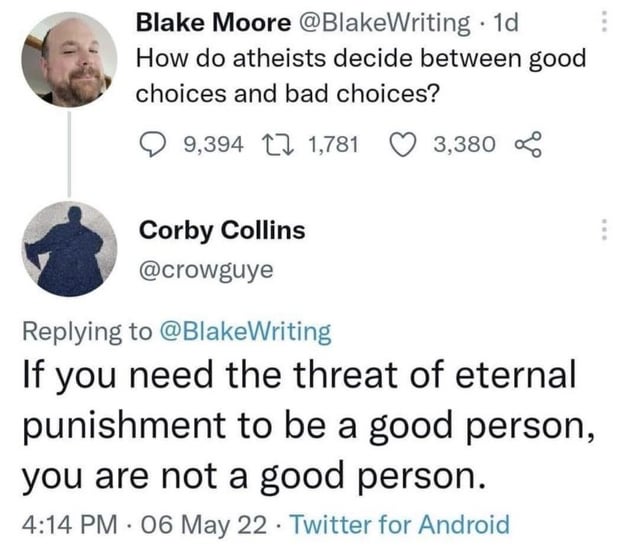
It’s much easier to be a good person when you aren’t indoctrinated from birth with some book of ancient myths telling you who to hate.