

cross-posted from: https://lemmy.sdf.org/post/58032842
Following the 10th anniversary of the South China Sea tribunal ruling [there is one] aspect of the ruling deserves attention: By failing to safeguard the marine environment of the South China Sea, China violated its obligations under the United Nations Convention on the Law of the Sea (UNCLOS). This legacy of environmental degradation should inform assessments of whether China is prepared to serve as a responsible leader in similar institutions, as it gradually positions itself at the forefront of another landmark treaty under UNCLOS.
he Agreement on Biodiversity Beyond National Jurisdiction (BBNJ), also known as the High Seas Treaty. entered into force globally on January 17, 2026.
[…]
In 2016, the tribunal concluded that China had failed “to protect and preserve the marine environment” of the South China Sea by constructing artificial islands and failing to prevent Chinese fishers from harvesting endangered and vulnerable marine species. In doing so, Beijing violated its obligations under Articles 192 and 194 of UNCLOS.
[…]
The tribunal’s first major environmental finding centered on China’s island-building activities. Through dredging and land filling, China had irreparably damaged approximately 3,170 acres of coral reefs by 2016. These processes involve cutter suction dredgers slicing through reef structures before pumping accumulated sediment via floating pipelines to create artificial islands. Entire reef ecosystems are effectively buried beneath the reclaimed land, and leftover sediment can float toward surrounding areas, killing other marine life.
Although China’s large-scale island-building campaign appeared to conclude around 2017, satellite imagery revealed dredging at Antelope Reef in the Paracel Islands beginning in October 2025. Measuring roughly 1,500 acres, the project is on pace to become China’s largest artificial island in the South China Sea. As a result, the estimated coral reef destruction caused by China’s island-building activities has now risen to approximately 6,224 acres—about half the size of Manhattan in New York City.
[…]
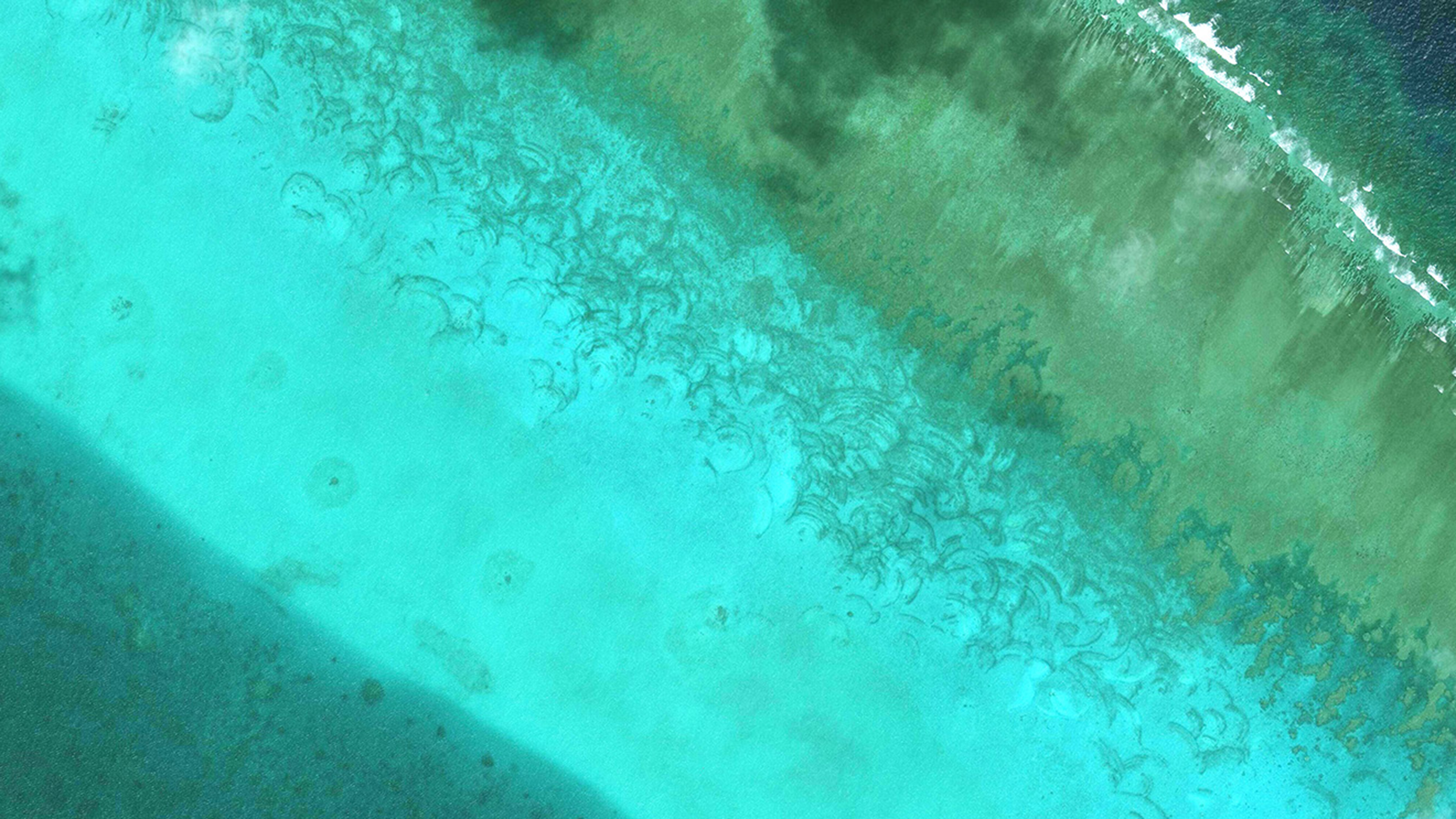
The tribunal’s second environmental finding concerned harmful fishing practices carried out by Chinese fishers. Giant clam harvesting was deemed “especially problematic” because of clams’ vital role in maintaining reef ecosystems and the destructive method used to extract them. Fishers drag specially designed brass propellers across coral reefs in semicircular patterns to expose buried clams, leaving behind distinct arc-shaped scars documented through satellite imagery. Despite supposed protection by the Convention on International Trade in Endangered Species of Wild Fauna and Flora from exploitation and illegal trade, the giant clam’s classification changed from “vulnerable” to “critically endangered” in 2024.
[…]
China’s island-building and giant clam harvesting activities have destroyed an estimated 22,759 acres of coral reef across the South China Sea.
[…]
China[…] has shown that it does not consistently follow established conventions under international law, ultimately weakens the principles of the BBNJ and global ocean governance as a whole.
[…]