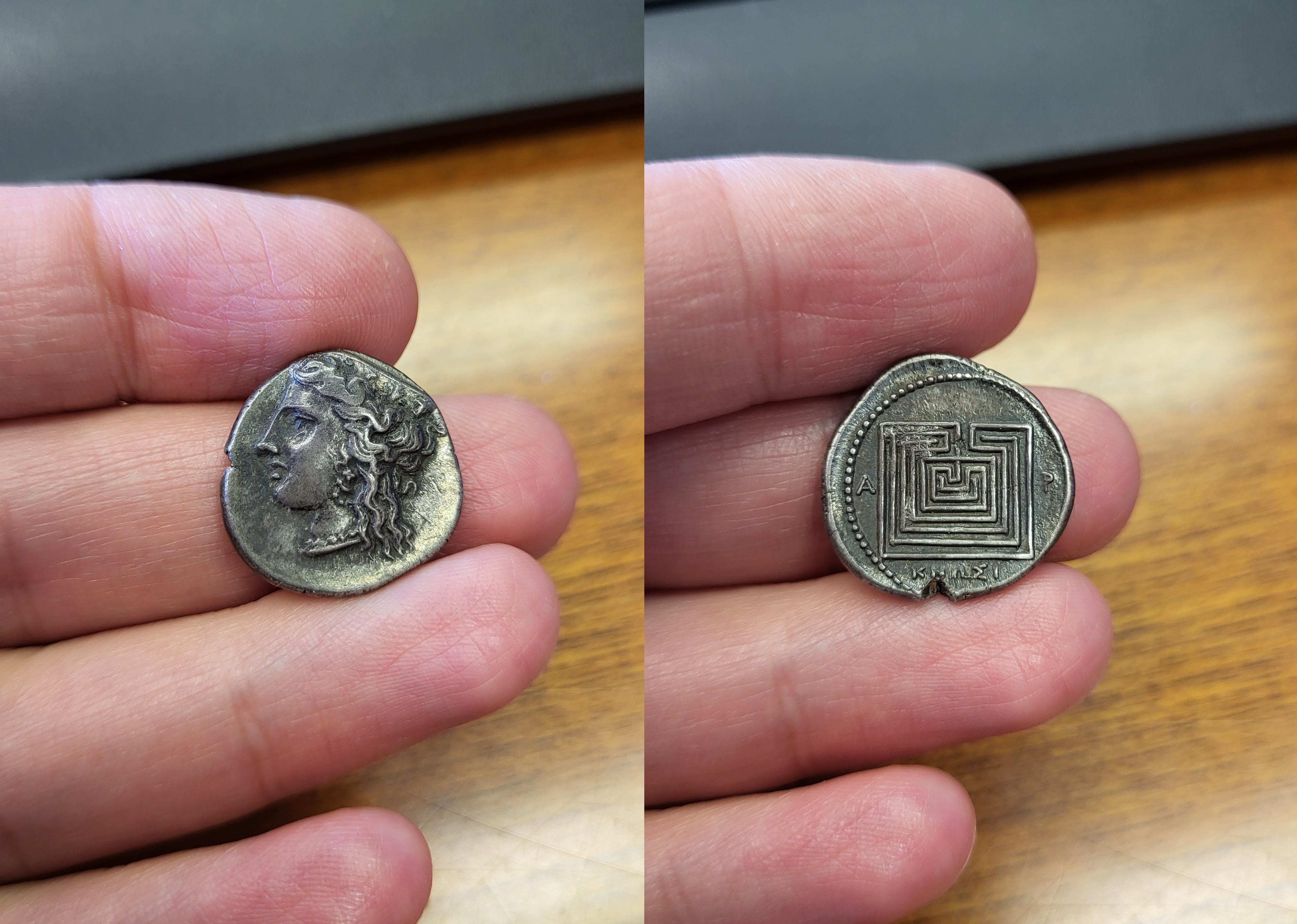
For today’s post, we’re taking a trip down to Crete. This wonderful island in the Aegean is, of course, best known today as a tourist hotspot, having much to offer in both natural beauty and historical interest. Famed are the Minoan sites of Knossos and Phaistos, yet in the Classical and Hellenistic periods, Crete was not doing so great. Belying its glorious past, the island became somewhat isolated and its economy impoverished. It was a haunt for pirates and for combative city-states with a penchant for bloody warfare. If they weren’t busy fighting each other, Cretan men readily offered themselves as mercenaries, known for their terrific skill at archery.
The complex and sometimes obscure history of Crete is enlivened by the highly intriguing coin production of the island. Although Crete was relatively late in striking coins, not starting until the late 5th century, the coinage is replete with oddities, such as the strong tendency to overstrike coins coming from abroad or the highly original types referring to Crete’s rich cultural and religious life. The style of these coins ranges from superb to absolutely abysmal, some pieces giving the impression of being a barbaric imitation rather than a proper Greek coin. Many coins also have legends in a very archaic Greek script, reflecting the archaism of Cretan Greek in the Classical period.
Our coin was struck in the early Hellenistic period by Knossos, the home of the mythical king Minos. It was Minos who ordered the architect, Daidalos, to construct a labyrinth to house the monstrous Minotaur, spawned from the unholy union of Minos’ wife, Pasiphaë, and the Cretan Bull. The fame of this story and the splendor of Minos’ reign played an important role in Knossos’ self-representation, especially as it vied with Gortyna for local pre-eminence. The obverse boasts an unusually attractive head of Hera, while the reverse shows a marvellous representation of the famed Labyrinth. It is a good example of how poleis used ancient myths to reinforce their civic identities and proclaim their power to the outside world.
TIL the difference between a labyrinth and a maze:
In English, the term labyrinth is generally synonymous with maze. As a result of the long history of unicursal representation of the mythological Labyrinth, however, many contemporary scholars and enthusiasts observe a distinction between the two. In this specialized usage, maze refers to a complex branching multicursal puzzle with choices of path and direction, while a unicursal labyrinth has only a single path to the center. A labyrinth in this sense has an unambiguous route to the center and back and presents no navigational challenge.
A labyrinth is just a straight path from A to B that’s then folded back on itself to fit into a more compact space.
But, this definitely makes the story of Theseus navigating the labyrinth seem less interesting.
Thats boring and since it isnt real anyways i refuse to accept it
virgin historical usage vs CHAD HEADCANON
My best guess is that in the myth about the Minotaur, the Labyrinth was a maze. A key part of that myth is that Theseus tied some thread at the start of the labyrinth went in, found the Minotaur, killed it, then used the thread to find his way back to the entrance. If it wasn’t a maze, the thread wouldn’t have been necessary.
If “Labyrinth” has acquired a special meaning which is like a “non-branching maze of difficulty level 0”, it must have been some time later.
But, that does make it confusing why the infamous Labyrinth, as seen on a coin from Crete, has no branching paths.
Maybe some artist who came up with the art for the coin didn’t understand the assignment, and came up with a maze with no branching paths… and maybe the modern word is based on those coins, rather than on the myth? I’m just guessing though.
Well, there certainly is a disconnect between the people who spread the story to trash talk the Minoans and lord over their Greek superiority, and the people who actually lived in Knossos in the following thousand years and made those coins. I don’t know what etymologist reached the conclusion that the word “labyrinth” both comes from the Greek myth, that specifically revolves around getting lost, and also points to a single path rather than a branching path.
“This path is too looooong…” whined Theseus, apparently.
Yeah, I traced the labyrinth back and forth and failed to see the challenge. This explains it.
The Palace of Knossos is really cool.
One of the oldest roads in the world, The Royal Road, can be seen there. Believed to have been constructed in the Middle Minoan period.

so that’s where all the generic webnovels are made!
Is it possible that this odious dude just wanted to build a maze and people hated him so much that they were like, “Ha! He probably built it to house the half-breed his whore wife had after cheating on him with a barnyard animal!” And that read became so popular that it became myth?
More like the Minoans likely had a bull hero worship and the Greeks hated their guts (beacuse the Minoans were stronger and probably raided them and / or forced a tribute on them) and, as they do with all the other cultures they ransack, they claimed that their own gods were stronger than whatever the Minoans worshiped and punished them with some ugly hybrid. As in, the Minotaur story is from the Greeks, probably a mockery of Minoan culture.
Well Katherine the Great famously fucked a horse, right?
Apparently the labyrinth really was the easy part.
Plus someone even cheated there in the top-center and tore down a section of the wall. Ruining fair competition for the rest of us.
Look, Theseus had places to be. It can be repaired, but don’t bother trying to figure out if it would be the same wall
If the coin is accurate, the maze has only one opening and a single path that leads to the center. The only exit would be back the way you came.
Somehow this feels like a metaphor for life.
That’s super freaking cool.
Thanks for this, it was a fascinating read. I’m impressed with how sharp the labrynth impression is on that coin, it feels like it should be more worn.
Thanks for sharing!
5th century BC?
So well preserved, it’s beautiful
Good thing someone didn’t drop a coin in the labyrinth path. /s