


cross-posted from: https://lemmy.sdf.org/post/55394990
- China’s annual emissions have risen by 8.8 billion metric tons since 2000, accounting for roughly 62% of the entire global increase.
- China’s national emissions are now about 2.5 times higher than the U.S., even though its per capita emissions remain lower.
- Despite record solar and wind installations, China still burns more than half the world’s coal, and coal-fired power is rising again.
China’s per capita emissions remain below those of the United States. The U.S. and Europe have contributed more cumulative carbon dioxide to the atmosphere since the Industrial Revolution. China has installed more wind and solar capacity than any other country.
All of those statements are true.
[…]
But none of those facts erase the central point: China’s total carbon emissions have risen dramatically, and that rise has been the largest single contributor to the increase in global emissions this century.
[…]
China’s annual emissions are now roughly two and a half times those of the United States. That is not a minor difference. It makes China the world’s largest annual emitter by a wide margin.
The trend is even more important. According to the Statistical Review of World Energy, global annual carbon dioxide emissions have risen by about 14 billion metric tons this century. China’s annual emissions have risen by about 8.8 billion metric tons over that same period. That means China accounts for roughly 62% of the global increase.
[…]
The renewable energy point also needs nuance.
[…]
China is not yet replacing fossil fuels fast enough to prevent emissions growth […] It is building renewables, but it is also responsible for over 50% of the world’s coal consumption. It is electrifying transportation, but it is also expanding industrial output. It is adding clean energy, but total energy demand has grown so quickly that renewables have not been able to fully offset fossil fuel growth.
That is the key point. The emissions outcome depends not only on how much renewable energy a country installs, but also on how fast total energy demand grows.
[…]
Any serious climate discussion has to hold those facts at the same time.
If the question is cumulative responsibility, the U.S. and Europe carry a large burden. If the question is per capita emissions, the U.S. still looks bad. If the question is renewable deployment, China looks impressive.
But if the question is why annual global carbon dioxide emissions have risen so rapidly this century, China is the biggest part of the answer.
That is not a myth. It is what the data show.
https://ember-energy.org/countries-and-regions/china/
China decreases fossil fuels and builds more renewable than the rest of the world
That headline is literally a lie, preying on people who will see headlines and never read tge article to see the bizarre way they massage numbers to deceive.
China does not increase fossil fuels as your own link reads, amongst others,
China is also the world’s largest coal mine methane (CMM) emitter, accounting for 76% of global CMM emissions in 2023. Despite this, independent estimates suggest actual emissions may be higher than officially reported figures.
(But the headline is promising, unfortunately also highly misleading.)
I wrote in another thread already that China’s emissions rose this century from less then 4 billion tons to more than 13 billions.
What makes the situation worse is that emissions in China are set to rise: Even the Chinese Communist Party’s 15th five-year plan says that China’s goals for non-fossil energy additions would see China’s annual green energy additions fall by more than half compared to the 14th five-year plan. At the same time, fossil fuel energy consumption will increase by 8-10%.
Here you can see the countries and their contributions to climate change (hint: China, together with Russia, ranks among the worst).
I wonder how those other countries reached their climate change goals… Oh right, outsourcing dirty industry to China and India.
Weird.
China is behind also in its ‘fair share’ contribution. Such arguments are what China’s propaganda outlets spread all the time, but it is not true.
China is behind also in its ‘fair share’ contribution.
This is incorrect. The country responsible for half of global production should probably be producing half of all emissions. It’s not. So…
Such arguments are what China’s propaganda outlets spread all the time, but it is not true.
Ah yes, famously pro-China propaganda outlets like the BBC.
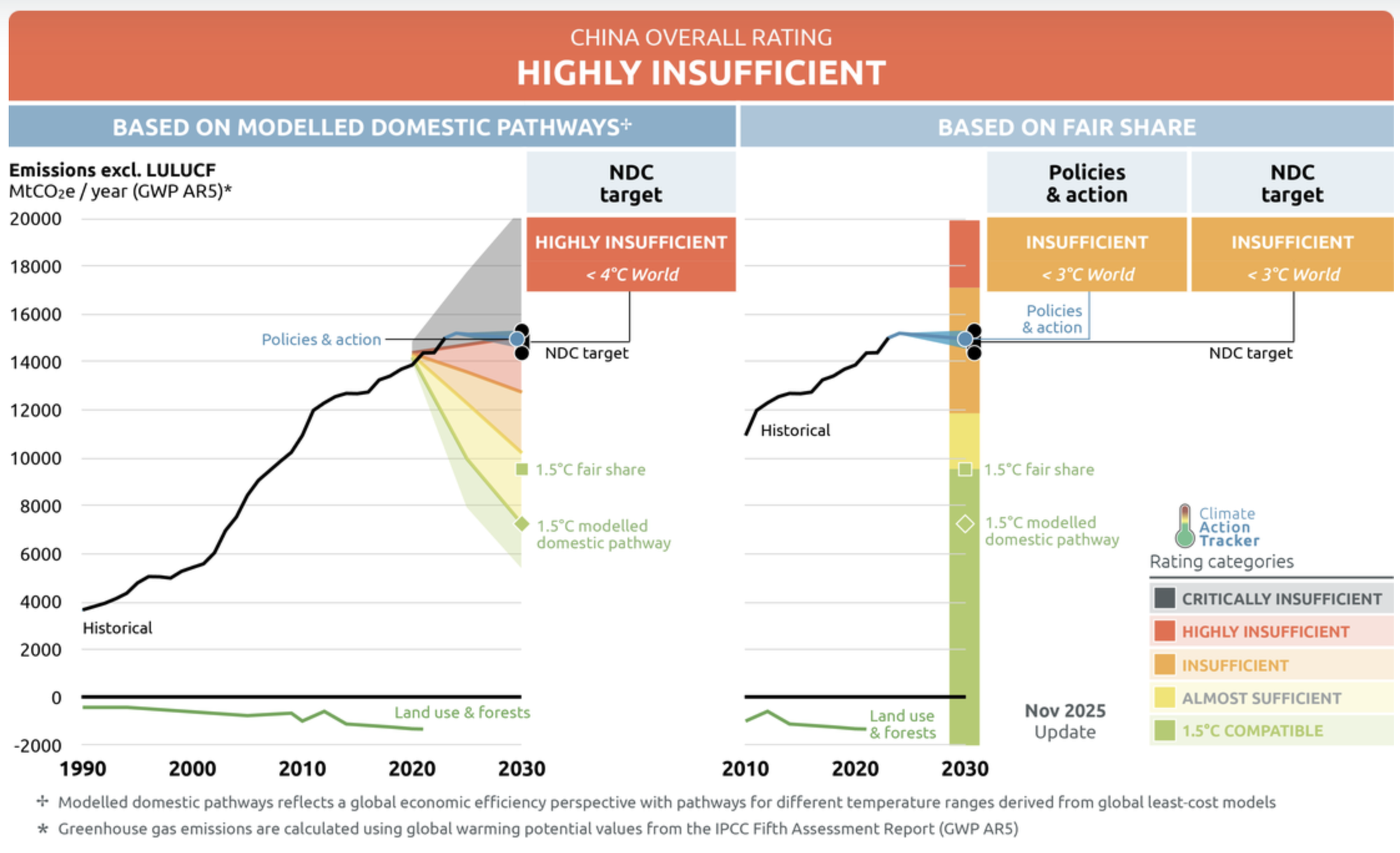
China’s emissions are rising, and are moving away from the IPCC calculated “fair share” of emissions. That doesnt negate the fact that they are driving the production of renewables, but they are not a climate hero either.
The country is also behind its fair share contribution. Even the Chinese government admits this.
It helps if you read the linked article instead of repeating always the same propaganda narratives. Such a conversation is waste of time.
Are you American? Like seriously you’re at their reading comprehension level.
The “Fair Share” contribution they’re behind is not literally their proportional fair share. It is the Fair Share agreed upon in the Paris Agreement, which was poorly calculated at the time and didn’t take into account just how fast China was able to improve living standards. That is what the evil Chinese Communist Satanist propaganda says they’re behind on.
It also didn’t take into account that companies would accelerate industry outsourcing to the point of crippling their home countries’ economies, or that the governments of those countries would help cripple said economy.
edit: Holy shit your entire account, your entire existence on Lemmy is anti-chinese propaganda. I knew the US was investing heavily lately into this shit but I really hope the paycheck is worth it.
Their name and way of speaking suggests they’re German.
Links please?
I provided the link already above, but here again.
Also, it’s easy to find the information from alternative sources.
Stop being weird with numbers by mixing absolute and relative percentages, rate of increase, percentages of vastely different quantities, etc. If you want people to take you seriously, you can say “China has this many GW of fossil fuels and this many GW non-fossil fuels. In 2030 they expect to have this”
The numbers and the way how they are presented are fine, there’s nothing weird.
It’s 15th five-year plan says that China’s goals for non-fossil energy additions would see the country’s annual green energy additions fall by more than half compared to the 14th five-year plan. At the same time, fossil fuel energy consumption will increase by 8-10%.
No, you are being intentionally deceptive by comparing it to how much it increased before instead of the actual numbers or numbers relative to total consumption, you are obscuring the fact that they are still increasing at a massive rate, reaching ~50% in 2030 while fossil fuel use will continue to increase slower than renewables; fossil fuel use peaking in absolute numbers in 2030.
If someone didn’t know better, they would think China was increasing their share of fossil fuels more than renewables, when the opposite is true.
You are simply wrong, and you don’t appear to read the articles.
The numbers are fine, and to a large part they even come from the Chinese government.
Coal should “play an important underpinning and balancing role” in China for years to come, China’s National Development and Reform Commission said a year ago.
One result of this is that coal power development is becoming more geographically concentrated: In 2018, the top ten countries accounted for 83% of global coal capacity under development; by 2025, that share had risen to 97%. China and India alone comprise nearly 90% of coal power developments..
In 2025, China’s new coal power installations reach 18-year high.
It’s 15th five-year plan says that China’s goals for non-fossil energy additions would see the country’s annual green energy additions fall by more than half compared to the 14th five-year plan. At the same time, fossil fuel energy consumption will increase by 8-10%. This will reverse the development in the last five years.
No country is on track to reach its climate goals, but China is among the worst in the long-term.
This is a simple fact, and the linked article explains this and the entire propaganda around the issue in more depth.
Once again, you don’t post absolute numbers or numbers relative to total power mix because that would show that coal is already a decreasing share of China’s power mix, it increases, but everything else increases faster, and by 2030 it will have peaked in absolute numbers.
China, the EU, and many (not all) countries and regions planned to reach its peak, but it is not enough. This is one part the linked report says.
Again, China is among the countries most behind. I provided all the links. What you are doing is repeating the same propaganda over and again. If you don’t come up with something related to reality, I end this conversation.
I feel like there’s probably a lot of .ml comments here that i cant see.
I dunno. I usually like OP’s posts, but he’s not coming off great in this one
They never do
