

The United States deployed its full military power in a new concept of warfare, where the dominance of cyberspace becomes a strategic and tactical factor of the first order , and the asymmetries are, for the moment, evident.
A Cyber Command was carrying out its attacks against Venezuela, beginning its actions at least 48 hours before the assault and kidnapping of President Nicolás Maduro and the fighting first lady Cilia Flores, in the early hours of January 3.
Venezuela has become a testing ground for these wars that include control over land, air, sea, space and cyberspace and that will surely be the new methodology of attacks by the United States and the main military powers.
The blackout tactic
“Trump claimed that, before the incursion, ‘the lights of Caracas’ were ‘largely turned off’ thanks to ‘certain skill’ on the part of the aggressors,” reports Cubadebate , adding: “As the forces approached the Venezuelan coast, the United States ‘began to layer different effects’ provided by the US Space Command and the US Cyber Command to ‘create a corridor’ that would facilitate the insertion of forces.”
Specialists cited by Axios (a US news and information website) noted that the nature of the outages associated with January 3—abrupt, focused, and synchronized with the attack— does not quite fit with usual failure patterns, which would confirm the “cyber-enabled” (cyber-assisted) blackout and the approach that combines physical actions, electronic warfare, and the use of digital capabilities to maximize the impact on critical infrastructure.
This operation aimed to diminish local resistance and limit the Venezuelan state’s command, control, and communication capabilities. It constituted a mechanism of tactical strangulation directed at the population . Beyond the military aspects, the attack on critical infrastructure generated a high cost for the Venezuelan people.
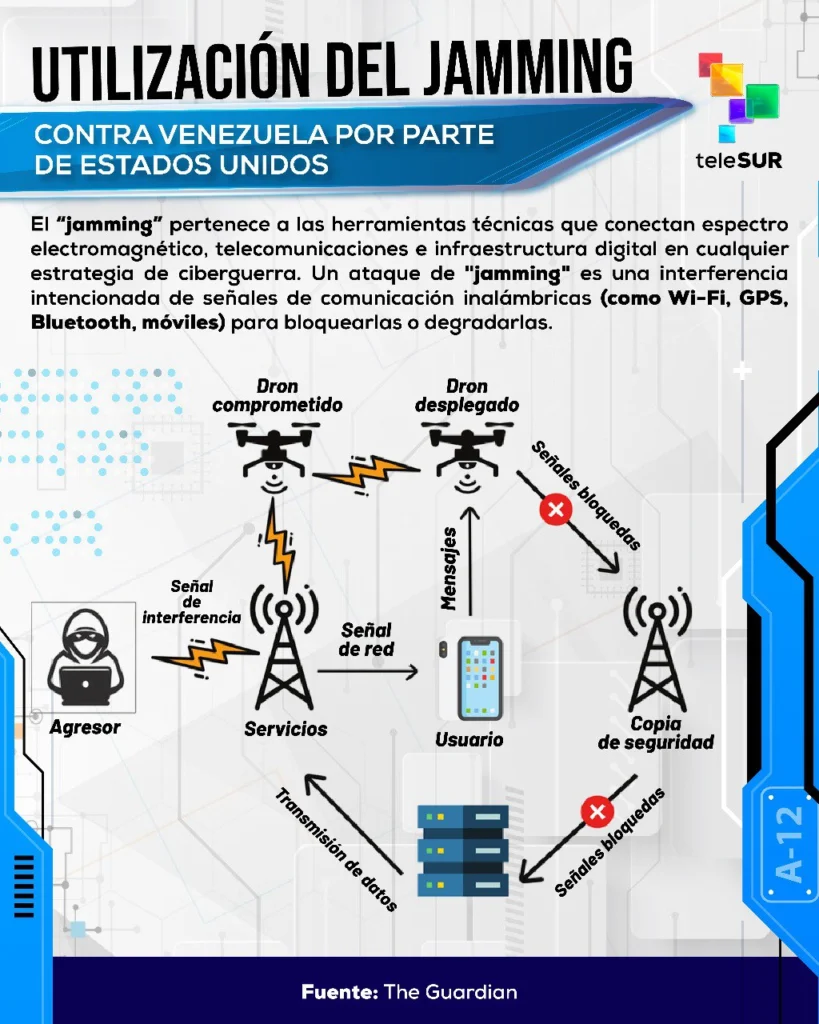
The disruption of basic services and urban risks were evident. There was damage to antennas, towers, and institutional infrastructure. The use of jamming as part of the operation was also reported .
Two days before the attack, Cloudflare, the global network of servers that acts as an intermediary between users and websites, documented a BGP routing anomaly associated with CANTV , Venezuela’s state-owned telecommunications company. In other words, problems with internet service were detected in that country, beginning more than 12 hours before the attacks on January 3.
Electronic warfare
Reuters and The Wall Street Journal reported the deployment of specialized signal jamming units in the context of the aggression. In air superiority operations, jamming is compatible with efforts to degrade communications and navigation, and with an environment of blackouts and information disruption.
This reinforces the asymmetries of the brutal attack suffered by the Venezuelan people. It attempts to undermine the sovereignty of the nations attacked by Washington.
The other battle: disinformation + AI
If the first layer of a cyberattack is to damage critical infrastructure, the second is to saturate the “enemy’s” information environment. Cubadebate’s Media Observatory extensively documented how false or decontextualized images and videos circulated (deepfakes, old material “cleaned up” to appear current, and audiovisual recycling).
According to Cubadebate , The Washington Post reported that hackers from outside Venezuela exploited the event to “contaminate” the debate with contradictory, conspiratorial narratives and manipulated material, using saturation strategies (“throw spaghetti at the wall”) and memes, including inputs generated with AI.
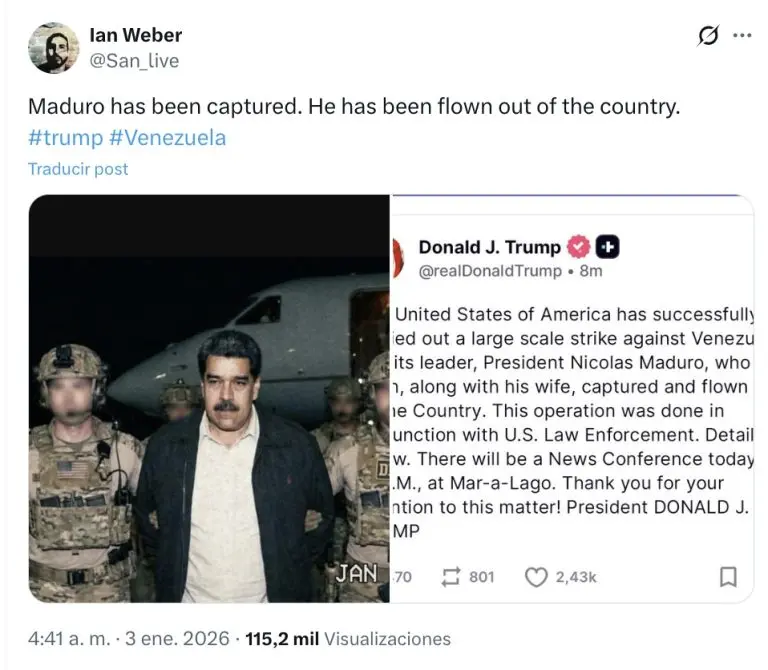
- Alleged first image of Maduro under the protection of US forces. The content was shared more than 4,000 times on X, Facebook, TikTok, and YouTube. The user @San_live, who describes himself as an “enthusiast of video art” made with artificial intelligence, has been identified as a possible primary source on X. The authenticity of this image has already been questioned by fact-checking services of agencies such as EFE and AFP (Source: Cubadebate).
The report concludes that: “the imperial attack against Venezuela on January 3, 2026 was not only a conventional ‘military’ episode, but a multi-domain (land, air, sea, space, cyberspace) act of domination , where cyberspace , the electromagnetic spectrum and information manipulation operated as weapons to disrupt state capabilities, condition public perception and reduce the political costs of the aggression
Control of the narrative was contested with the same priority as control of the territory. A “second layer” based on disinformation and recycled audiovisual material was observed. There was evidence of synthetic or deepfake content and structured campaigns.
Reports describe the debate as being “contaminated” with contradictory narratives. These tactics aimed to amplify versions favorable to the U.S. military. The objective was to erode trust and hinder the attribution of sources.
Washington has doctrinal frameworks for foreign influence operations (MISO/PSYOP and identity management) . This suggests the activation of these units before, during, and after January 3rd in Venezuela.
MISO ( Military Information Support Operations ) and PSYOP ( Psychological Operations ) are terms for military operations that seek to influence the emotions, motives, and behavior of foreign audiences through messages, propaganda, and information actions . MISO is the more recent term that sometimes replaces PSYOP to soften connotations, although both terms are used for activities such as distributing leaflets, using social media, or direct communications to support military and political objectives.
This reinforces the asymmetries of the brutal attack experienced by the Venezuelan people.
Ngl, I feel a little vindicated for my post about AWS and Verizon.
