
You must log in or register to comment.
It’s important to dress for the job you want, not simply the job you have.
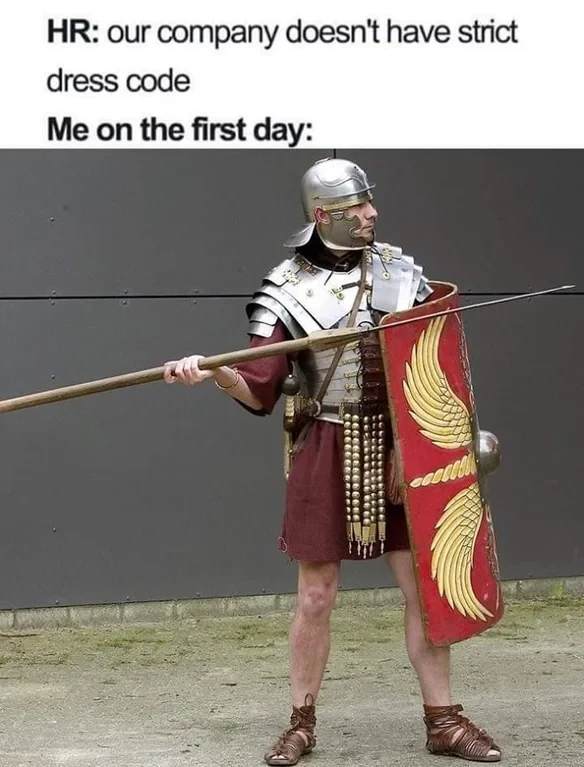
<Insert Cesar outfit image>
I’m not sure I want that job. At least not for long. I don’t want that food, that’s for sure.
I dig the caligae though.
I don’t want that food, that’s for sure.
Bread, cheese, olive oil, meat, and wine? What’s not to love, unironically? Funny enough, for all the complaints we have of Roman legionaries during the Principate (shit pay, long terms of service, harsh discipline, corrupt officers, being posted in Br*tain, etc etc etc) food quality doesn’t pop up despite being a constant complaint of soldiers in other eras, suggesting that it was at least passable. This meshes nicely with the emphasis the Romans put on a balanced diet as a means of preserving health and their advanced supply systems.
Funny enough, fresh bread was one of the ‘conveniences’ of the Legions that the Romans regarded as inherently ‘civilized’. Many other Mediterannean armies of the period would carry and eat grain as porridge (a practice the Romans regarded as ancient and honorable, not barbaric, mind), but the Legions went through the bother of having hand-querns and portable ovens in massive amounts carried with every legion to ensure a steady supply of flatbread even on campaign.
You may be marched to exhaustion, beaten like a dog, worked from sunup to sundown, and posted on some godless frozen frontier, but a civilized man must still have BREAD!
I might confuse it with gladiator food like puls. Eating barley, like a brute!
“Puls every day? What is this? 2 AUC?”
The Romans actually even kept a little mud hut in the middle of the city of Rome, supposedly the preserved residence of the founder of the city, Romulus. Rather than being gussied up to shine the LEGEND of the FOUNDING of ROME and the deified Romulus, it was kept (one presumes as much as the generational memory allowed) in its primitive, small, unimpressive form. This was partly as a reminder of how far human/Roman ingenuity had come since the days when the most powerful man in the city, the literal king of Rome, lived in a dingy little hovel that even the imperial-era Roman working poor would turn up their nose at!
The past was to be honored, but also surpassed whenever possible!
Not the worst way to view the past to be honest
Be the reason why the rules exist
Ah yes, the traditional pastry pasty white complexion of the Roman soldier.
Hey now, Romans came in all sorts and shades.
Sure, but soldiers were all out in the sun a lot.
Well, yeah, but that’s how ya get skin cancer, mate. They were issued sunscreen of course, can’t be fighting no barbarians with a sunburn, can they?
Recruited straight out of Londonium.
Tunics and tunic-like clothing as acceptable men’s wear needs to make a comeback.
And the pilum could be helpful in salary negotiations.