
deleted by creator
From wikipedia:
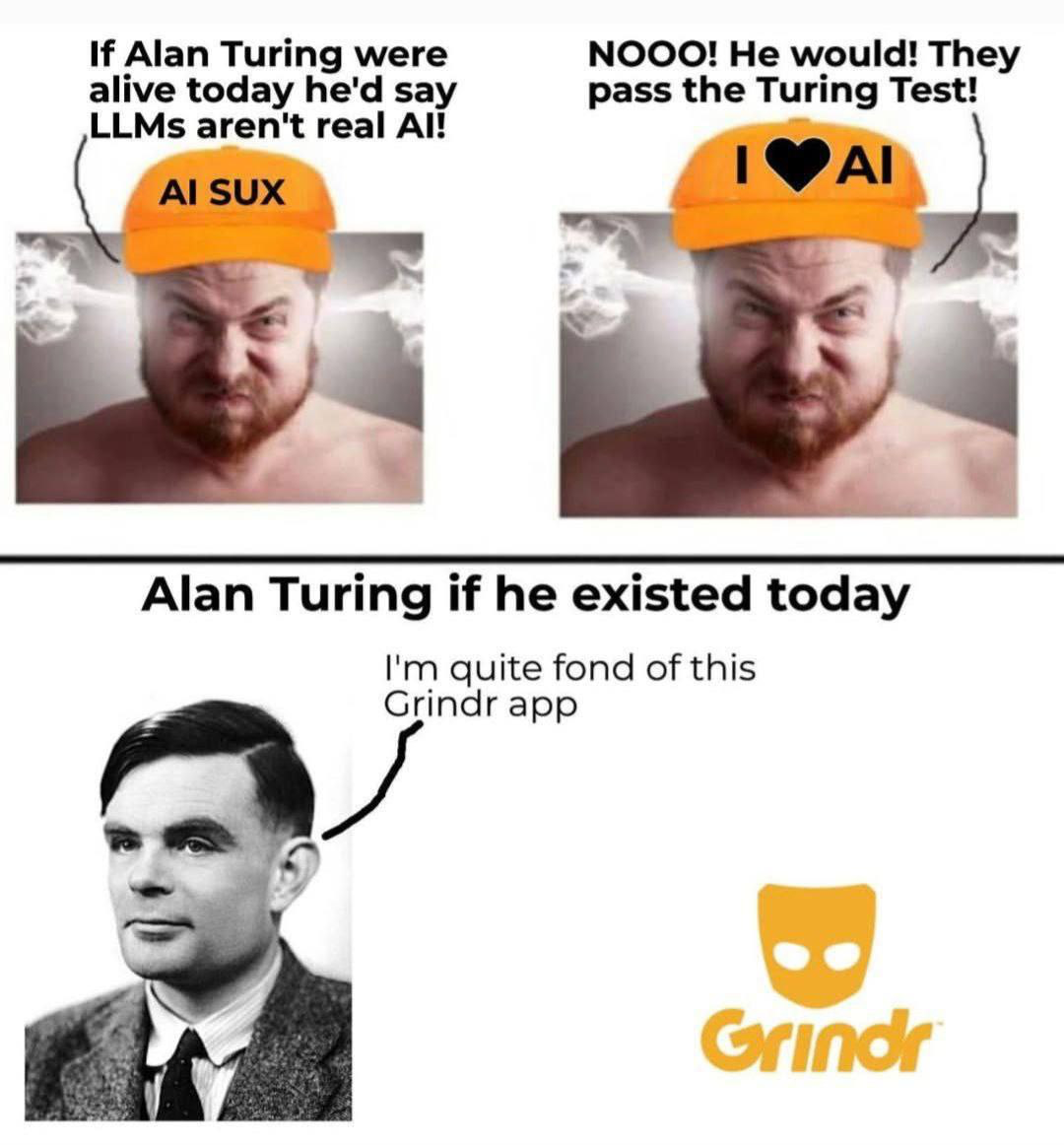
The Turing test, originally called the imitation game by Alan Turing in 1949,[2] is a test of a machine’s ability to exhibit intelligent behaviour equivalent to that of a human. In the test, a human evaluator judges a text transcript of a natural-language conversation between a human and a machine. The evaluator tries to identify the machine, and the machine passes if the evaluator cannot reliably tell them apart.
This isn’t as hard a test as the one you’re describing. There’s research showing LLMs pass very similar tests:
randomised, controlled, and pre-registered Turing tests on independent populations. Participants had 5 minute conversations simultaneously with another human participant and one of these systems before judging which conversational partner they thought was human. When prompted to adopt a humanlike persona, GPT-4.5 was judged to be the human 73% of the time: significantly more often than interrogators selected the real human participant. LLaMa-3.1, with the same prompt, was judged to be the human 56% of the time – not significantly more or less often than the humans they were being compared to – while baseline models (ELIZA and GPT-4o) achieved win rates significantly below chance (23% and 21% respectively). The results constitute the first empirical evidence that any artificial system passes a standard three-party Turing test.
That’s not quite the same thing as LLMs being so good at imitating humans that a trained expert has no possible edge for telling the difference, but it is a major milestone, and I think it’s technically accurate to say “AI has passed the Turing Test” at this point.
There are also thoretically infinite Turing tests. Some of them don’t involve talking at all.
Alan designed a variety of tests to evaluate different and changing measures of intelligence.
We should assume he would have kept making new tests that address the advancements in technology and that the tests would usually be on a case by case basis depending on how the tech was implemented and what would be the best methods for testing it.
Technically, it involves three people. The interrogator is supposed to pick which unseen participant is human. (Originally proposed as, picking which participant is a woman. Chatbots being extremely not invented yet.) If people can’t tell the difference - there is no difference.
LLMs definitely are not there. I doubt they ever will be. They’re the wrong shape of network. I object when people say there’s nothing like cognition going on inside, but ‘what’s the next word’ is estimating the wrong function, for a machine to be smart enough to notice when it’s wrong.
Humans not passing mean machine won the test.
deleted by creator
The goal of the turing test is for a human to differentiate between human and AI. You can’t be “too incompetent at being human”, you can be stupid, but that doesn’t make you less human.
Moving both human and AI into AI category = the categorization is broken, AI is indistinguishable from a human.
deleted by creator
To be fair some humans are utter idiots…
Good things about grinder: ability to find dick (quality varies) vary easily.
Downsides: fucking everything else. Also, possibility of getting murdered
Lmao.
Searle is really who we should be asking