
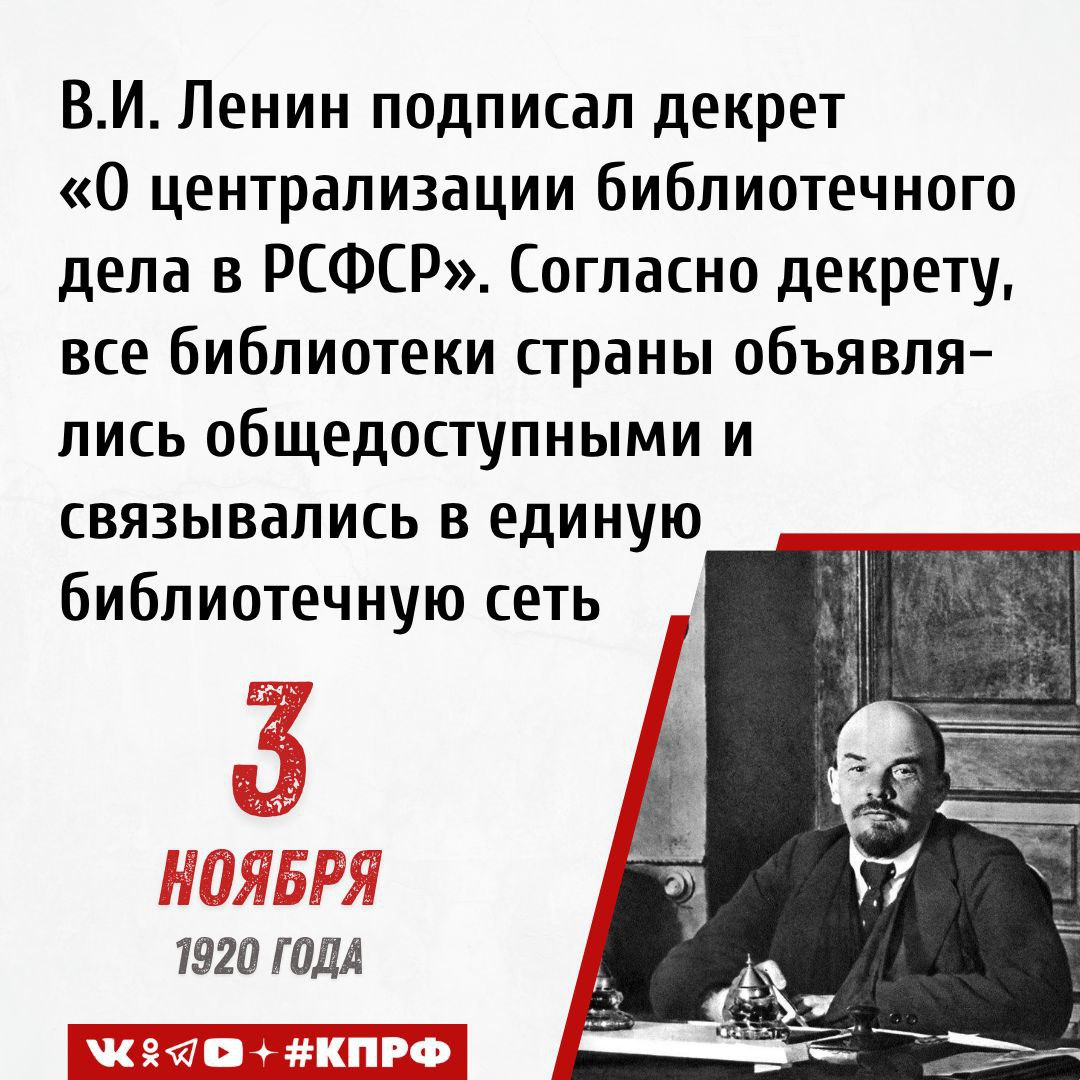
On November 3, 1920, V.I. Lenin signed the decree “On the Centralization of Librarianship in the RSFSR.” According to the decree, all libraries in the country, regardless of departmental affiliation, were declared publicly accessible, linked into a single library network, and transferred to the jurisdiction of the People’s Commissariat of Education.
Before the Great October Socialist Revolution, Russia lacked centralized legal regulation of library services, which meant that many libraries across the country faced significant difficulties operating. As early as 1918, the RSFSR adopted the first regulations governing relations in this area: “On the Organization of Library Services,” “On the Protection of Libraries and Book Depositories of the RSFSR,” and others.
A key step in the development of this field was the decree “On the Centralization of Librarianship in the RSFSR,” signed by Vladimir Ilyich Lenin on November 3, 1920. According to the decree, all libraries in the country, regardless of departmental affiliation, were declared publicly accessible, linked into a single library network, and transferred to the jurisdiction of the People’s Commissariat of Education.
The adoption of the Decree “On the Centralization of Librarianship” unified the legal regulation of library activities, established the principles of book supply procedures, and made all libraries in the country publicly accessible. This significantly improved the public’s access to books, thereby creating the preconditions for eradicating illiteracy.
o7