
1·
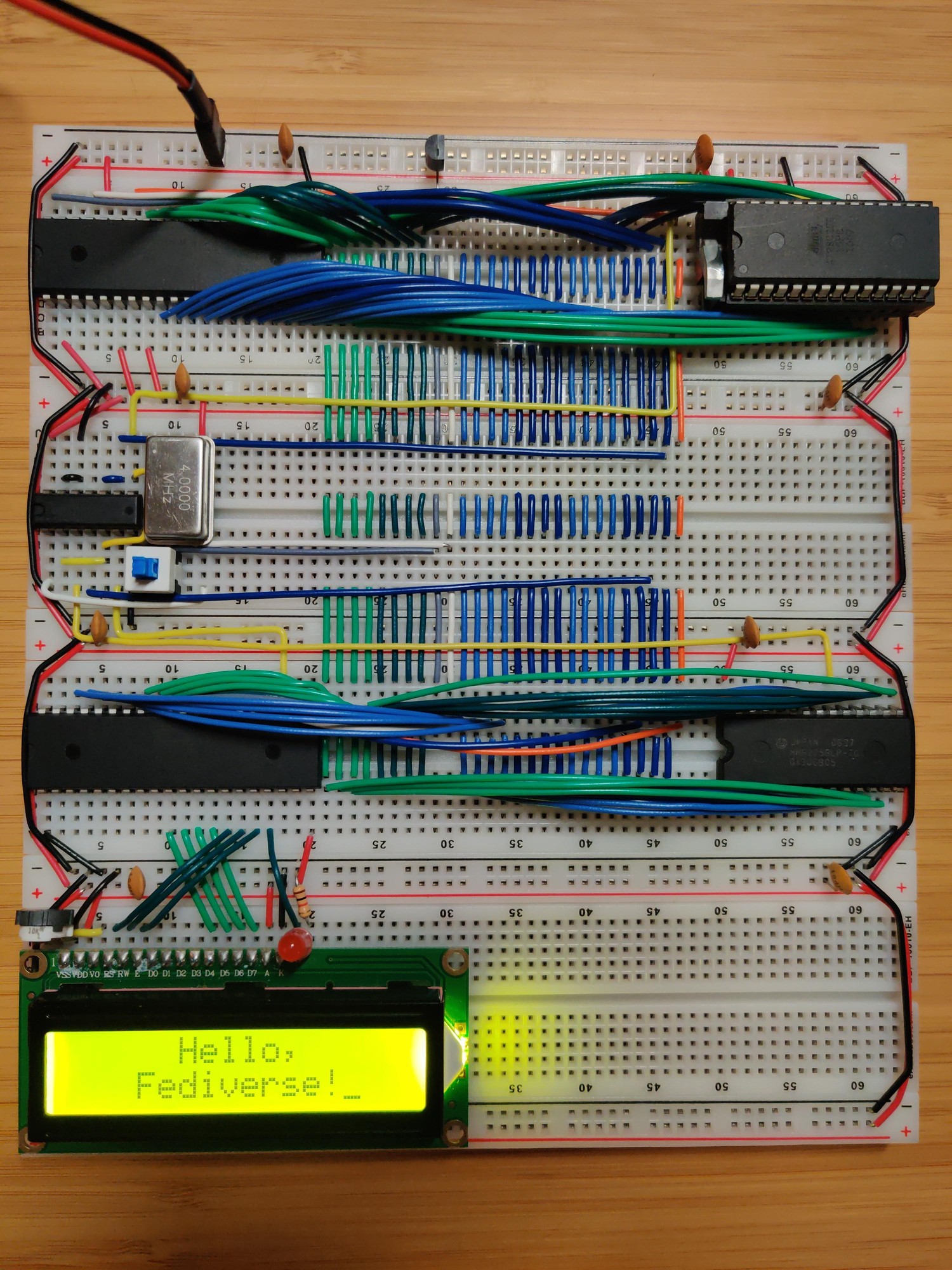
2 days agoI reorganized my breadboard computer. What happened next will shock and amaze you!
“Our ability to interrupt television has been demonstrated.”
Hobby electronics and programming projects: https://codeberg.org/interrupt_tv
I reorganized my breadboard computer. What happened next will shock and amaze you!
It’s not too difficult to learn. Ben Eater is really good at teaching this stuff. He guides you through everything in small steps that are easy to understand: https://www.youtube.com/watch?v=LnzuMJLZRdU
Thank you. I’ve got the PCB design and assembly instructions here if you want to make your own: https://codeberg.org/interrupt_tv/alpz-bb
Not sure exactly how long it took. I worked on it off and on over the span of a few days.
Definitely a great resource. I’ve got it bookmarked to read more of later. From the address decoding chapter, I can now better appreciate Ben’s weird memory layout that leaves half of the RAM inaccessible. It allows you to hook up a ton of peripherals and use the individual address lines to select them. You can even select multiple devices to write to simultaneously, depending on which part of the address space you access.
Ah, sorry, I could have been more clear there. It can do arbitrary mappings between input values and output values. So for each possible 4-bit value, you can pick a different 8-bit value to be output.
For my case, I’m working with a 7-segment LED display, like the display on a microwave. It’s got 7 LEDs arranged to display a number, plus an 8th LED for a decimal point. Like this:
 ---
|   |
 ---
|   |
 ---  .
if the ROM is getting 0000 for its input, it should light up all segments of the 7-segment display except for the horizontal one in the center, to display a zero. Then for the 0001 input, it should light up the two vertical segments on the right, leaving the rest dark, to display a one. And so on. Each output bit goes to a particular segment of the display.
To relate it more directly to programming, it’s like having a 16 byte array. The input gives the array index that you want to access, and the output gives whatever byte is at that index.
Oh, that’s cool. I hadn’t heard of slimevr before.
My use case for the diode ROM board is to take 4 binary input bits (16 possible combinations) and translate them into what segments of a 7-segment LED display should be lit or unlit, in order to display the corresponding hexadecimal digit (0-9, A-F). Like so:

It could be used for any other case where you need to convert a 4-bit input into 16 possible 8-bit outputs. In theory you could use them in multiples for more address space, but I forgot to include an enable pin on the board to allow for that. Something to add to the next version.
Not programming per se, but I’ve been working on some electronics projects. If you check my profile, there’s two PCB designs that I’ve posted. They’re fairly simple, but I’m working on a larger project that I should be posting relatively soon. Currently I’m just waiting on a shipment of parts, because I didn’t realize I would need XNOR gates.
Thank you. I agree, it is a really impressive piece of software.
I went with JLCPCB. Cost about $5 for the 5 boards with shipping, which took two weeks. I just added some additional instructions to the readme about getting the boards manufactured. The process seemed daunting before I did it, but it turned out to be really easy.



With extra USB cables as a garnish. Very nice.