
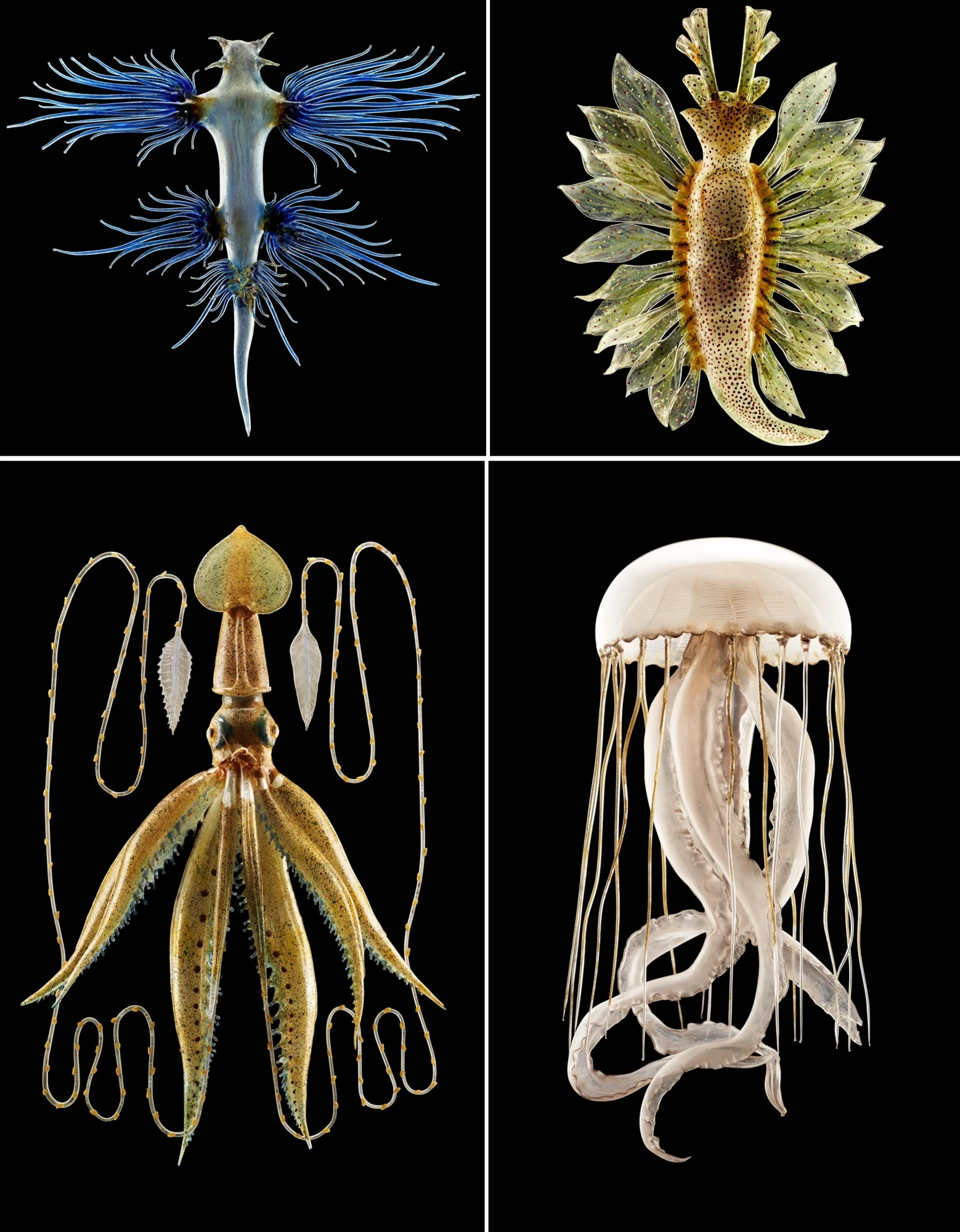
These specimens are some of thousands of meticulously detailed marine invertebrate models fashioned between 1863 and 1890 by a father-son glassworking duo, for the primary purpose of research and education. Collectively, their work depicts more than 700 different species—including various anemones, squids, and sea stars—found in waters around the globe.
Clockwise, from upper-left:
- Blue Sea Dragon slug ( Glaucus atlanticus )
- Spotted-Sacoglossan nudibranch ( Caliphylla mediterranea )
- Compass Jellyfish ( Chrysaora hysoscella )
- Long-Armed squid ( Chiroteuthis veranyi )
The models’ destinations were also far-flung. From their glassworking studio in Dresden, Germany, Leopold Blaschka and his son, Rudolf, shipped their fragile pieces to museums and academic institutions in locales as diverse as Australia, India, Japan, and the United States (where Cornell University now holds what’s likely the world’s largest collection, at more than 570 pieces).
As an artist (who never worked in blown-glass), I find myself frequently amazed by the precision and detail possible in that medium. oO
More info & examples:
https://www.guidomocafico.com/work/leopold-rudolf-blaschka/blaschka-i/
https://www.sciencefriday.com/articles/a-tale-of-two-glassworkers-and-their-marine-marvels/