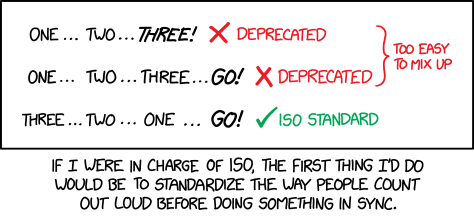
xkcd #3232: Countdown Standard
Title text:
Anyone who is caught counting ‘three … two … one … zero … GO!’ will be punished with a lifetime of eating only ISO standard food samples.
Transcript:
Transcript will show once it’s been added to explainxkcd.com
Source: https://xkcd.com/3232/
You must log in or register to comment.
This, and standardizing what “this Thursday” and “next Thursday” mean. These terms have become functionally useless (to me) because of how they’re used differently by different people. Whenever someone uses these terms to try to intimate a particular date to me, I just ask for the exact calendar date rather than the day of the week to avoid ambiguity.
Biweekly is another one. Two times a week, or once every two weeks (also called a fortnight)?
This is one of those ones that’s a tragedy. Biweekly “should” always mean every two weeks. Twice a week is “semi-weekly”, aka every half a week.
But regardless of what it “should” mean, people use it wrong often enough that you have to check every time, not because the word is ambiguous, but because people are often mistaken.
It’s a shame, but it’s part of human communication 😅
I’m a theatre tech and stagehand. “Go” is saved for cue calls. It’s always lift on three. One two THREE.
LX7 Standby
Standing
It always tickles me when I come across people with enough comms etiquette to not say “Go” unless they are giving a cue. “I’ll wait for you to say G. O. before I do anything”
My favorite thing is the ability for most if not all hands on comms to have the most random conversations and then stop cold as soon as “standby…” Is heard. Then after all the cues have been given, the conversation picks up exactly wherever it left off.