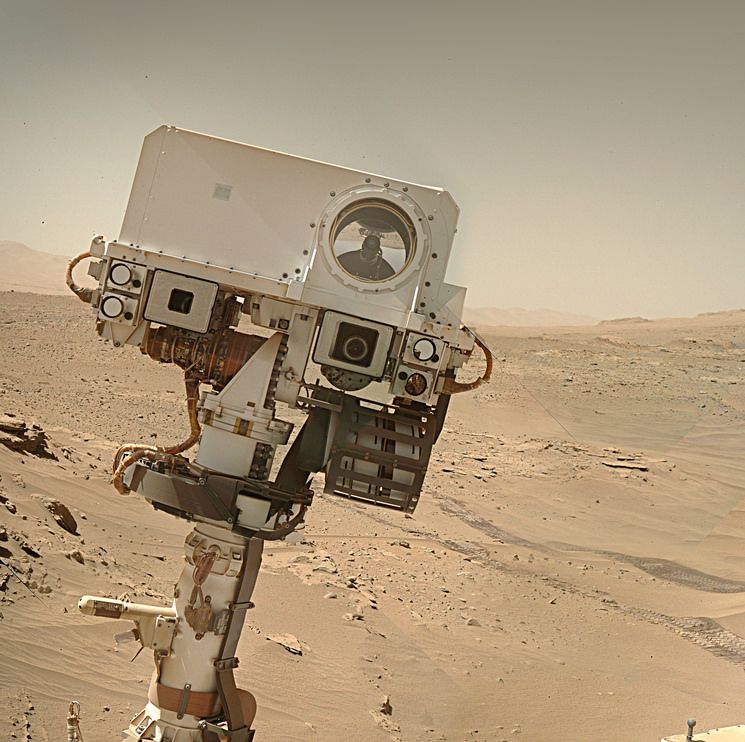
MAHLI image of one of the rover’s wheels. Image credits: NASA/JPL-Caltech/MSSS
Keep in mind as well that the rover only moves at a maximum 4cm/s (0.087mph/0.16kph), but more commonly at about 30 meters per hour. It has also only moved 36.55km (22.71 miles) in its entire lifetime, since Aug 2012.
All of that damage for something moving very slowly and not very far.
They still got 20,000 miles left on them.
They still got 20,000 miles left on them.
At least :)
“Just rolled in to the shop” moment
“Just rolled in to the shop” moment
Customer: I’ve been doing some ‘Off-Roading’
Shop: How long were you driving off road?
Customer: Over the last 12.5 years (August 5, 2012)
Shop: Can we interest you in an extended warranty plan?
Lmao
It must be so agonizing watching this and knowing that this $M rover cannot be repared
Fear not, they have a plan - https://spectrum.ieee.org/if-necessary-mars-rover-curiosity-could-rip-its-own-wheels-off-to-stay-mobile
From the article:
In addition to the 19 grousers that go around the wheel, each wheel also has an odometry feature, which is a section of the wheel that has a pattern of holes in it. These holes help the rover visually track its progress, and they also spell out “JPL” in Morse code, because why not.
Love nerds! That’s so cool
Love nerds! That’s so cool
JPL wanted to use the letters J - P - L in the wheel design, but NASA said no, so they added the Morse code and got away with it. Nerd Rule :)
Hey thanks for sharing!
This was a really neat read and I’m really happy now that the JPL team has a funny but ingenius plan🤭🤗
It involves Curiosity finding a nice sharp rock and using it to rip out the insides of its own wheels.
TL;DR:
Imagine a wheel (with rims still attached) rolling towards you and a saw slices it in half.Oh wow that’s cool!
Dang that’s really cool and very clever.
I know they probably can’t but the way NASA has fixed things remote in the past i wouldn’t be surprised if they repaired it somehow
You know NASA too well… They do have a cunning plan…
Not exactly a repair, but when things get really bad, JPL has a plan to minimize risk with a “wheel shedding” maneuver…
You can read all about the plan here: https://spectrum.ieee.org/if-necessary-mars-rover-curiosity-could-rip-its-own-wheels-off-to-stay-mobile
That’s so damn cool, cheers mate
What is the skin made out of? Is it also aluminum? What ever happened to using nitinol or whatever that memory metal was for wheels where rubber wasn’t appropriate?
What is the skin made out of? Is it also aluminum
Each of the wheels were machined out of solid billets of aluminum, the skin is very thin, the thickness of a old soda can (back in the day when cans were thicker than today). The wheel spokes are made from titanium. I’m not sure what other materials were considered for the wheels on this mission, but there would have been alternatives like you mentioned.
For Perseverance Rover they also used aluminum wheels, but they added additional grousers and replaced the zig-zag design with a gentle curve that reduced the numbers of stress points dramatically. Other changes were also made, and the new designed wheels are performing great in and around Jezero crater, with only a few scratches after more than 1800 solar days on Mars
Is the heat cracking the metal?
Is the heat cracking the metal?
The very low temperatures encountered on Mars can embrittle some metals, but this damage is mostly caused by stress fractures after repeated bending of the grousers where after the thin skin was punctured years earlier.
When this image was acquired the night time low temperature was -148° F (-100° C)
Define “heat” in this context… Because by Earth standards it’s never “hot”.
The maximum temperature is only 70F/20C, and a low of -225F/-153C. And with such a thin atmosphere, it doesn’t hold heat well, so the difference in temp from the surface to just 5 feet in the air is about 43F/24C.
I would like to subscribe to more mars facts
So it’s not the heat, but the cold that could be making the thin metal brittle. And the fact that it is well used and old. Or… was this a drunk driving accident? I mean, what else is there to do on Mars?
Want $2,000,000 cash
Buyer collects
No negotitions or lowballers I know wat I got/s
In all seriousness though, damn. She be enduring the harsh terrain💪. I hope Curiosity is able to explore for as long as possible until someone hopefully decides to fund the next mission to understand what happened to Mars’s atmosphere🍀