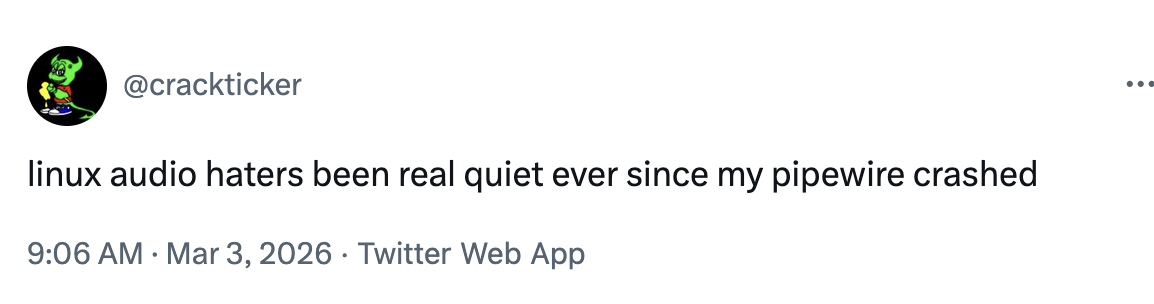

Never buy an HP laptop for linux. They often try to have some gimmicky special audio hardware with terrible driver support
Strange I never had any problems with PW, for me it’s probably the most reliable Linux software there is
I have a terrible confession: i have loads of audio issues im with atm. My desktop setup basically gets confused and stops working whenever i try to switch fom headphones to speaker, and my two laptops just do not want to pair with my bluetooth headphones unless i futz with bluetoothctl every time
Anyway, tangent aside. my terrible confession is that i go to linuxmemes for tech support, someone pls help
Try to use a normal computer instead of trying to kick linux into a ATM.
Most ATMs are acually now linux based,. Weeell the new ones anyway. Old ones are still running on XP.
Not sure, xp might be too new. I’ve definitely seen nt 4 on an ATM before.
Dépend of thé country, Saw some are on windows 10. I guess windows 11 is too unstable yet.
I definitely remember having to futz with audio a looooong time ago, but honestly getting xf86config to work with my video card and monitor was much more difficult.
The dark days of fucking with xorg.conf files and ndiswrapper to get WiFi working are things I’m glad no longer exist.
I think I managed to skip the ndiswrapper era. I was using Ethernet on desktops and my laptops were Macs. Nowadays my desktop has both wifi and Ethernet, and my laptops run Linux but nmtui just works.
Ive not been using Linux for long, maybe only 5 years or so. But I’ve never had any audio issues.
My audio needs are not as straightforward as the average user. I play drums over midi into reaper. I have used guitars and mics through my audio interface. My midi controllers work without any issues.
Im using pipewire and running reaper with pipewire-jack. I’ve used mint for years with no issues, and now running debian Trixie with no issues.
Linux user for 20 years: in my days I has to compile X by hand if I wanted a graphic interface.
Linux users for 10 years: kinda worked, sometimes you had to install the same a couple of times with different configurations until one worked for you.
Linux user for 5 years: lmao, this easier than windows.
It’s mostly an old notion that just won’t die. Especially in the years after its initial release (2004) it was just a disastrous experience sometimes with cracking noises, misconfigured sinks (or outright missing), crashes and - if I still remember one of my first Linux experiences with Ubuntu 8.04 right - the sudden decision to repeat the current audio buffer at maximum volume.
Ever since I came back to Linux on Desktop around 2017 I didn’t had any bigger issues with Pulse either. Ever since Pipewire became the default stuff just works, no issues whatsoever.
okay here me out:
Pipewire is one of the best pieces of software I used. It has a cool ass patchbay and unlike PulseAudio I’ve never had it crash on me. It is the best thing that happened to Linux audio
I was blown away when I connected my phone to my PC through Bluetooth and phone audio started playing through my PC. It just worked without me touching anything
I also really like how “Linux Studio Plugins” are standalone apps that you can run. I don’t produce music or anything but I still use stuff like equalizers and spectrum analyzers. It is insane how flexible the “each app has inputs and outputs you can hook together” architecture is.
PulseAudio probably also had some of these features but I never used those because pulse would fall apart every time I touched it. Pipewire doesn’t
Broken Linux audio is about to become old news
I also really like how “Linux Studio Plugins” are standalone apps that you can run. I don’t produce music or anything but I still use stuff like equalizers and spectrum analyzers. It is insane how flexible the “each app has inputs and outputs you can hook together” architecture is.
It’s weird that parts of this approach have been around for a long time, but barely anyone can make them all work together out of the box.
Mac has AU Lab that can host AU apps, i.e. Apple’s analog of VST, and feed system audio through them. Plugging any app into another is a bit more involved, though: there was the open-source Sunflower made like fifteen years ago, but bit rot gotten it, and another open-source clone doesn’t work for some reason either — so paid apps are the best recourse, just like on Windows iirc.
Mac also has a feature where one can combine multiple audio inputs into one virtual input. A funny application of this is, if you put the mic into a virtual input and call it ‘Rocksmith Something Something Controller’, you can play guitar with Rocksmith without their special usb device.
Next stop: iOS has an audio bus for connecting apps together just like VST/AU on the desktop. Android has jackshit, and if you feel that audio latency could be lower, it’ll spit in your face.
i don’t know about you but broken Linux audio has BEEN old news ever since i started using pipewire
Pipewire has some neat tricks that i use on a daily basis but i can also make it crash on demand so idk :p. I have a restart script in my home directory for that exact reason.
It just does not like audio going out my gpu, together with video, through my receiver and into my tv.
Receiver not on while linux was booting? Guess what, pipewire reboot. Tv goes off because of “inactivity”? Thats a pipewire reboot… And yet i love pipewire haha. But ye, audio issues are still a thing
Have you reported the crashing issue to the developers of pipewire?
Not yet. Ive been too busy tbh. I assume that, like many linux tools, its a bitch to report something. Not just a easy bug tracker or something
From what I found this is their official bug tracker
How is the latency on Pipewire? Have you tried using it for instruments at all?
Have you gotten any amount of stable behavior when two users are logged in?
Yes. The only times I’ve had any problem with pipewire were when pulse decided to run for some reason and disrupted everything.
Also, I can open a pipewire device, write data there, and not run into C assert faults. I can do this with oss and alsa too, of course, but AFAIK, it’s impossible with pulse and all the Linux DEs ran on pure magic for a decade.
It has a tendency to break my USB audio after updating the kernel. I just have to remember the incantation to restart it though and it seems to fix it.
Been around since OSS and ALSA was the new kid on the block. Yet to experience these supposed sound issues.
Yeah I am also running linux for 20 years or so. Minor hiccups here and there, but sound has been solid generally.
All i can say is, you have been a very lucky individual.
Then you didn’t use your computer for much involving audio.
You must have been blessed by the hardware gods. I had several scripts bound to hotkeys to fix various issues that would occur regularly and this was only 5 or so years ago. Volume would reset, wrong sink would get selected, it would crash, it would crackle, it had bad latency but most of the time it was fine.
I 'member having to use a script to do software mixing of multiple audio streams in alsa, so I could listen to a music CD while playing WOW. Otherwise whichever thing started first would grab the audio device and the other thing couldn’t use it. This would’ve been back in like 2006-7.
Same, I have it running on several different laptops/desktops, it’s probably a certain piece of hardware.
I’m sure it’s happening to people, just not everyone.
Oh no not
systemctl --user restart pipewire.service!Pfff why not the sudo reboot now. That’s much better /s
May as well just reinstall the os at this point.
Windows habit
It’s ironic how, just like people make jokes of Linux audio even though it’s been stable for years, people stil joke about Windows throwing BSODs or requiring reinstalls non-stop, even though the last BSOD I had that wasn’t caused by faulty hardware or a weird one-of-a-kind driver issue was… 12 years ago? Something like that.
if you’ve been running the latest windows 11 that’s very good luck
“Latest” as in “Insider”? I’m on the first Patch Ring at work, so I’m one of the five people who get the latest patches, but we’re not Insiders. We had 3 BSODs last week when MediaTek fucked up their WiFi drivers and the devices crashed if connected to WiFi 7.
The previous BSOD I saw at work was 3 years ago. The tech came in, replaced the MOBO and the issue was solved.
A colleague of mine had a BSOD while we were doing our stand-up, and I have had a few over the last few years.
Also, you don’t get to tell us that BSODs don’t count if the driver is written by someone else, that’s not how it works. Otherwise Linux has no audio problem, only alsa does. Completely different thing.
IDK why you’re shilling for them honestly
I have a strange Dual Screen Asus on Intel with mobile arc. About 10% of the time, waking from sleep will crash the taskbar, something about the video driver not being ready yet.
I just wrote a daemon to kick plasmashell in the ass if it notices the bar isn’t there.
ewwwwww SystemD
Systemd haters when you use systemd instead of UltraXinitializer made in 2005 by John Init in C-- that requires you to manually write init scripts and has 894 critical severity CVEs
John Init writes bloated software. I only use suckslot init.
I got your System “D” right here \*grabs crotch\*
No, eww is eww. Systemd is systemd.
Gotta be real here for a moment, the last time I had any sort of trouble with audio on Linux was back in the day when I was still fiddling about with Gentoo. But that was, what, fifteen, twenty years ago?
You know, I don’t get this joke. I have been using Linux and BSD since 2019, and the only incident I ever had was with
sndio(7), and that was because I decided to switch to the-currentbranch of OpenBSD without heeding the warnings.Apart from that, whether I was using ALSA, PulseAudio, PipeWire, JACK, or OSS (on FreeBSD), I always had a perfect experience.
The joke is they can’t hear them because their audio broke. You’re overthinking it. Lol.
Flashbacks to having
pavucontrolopen, editingdefault.paand watching pulse crash over and over trying to get echo cancelling workingWhy is my Bluetooth stuttering
Because it’s nervous and under a lot of pressure. Go easy on it.
Try changing the audio codec in the hardware profile.
Yours too?
I have linux issues every time I have a “new” machine, and it makes sense. Linux is a volunteer/ opensource project. It isn’t getting chipsets before, and building drivers in advance of hardware releases (at least it mostly isn’t; I understand that some times it does).
Because of that, the newer your harder, the crappier it works. The longer your hardware has been around, in-general, my experience is that Linux becomes an “it just works experience”.
Also, fuck you mediatek 7925e.
I built a new 9950x3d + x870e system last year. trying to use the motherboard’s wifi would kernel panic things. couldnt turn bluetooth on and off. couldn’t control the RGB.
Now, WiFi works great. Bluetooth works great. OpenRGB supports the RGB. Things are great. Took time to get here, but we got here.
9950x3d
🤤
The strong irony is that when high core count and asymmetrical multi-CCD chips started rolling out, they were having CCD pinning issues in windows. But since Linux has a scheduler that has been NUMA awareness for ages… Linux was actually just fine with these things.
Linux was actually better for bleeding edge hardware for once.
try disabling bluetooth power saving
try libspa-bluetooth if pipewire
force A2DB profile in pavucontrol or blueman
make sure you have bluez and bluez-utils?
Nah. I’m just gonna hope distros once the paper I’m submitting is accepted and I don’t need this machine again. I think I’m going to go fedora so I can stay closer to bleeding edge on the kernel.
That’s the best thing bluetooth audio can do for you. Much better than anything it does to music.
Pro tip: putting the URL in the following character sequence will just show the image in your comment instead of the URL

Another tip: Be careful linking images from hosts that you don’t control.
You don’t want to come back and find your funny.gif picture is now displaying a goatse.
Yeah, this and a bunch of nearsighted VST developers are the only things keeping me from switching to Linux entirely anymore. Things have definitely gotten better on the Linux side of things, and definitely gotten worse with Windows, so I feel like it’s only a matter of time.
OP. Fuck right off with your nazi-bot repost.