It works the same because the value of the last expression in the for loop is not used for anything. It’s the side effect of that statement that counts. Eg, the value of i is checked the next time the for loop is executed by the condition check. Try replacing i in the condition check instead with i++ or ++i and you would see different results.
Something like: for (int i = 0; ++i < 10;) { ... }


I gave it a shot in Compiler Explorer, with the following code:
#include <stdio.h>

int main() {
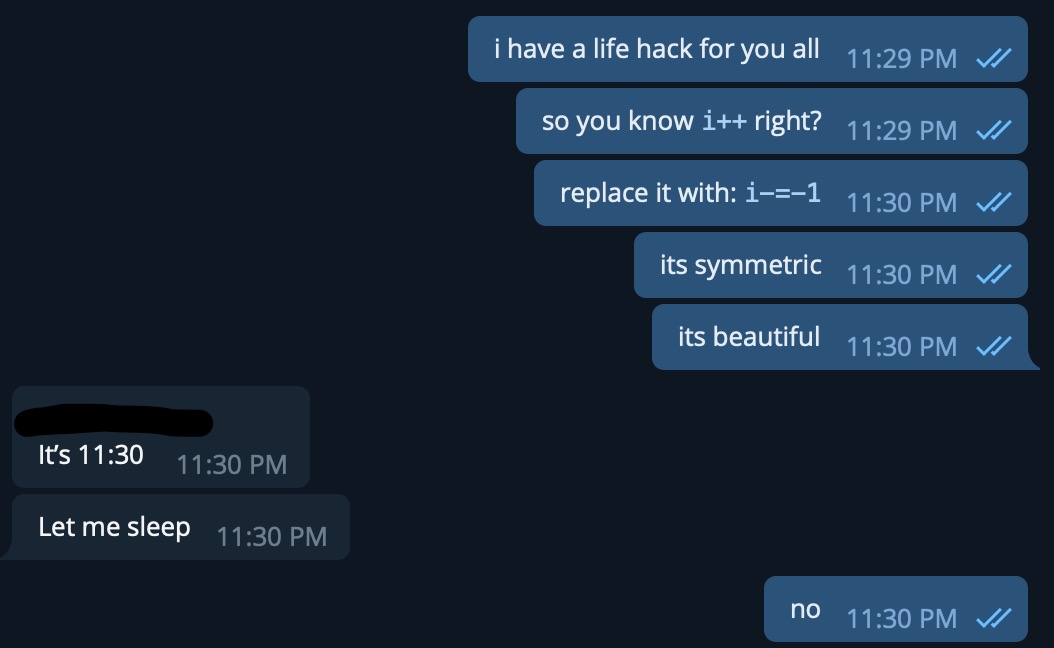
  for (int i = 0; i < 10; i -= -1) {
    printf("%d", i);
  }
}
GCC takes the
i-=-1and optimizes it intoADD DWARD PTR [rbp-4], 1, and changing it around to++iori++makes no difference.So, at least in C and C++, it works all the same. Even on unsigned integers.
It works the same because the value of the last expression in the
forloop is not used for anything. It’s the side effect of that statement that counts. Eg, the value ofiis checked the next time the for loop is executed by the condition check. Try replacingiin the condition check instead withi++or++iand you would see different results.Something like:
for (int i = 0; ++i < 10;) { ... }