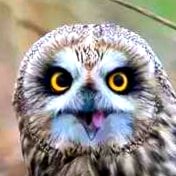


Photo by Neil Brailsford
We’ve had a few comments/questions recently about how owls sleep, so I thought I’d do a little reading on the matter. For a bird that is already asleep for us when most of us are awake, I found surprisingly little. What I did find though was still pretty interesting.
Let me get this out of the way first, I’m a hobbyist owler, not any kind of biologist or physician qualified to interpret this study. The closest qualification I have is studying my own sleep data with OSCAR (Open Source CPAP Analysis Reporter, if you have a CPAP and aren’t using this, you may not be sleeping your best! (Not a sponsor!)).
We’ll start with a little intro to sleep stages. Here’s a chart showing the stages and what they’re accomplishing. This chart is for humans, so ignore the times for now.

One of the interesting points of this paper seems to be checking out if owls had an equivalent of REM sleep (rapid eye movement) because of the owl’s physiology, their eyes can’t move! They aren’t round like ours are; they are lightbulb shaped and take up too much of the head to allow movement. If you check out the charts in the paper, PS (paradoxical sleep) is the term for REM sleep they used in their report.
The rest of the testing parameters were comparing owl sleep to other birds and a different prior study on some Burrowing Owls. This paper’s testing was done with a pair of Tawny Owls. This post’s photo is a sleeping Tawny that went viral at some point, article linked. The owls were fitted with some sensors to monitor breathing, eye movement, heartrate, and some other sensors to check on involuntary muscle movements and relaxation.
There were a few similarities and differences for owl sleep compared to that of mammals and even other birds. Neck muscles for birds look to remain largely engaged for almost the entire sleep period, which they made seem typical for birds, so they do not “nod off” like mammals will often do, so monitoring neck muscles doesn’t give an indicator of sleep stage. Their breathing and heartrate do drop off as they enter deeper into sleep. The only different muscular relaxation in the owls is that the lower eyelids relax and will fully close the eye once deep sleep occurs. This closing of the lid is called palpebral closure. When going to sleep or in light sleep, the upper lid is closed, but the eye is still open a sliver, like we often see in housecats.
They made some comparisons between the sleep patterns of the owls and other studies of pigeons that showed some sharp contrasts. Owls kept a higher heart and respiratory rate while awake, while the pigeons were lower, but when they went to sleep, both inverted. The owl’s breathing and pulse lowered, while those of the pigeon increased. No comments were given to why, but I wondered if that was the nature of being a prey species vs that of a predator. The pigeon is normally relaxed and grazing, while the owl needs to be ready to strike at short notice when awake. While sleeping though, the pigeon is now vulnerable and may need to be ready to wake rapidly while the owl on the other hand is now “off duty” and can relax. Again, just me thinking out loud, I don’t know squat.
Most of an owl’s “night” of sleep is made of the deep sleep stage, often called N3 (non-REM stage 3), and called Slow Wave Sleep in the study here. Of the time spent sleeping in the exam periods, it made up 95-98% of the owl’s sleep time! Paradoxical sleep (owl REM, basically), was only 2-5% of the sleep. The number of sleep cycles they experience is huge, at about 100-140 for the full sleep period.
To put that in contrast to human sleep, we spend about 25% in deep/slow-wave sleep and 25% in REM/paradoxical sleep, and we have about 4-6 sleep cycles per night!
So it looks like our feathered friends go in and out of sleep much quickly than we do, and they have much more deep sleep and much less REM sleep. Again, I did some more pondering on why the significant differences. Owls have much more dangerous lives than we do, so quick to fall asleep when they get a peaceful moment and quick to wake sound like great survival benefits. They have tremendously physically and metabolically intense lives, so getting into that reconstructive deep sleep phase quickly and for a maxxed out time seems needed to keep the body in shape. And when you have a walnut sized brain and minimal emotions, having long, deep dreams and meditative time for the subconscious mind seems not so crucial to a wild animal. I’m still waiting for the first great owl philosopher to appear on the scene. 😄
Owls do have a few sleepy moments that can mirror our experiences. They will talk in their sleep a bit when they are first going to sleep and when they are in deep sleep, and vocalization finally stops during the periods of paradoxical sleep. They will have the rare full body muscle spasm, like when we catch ourselves starting to fall asleep. They will also have the occasional apnea that will cause them to wake temporarily.
Otherwise, owl sleep seem very different than our own. Their findings matched the prior Burrowing Owl study for the most part, and the differences in times and rates were withing reason, and with a larger sample population (this study had 2 owls, the other 4) they felt things would average out.
I really enjoyed this short 3 page read (if you exclude the chart areas) and the charts are similar to what I see on the things in my OSCAR sleep data.
I hope this presented things in an interesting way. I thought it was pretty enlightening. If you have any different takes on the data, I’d love to hear them. Like I said, all my takes are just guesses based on what I felt would make sense. Feel free to chime in.
In hootels.
Love it! 😆