
abandoned account
- 745 Posts
- 565 Comments



 491·1 year ago
I can’t understand this logic.
Assume as stated that a website is a copyrighted and protected. Sure, that means I can’t redistribute it to others without permission or a license. But I can’t see how me locally, privately modifying the site would be against the law. Should Crayola be sued because their crayons can be used to modify a copyrighted art piece? Is it illegal for me to watch a movie with a blue-light filter on because it modifies how the content is displayed?
Edit: After further thought, a stronger argument would be that it’s illegal (in some places) to bypass DRM protections. That’s because if I break DRM of some media (say, of a rented DVD) so that I can keep it forever, that would technically be illegal even if I never shared it with anybody else. So if a site tries to break ad blockers but an ad blocker works around that, that would be “breaking” DRM, therefore illegal. But I still find that to be an lacking argument.


 1·1 year ago
Debian 12.7 is a year old. You’re supposed to upgrade to the latest version (currently 12.11) before doing the upgrade.









 102·1 year ago
For fastest hardware support, you will want a rolling distribution like Arch (requires a do-it-yourself attitude) or OpenSUSE Tumbleweed (complete out of box, but some quirks, like missing codecs requires manual work). Fedora also has decent new hardware support, not rolling so not as good, but same problem as OpenSUSE Tumbleweed. You can also consider derivitives like CachyOS (Arch, but has a nice installer).
Ubuntu and Linux Mint have OK new hardware support. Twice a year they release new “hardware enablement upgrades” to bring new support.
And worst is Debian. They don’t do hardware ennoblement upgrades at all. It’s something you have to do yourself by using backports. They bring new hardware enablement by default with new releases every 2 years.
 13·1 year ago
GrapheneOS is talking to OEMs to create a phone. Up to this point, they’ve only supported Pixels because they’ve had the best security. But with Android 16, Google stopped sharing important files that make it more difficult to continue supporting Pixels. Hence the desire to create their own device.
Yes. It’s not clear if this was photoshopped or a bug that has been around for years, I believe related to GeForce NOW streaming. The two clients share some code, and GeForce NOW does have an age requirement.
https://www.nvidia.com/en-us/geforce/forums/game-ready-drivers/13/572753/nvidia-app-accessibility/
We have to wait and see if it’s really mediocre. Gnome Web certainly has performance issues, but those may be due to WebkitGTK.
Orion is not using WebkitGTK, despite using GTK and Libadwaita. Their port may not have the same performance issues.
And when I say performance issues, I don’t mean benchmarks. Gnome Web actually does pretty decent on benchmarks, but things like scrolling with a mouse just don’t feel smooth (but do with a trackpad).

This also affects dnf since OpenH264 is distributed from Cisco’s server’s, not Fedora’s.
You can follow this blog post: https://yselkowitz.github.io/blog/2025/08/12/openh264-fedora-flatpaks.html
Should be fine with option 1. Just need to install
flatpak-module-toolsbeforehand.
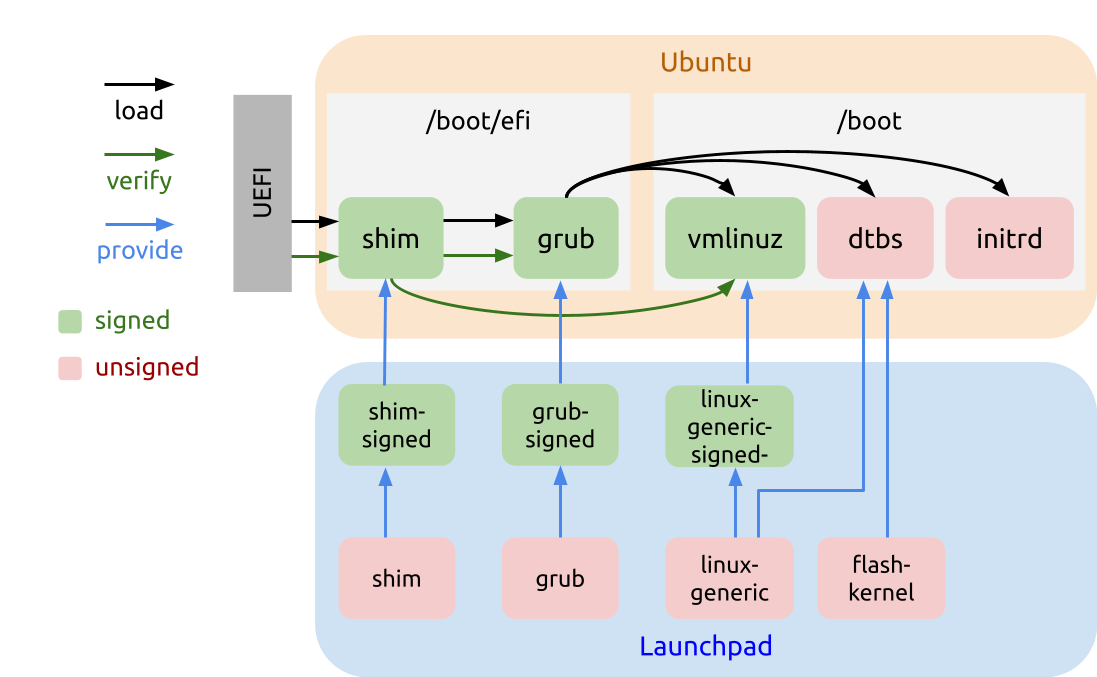
I don’t believe that’s the case, according to Aeon. The state of secure boot can be measured, so if you have it enabled/disabled, you have to keep it that way or else the measurement will fail and the TPM will complain.
No, it requires a TPM2 chip. So the requirements for measured boot are to similar to Windows 11.
Poettering has a few blog posts and conference videos on it. And Aeon is a distro that implements measured boot as the default.
For Linux, the protection is weak.
But if properly implemented, it’s good. But it would be a hassle to do and would require users to register new keys and blacklist Microsoft’s.
Measured boot is a better solution for Linux. It’s decentralized and does not rely on Microsoft. It uses the TPM to “measure” various parts of the UEFI, bootloader, and OS to ensure they have not been tampered with.
Xwayland doesn’t have all keystroke access, though Plasma does have a feature that lets you do just that.
Discovers talks to PackageKit, a project that attempts to abstract packaging concepts. So rather than Discover supporting dnf, apt, pacman, etc, it talks to PackageKit and that handles the lower level stuff.
But PackageKit is not perfect. It’s better to use dnf directly and use the flag for offline upgrades (for more reliable upgrades).
 7·1 year ago
Steam is still usable. They’re just saying that running 32 bit packages on 32 bit hardware doesn’t get full support anymore.
32 bit packages are still supported on 64 bit hardware, such as for Steam.


Maybe. The thing is that Electron is not made by Google. There’s always a chance that downstream they may still default to X11.
Chromium defaults to using X11, even on Wayland. By setting the ozone hint to auto, it will then default Wayland users to using Chromium’s Wayland backend.
It’s resolved now.
Fedora Flatpaks are better in this regard. They are built entirely from Fedora rpms. When an rpm gets updated in the Fedora repos, rebuilding the flatpak will automatically pull in that updated rpm. And with flatpak’s deduplication feature, any reused vendored dependency should be perfectly deduplicated since the input is exactly the same (the rpm).
The problem just is that the repo is small, it’s affected by Fedora’s risk-averseness (so no codecs), and people don’t like them.
Yes

Fedora Atomic variants just differ in the desktop environments.
You can see Universal Blue stuff here: https://universal-blue.org/. But in short, Bazzite is for gaming and the others are for regular desktop uses. All have a “batteries-included” attitude. There’s also some images meant for servers.