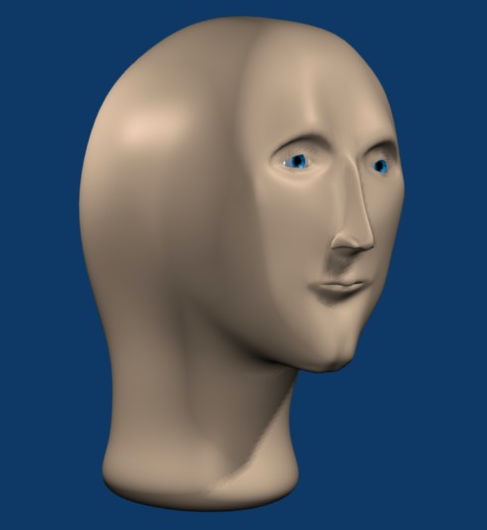


Careful, when the AIs get so good that you can ask them anything and they perfectly understand what you want and produce great results, you’re going to get left behind because… you won’t know how to use the… incredibly easy tools… hang on…



Careful, when the AIs get so good that you can ask them anything and they perfectly understand what you want and produce great results, you’re going to get left behind because… you won’t know how to use the… incredibly easy tools… hang on…

Apple proposed something a few years ago, when governments were making similar threats, that attempted to strike a middle ground. The idea was that upon uploading an image to iCloud Photos, a on-device scan would be run on that image and an encrypted report generated to be sent up along with the photo. There was differential privacy involved, the report would also sometimes be generated for entirely normal photos, so seeing a report didn’t necessarily indicate anything, and they had set it up such that the server would only be able to decrypt the reports if it had a sufficiently large number of photos that had been actually found to be CSAM by the local scan, so there would have to be many false positives to incorrectly get flagged.
It was incredibly controversial, and they ended up not doing it after all. In my opinion, it’s probably the lightest touch and most responsible way to do something like this, and obviously they always pick the most worthy cause for invading privacy… but I still viscerally dislike the idea that my computer would have code designed to try to get me sent to prison under certain circumstances (not that I’d ever be triggering that code with anything but a false positive of course). Somehow it’s worse than just saying “in the cloud you have no privacy, your photos aren’t encrypted on our servers, and if you upload CSAM we’ll drop a train on you.”
For about $2000, I picked up a Mac Studio with 96 gigs of RAM, which is effectively all VRAM thanks to Apple’s architecture. It doesn’t have the raw number-crunching power of the big GPUs but with all that space, you don’t need to worry much about the size of the model until they start getting really big, so it’s pretty easy and flexible.
I’m able to do basically everything that others are doing with AI, entirely locally. It generates text and writes code (it’s no Opus, but probably on par with the best of a year and a half ago), images, videos, songs, all that stuff (those last few are garbage but it’s basically the same level garbage that the cloud models are making). And I have total privacy, will never get a surprise price hike or lose access to a model I like, and know exactly how many bottles of water I’m using to cool it (zero).
It’s not heroin, it’s weed. There will be a market for it, but, like, you can also just make it yourself. 90% of what people want will just get done on device. I can’t see any way this turns into a trillion dollar industry.


On Apple platforms, alt-hyphen is en dash, and alt-shift-hyphen is em dash, and on iOS it’s on the long press of the hyphen button, so the kind of person who likes to use them can do so pretty easily if they’re an Apple user.


Safari on iOS has always had some pretty strict limits on what extensions can do. For example, content blockers don’t get to run code on the pages you browse, it’s more like they give the browser a list of what type of thing to block when you install and configure it, then when you’re browsing, the extension isn’t even doing anything, it’s just the browser using the list. Obviously that’s more limiting, there might be ads that are best dealt with by running a bit of code, so it makes sense that they’d consider it “lite”. (The benefit of those limits is that ad blocking extensions can’t run amok and kill your phone’s battery since the browser’s handling it by itself.)
There isn’t a simple evolutionary definition of “fish”, not the same way there is for, say, mammals. If you found the common ancestor of everything we call a mammal and said “everything descended from this one is also a mammal”, you’d be correct. If you did that for everything we call fish, every animal in the world would be a fish. Also, we decided which animals were fish mostly on vibes, so without a clear definition you can pedantically argue that everything is a fish including mammals.


I would guess it’s web requests made during a chat session, e.g. the user asks about kayaks and the AI searches and fetches some pages to put into its context before answering. That’s not really scraping, it’s data being used in the moment in response to a user request, closer to what a “user agent” has always meant in the web world. A crawler would be crawling the site, systematically trying to follow every link and collect what’s there with little to no human involvement.
If nothing else, it seems reasonable to assume that a computer could run a program that does all the important things 1 neuron does, so from there it’s “just” a matter of scaling to human brain quantities of neurons and recreating enough of the training that evolution and childhood provide to humans. But that’s the insanely inefficient way to do it, like trying to invent a clockwork ox to pull your plow instead of a tractor. It’d be pretty surprising if we couldn’t find the tractor version of artificial intelligence before getting an actual digital brain patterned directly off of biology to do it.
It’s making mistakes and failing to think abstractly at levels previously only achieved by humans, so it’s only rational to expect it to take over the world in 5 years


That’s a decently rational response you’ve described, though. If you were really at immediate risk, you’d probably know it, especially with an alarm going off to get you looking for signs of danger. And it’s usually better to have a lazy, skeptical evacuation than a panicked stampede. Schools do fire drills to check the alarms, sure, but it’s also important to make them a routine thing that all the kids know how to handle.


It’s in the nature of conservatives to be afraid, it’s their fundamental motivating emotion. That’s why they’re so eager to put their tough strong daddy into office who promises to put things back to the reassuring, comfortable way they used to be.
I’m sure shuffled pieces have been a thing, there’s also Really Bad Chess which gives you different piece quantities entirely.


The tokenization is a low-level implementation detail, it shouldn’t affect an LLM’s ability to do basic reasoning. We don’t do arithmetic by counting how many neurons we can feel firing in our brain, we have higher level concepts of numbers, and LLMs are supposed to have something similar. Plus, in the “”“thinking”“” models, you’ll see them break up words into individual letters or even write them out in a numbered list, which should break the tokens up into individual letters as well.
Ah, yes, I see that you know your judo well. Good one.


It’s a TV show on PBS. People bring antiques to be appraised, and an expert tells them what they have, what’s special about it, and how much it could be worth. The fun ones have someone coming in like “this was my grandmother’s cabinet growing up and I haven’t thought twice about it” and then the appraiser telling them “this was made by the most famous carpenter in 1890’s Massachusetts, it’s worth $20,000” or similar stories.
I am deeply troubled by the way that AIs slip right past peoples’ defenses and convince them of things that are absolutely not true. Not just things like the AI psychosis that some people have been driven into, not just the hallucinations or overly fawning over terrible ideas, it goes so much further than our monkey brains can understand. These things do not think, they do not have feelings, they don’t have motivations, they don’t have morals or values, no sense of right or wrong, they are, quite literally, word prediction machines that are selecting their responses semi-randomly. And yet, even people who know this to be the case cannot stop themselves from anthropomorphizing the AI. All of our human instincts scream “this is a person!” when we interact with them, and with that comes an assumption of values, morals, thoughts, and feelings, none of which are there. There is a fundamental mismatch between the human mental model and the reality of the software, and that is harmful, even dangerous. We will give benefit of the doubt to them, we will believe their explanations about “why” they “chose” to say or do what they did, and we will repeatedly make the same fundamental mistakes because we want to believe a total lie.
And that’s not even getting in to the harm when they are working properly, encouraging us to outsource our thinking and creativity to a service that charges monthly. I’m seriously worried that kids in school now are going to have their learning stunted terribly, it’s just so easy to have any and all homework done in a matter of minutes without learning a single thing.


Not just a disadvantage, a cognitive disadvantage. @grok is this true??? my critical thinking skills have atrophied to nothing now that i rely on ai, i need u gronk


That sounds like a problem for Future Leadership, I’ve got quarterly goals to hit and the shareholders really want to hear about how I’m using AI to do some unnecessary layoffs despite record profits reposition our company for the future.


Older Unix systems used to only do the first 8 bytes for passwords. Sometimes for my own amusement when logging into one of the Sun machines at school, I’d type in enough of my password to count and then just mash the keyboard.
👀